
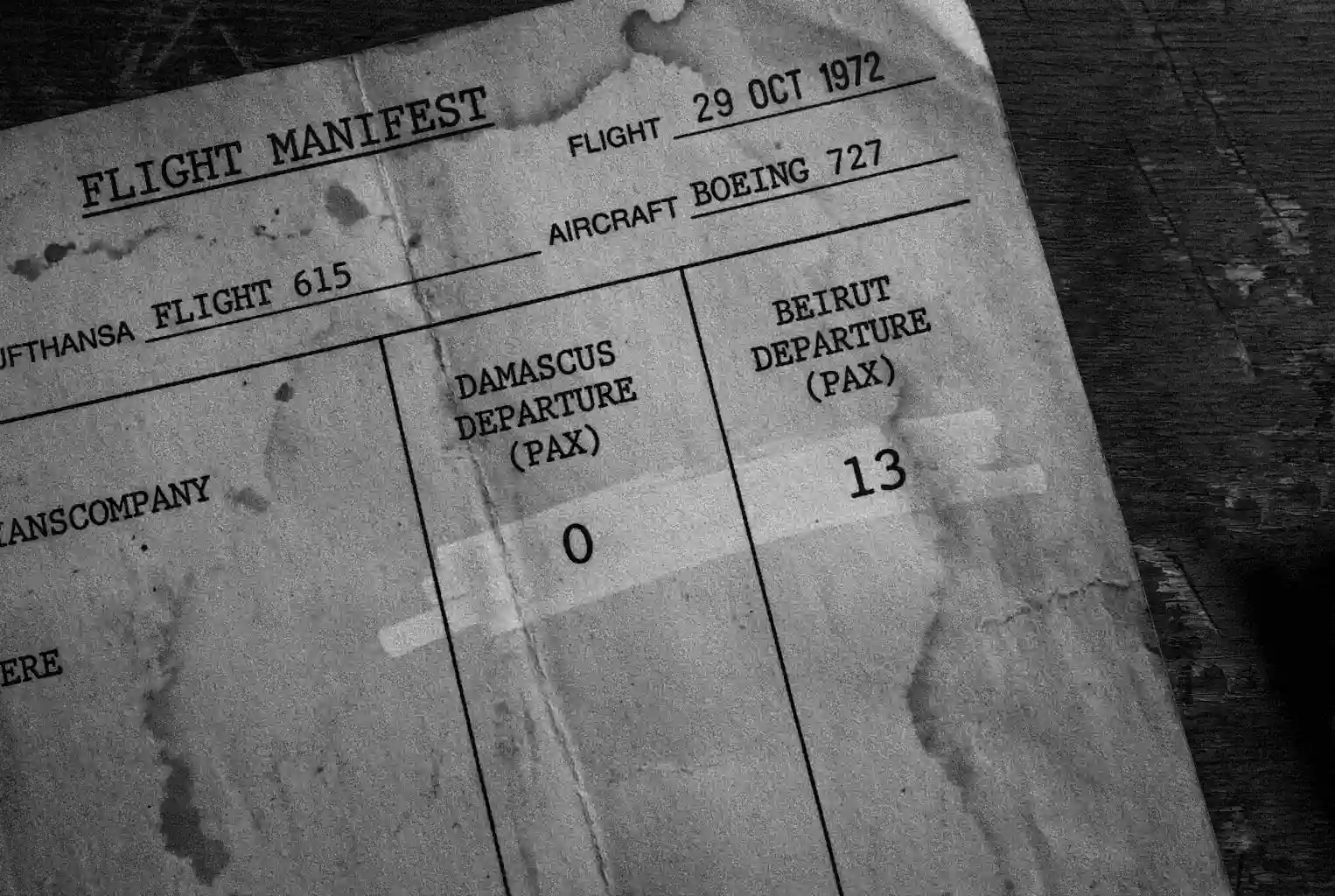
On 29 October 1972, a 130-seat Boeing departed Damascus without a single passenger. Hours later, West Germany handed over three convicted terrorists to armed hijackers without demanding any security guarantees.
The flight manifest and the political timeline clash directly, leaving a massive gap in the official record.
Data Manifest
- Primary Investigation: The 29 October 1972 scheduled commercial flight of Lufthansa Flight 615 departing Damascus with zero passengers aboard, the boarding of thirteen male passengers in Beirut including two armed hijackers, and the West German government's rapid surrender of three surviving Munich attackers without security guarantees.
- Key Anomalies Documented: A 130-seat Boeing 727-100 flying empty on a scheduled origin leg; an explicit intelligence warning on 6 September 1972 from Mossad Director Zvi Zamir that went without documented operational prevention; an unconditional state surrender completed within nine hours of the hijacking; and the unilateral intervention of Lufthansa Chairman Herbert Culmann, who defied government orders to deliver the prisoners to Zagreb.
- Primary Sources Utilised: Declassified Israel State Archives diplomatic cables and cabinet stenograms (Documents 37 and 43); West German Kabinettsprotokolle from 31 October 1972; commercial aviation flight logs and passenger manifests for Boeing 727-100 D-ABIG; and historical academic research by Carole Fink.
Glossary
- Boeing 727-100 (D-ABIG): The 130- to 150-seat commercial jetliner operating scheduled Lufthansa Flight 615 from Damascus to Frankfurt on 29 October 1972.
- Condor (D-CFCF): The Hawker Siddeley HS.125 corporate aircraft owned by Lufthansa subsidiary Condor, used by Chairman Herbert Culmann to transport the three Munich prisoners to Zagreb.
- Kabinettsprotokolle: The official verbatim minutes and formal records of West German federal cabinet proceedings.
- Club de Berne: A European intelligence-sharing network between state agencies whose communication logs remain restricted or unavailable in the public archive.
- Committee X: The specialised group directed by Israeli Prime Minister Golda Meir to formulate lethal retaliatory actions following the Munich Olympic attacks.
The Empty Origin and Boarding Anomalies
Lufthansa Flight 615 was operated by a Boeing 727-100, registered as D-ABIG, serial number 18364, line number 37, powered by three Pratt & Whitney JT8D-9 engines. On a commercial scheduled route, this aircraft type carries between 130 and 150 passengers. The flight originated at Damascus International Airport in the early hours of Sunday, 29 October 1972, carrying seven crew members and nobody else. No passengers.
The abnormality here is not subtle. From a purely commercial standpoint, an empty scheduled-route leg on an aircraft of that size is a significant logistical anomaly. Repositioning flights occur, but they are documented as such. The record does not provide an operational explanation for why this particular aircraft was flying empty on a route scheduled to terminate in Frankfurt. That absence is worth noting before anything else.
At the first scheduled stopover at Beirut International Airport, exactly thirteen people boarded. The manifest included citizens of Arab states, two Americans, a German, and a French national, as well as a Spanish journalist who later documented the events. All thirteen passengers who boarded were male. On a commercial jet built to carry 130 passengers out of a major Middle Eastern hub, having only ten civilian male passengers and one civilian female is, by any statistical measure, highly unusual.
The documentary One Day in September (1999) alleges that the West German government communicated through backchannels that any hijacked aircraft should carry no women or children, to minimise the political cost of a planned capitulation. That claim carries no automatic legal protection and comes from investigative sources without independent documentary corroboration. But the physical reality of the manifest does align with it. That is a correlation. The record does not establish it as a causation.
Departure from Beirut was scheduled for 05:45 Central European Time. The actual take-off was at 06:01, a delay of sixteen minutes. Less than fifteen minutes into the flight, two of the Arab passengers produced explosives hidden in the first-class cabin and declared the hijacking. Aviation security reviews conducted after the event assessed it as likely that the explosives had been smuggled aboard during the aircraft’s empty staging in Damascus. ‘Likely’ is how those reviews framed it. There is no photographed chain of custody and no contemporaneous inspection report confirming it. This remains an assessment rather than a proven certainty.
Flight 615 Manifest Anomalies
| Metric | Standard Commercial Profile | Flight 615 Profile (29 Oct 1972) |
|---|---|---|
| Aircraft Capacity | 130 to 150 passengers | 130 to 150 seats available |
| Damascus Departure | Scheduled commercial passenger load | 0 passengers (Empty staging) |
| Beirut Boarding | Standard mixed demographics | Exactly 13 passengers boarded (All male) |
| Operational Justification | Documented commercial or repositioning logic | No operational explanation documented |
The Intelligence Forewarning
The hijacking was not a surprise. It was explicitly predicted at the highest level. That is the problem.
On 6 September 1972, the day after the catastrophic failure at Fürstenfeldbruck airfield that killed all nine Israeli hostages, Mossad Director Zvi Zamir held a meeting with his West German intelligence counterpart. The content of that meeting is captured in Document 37 of the Israel State Archives (file reference A 7069/6), summarised by Yisrael Galili and Foreign Minister Abba Eban. Zamir asked his German counterpart directly. What would happen if terrorists hijacked a Lufthansa aircraft to force the release of the surviving Munich attackers?. The German official replied that he could not promise this would not happen. He offered no guarantees.
On 9 September, the Federal Ministry of the Interior received an anonymous letter claiming a hijacking was imminent. Interior Minister Hans-Dietrich Genscher formally considered denying boarding to citizens of Arab states on Lufthansa routes. There is no record of that measure being implemented. Commercial aviation protocols for Lufthansa’s Middle Eastern routes remained largely unchanged.
So the threat was named. The specific mechanism was described. The responsible ministry acknowledged it in writing. What happened next, in terms of documented preventive operational measures, is not in the available record. Whether that represents a gap in our access to the files or a gap in the actual response is one of the questions this investigation cannot answer.
Chronology: The Forewarning and the Flight
-
6 September 1972
Mossad Warning
Mossad Director Zvi Zamir asks his West German intelligence counterpart what would happen if terrorists hijacked a Lufthansa aircraft to force the release of the Munich attackers. The German official offers no guarantees.
-
9 September 1972
Ministry Notification
The Federal Ministry of the Interior receives an anonymous letter claiming a hijacking is imminent. Interior Minister Hans-Dietrich Genscher considers denying boarding to citizens of Arab states, but protocols remain unchanged.
-
29 October 1972, Early Hours
Empty Staging in Damascus
Lufthansa Flight 615 departs Damascus International Airport on a scheduled route with zero passengers. Aviation reviews later assess it as likely that explosives were smuggled aboard during this staging.
-
29 October 1972, 06:15
Hijacking Declared
Less than fifteen minutes after a delayed take-off from Beirut, two armed passengers produce hidden explosives and declare the hijacking.
-
29 October 1972, 17:05
The Unconditional Exchange
Defying government directives to keep the prisoners in German airspace, Lufthansa Chairman Herbert Culmann arrives in Zagreb with the prisoners. The exchange occurs on the tarmac without requested security guarantees.
The Rapid Capitulation, Measured in Hours
After declaring the hijacking at roughly 06:15, the two armed passengers ordered the aircraft towards Munich-Riem Airport, where they intended the prisoner exchange to take place. Following a mandatory fuel stop at Nicosia International Airport in Cyprus, the flight reached Austrian airspace around midday. There, the hijackers reached a logistical reality. The West German authorities could not physically transport the prisoners to Munich-Riem in time to meet their demands.
The plan changed. The crew was ordered to divert to Zagreb in Yugoslavia, where the aircraft began circling, burning through its remaining fuel. At 15:00 Central European Time, the West German government officially agreed to the hijackers’ demands.
That left nearly nine hours from the moment the hijackers took control. We know exactly what Israel was doing during that window. Declassified transcripts show Foreign Minister Abba Eban and Yisrael Galili holding an emergency meeting that same morning. They explicitly warned Germany that releasing the men would compound the Munich disaster, a message Ambassador Elyashiv Ben-Horin delivered straight to Bonn. The German government capitulated just hours later anyway.
On 5 November 1972, the verbatim transcript of an Israeli government meeting (Document 43, Israel State Archives) records Minister Warhaftig openly raising the possibility of a German conspiracy with the terrorists. Prime Minister Golda Meir’s recorded words were measured but significant: ‘Everything happened so fast, they didn’t even try to bargain with them. As if the helicopters were ready and waiting’. This stands as a record of allied suspicion rather than a finding of guilt. But it belongs in the evidence map.
Whether the speed of surrender reflected prior intent or simple crisis panic is precisely the question the available documentary record cannot definitively answer. What the record does confirm is that standard negotiation stalling, the kind documented in comparable aviation crises of the early 1970s, did not occur here.
Everything happened so fast, they didn’t even try to bargain with them. As if the helicopters were ready and waiting.
— Prime Minister Golda Meir, 5 November 1972The Corporate Defiance of Herbert Culmann
If there was a smooth, centrally managed government plan, the events of the late afternoon on 29 October do not fit it. Once word of the hijacking reached Lufthansa headquarters in Cologne, Chairman Herbert Culmann took personal action. He boarded a Hawker Siddeley HS.125 corporate aircraft, owned by the Lufthansa subsidiary Condor and registered as D-CFCF, and flew to Munich.
The West German government’s strategy at that point was to keep the Condor aircraft, carrying the three prisoners, within German airspace. The logic was leverage. The hijackers would not get the prisoners until the flight crew and passengers were safely released in Zagreb. That was the directive.
At that point, according to the historical research of Carole Fink cited in published academic material, Culmann defied the government directive and ordered the Condor’s departure for Zagreb. He flew there accompanied by two plain-clothes Bavarian police officers, a pilot, and the three Black September prisoners. He arrived at 17:05. The exchange took place on the tarmac, unconditionally, without the security guarantees Bonn had originally demanded.
This sequence matters for the malice assessment. A government that had pre-planned the entire operation with Black September should not have needed its own airline chairman to break official orders to ensure the prisoners reached the handover point. If there was a pre-existing script, Culmann’s intervention represents a bizarre and operationally unnecessary improvisation. The more straightforward reading is a fractured authority structure under extreme pressure, where the corporate leader made a unilateral decision to end the crisis his aircraft was at the centre of. Veriarch approached Lufthansa and Culmann’s estate for comment but received no response.
Chain of Command Breakdown: The Handover
Hijackers divert flight to Zagreb after realising West German authorities cannot physically transport the prisoners to Munich-Riem in time to meet their demands.
West German government strategy mandates keeping the Condor aircraft, carrying the three prisoners, strictly within German airspace to maintain control.
Lufthansa Chairman Herbert Culmann breaks the official government directive and unilaterally orders the Condor's departure to Zagreb accompanied by Bavarian police.
Culmann arrives in Zagreb at 17:05. The exchange of prisoners takes place on the tarmac unconditionally, without the security guarantees Bonn had originally demanded.
The Diplomatic Fallout and Witness Contradictions
The West German capitulation detonated the alliance with Israel. The Israeli government’s internal record of what followed is detailed and unambiguous in its tone. Foreign Minister Abba Eban met the German ambassador after the release and placed his view on the record: ‘The main result is that the three terrorists have been released, and they are now free to commit more crimes and to murder more Israelis. To some degree, it is as if the action passes a death sentence on other Israelis’.
By 5 November, Document 43 of the same archive records an Israeli government session in which Warhaftig raised the conspiracy question directly, and Meir’s ‘ready and waiting’ observation entered the official record. Chancellor Willy Brandt responded with a personal message to Meir, maintaining that the decision was made entirely to prevent the loss of civilian lives, and that it represented no capitulation to terror. He expressed personal offence at comparisons made in the Israeli press to the Nazi era. On 8 November, Meir adopted a conciliatory position, stating there was no intention to injure Brandt personally.
The immediate diplomatic confrontation subsided. The underlying suspicion did not.
The primary beneficiary of the release, Jamal Al-Gashey, gave an interview included in One Day in September (1999) in which he claimed: ‘An agreement had been made with the German government for our release after the hijacking of a Lufthansa plane. I found out later’. That is a direct conflict with Brandt’s stated position. Al-Gashey is an active militant with clear motivation to embarrass a Western government. His testimony is unprivileged and uncorroborated by primary documentation. It sits in the record as a serious claim that cannot, on present evidence, be treated as established fact.
Abu Daoud, the operational mastermind behind the Munich attack, claimed in his 1999 autobiography that ‘the Germans’ offered him nine million dollars to arrange the fake prisoner release. In later years, he refused to repeat or elaborate on this specific allegation. A claim its own author walked back carries limited evidential weight.
The long-term consequence of the release was the creation of ‘Committee X’, a small group tasked by Meir with formulating a lethal response. General Aharon Yariv and Mossad Director Zamir directed Operation Wrath of God, authorising the assassination of anyone connected to Munich. Two of the three released gunmen, Mohammed Safady and Adnan Al-Gashey, were allegedly killed by Mossad in the following years, though exact accounts vary. Jamal Al-Gashey survived and became the primary source for the collusion allegations. That the sole surviving witness has an interest in how the story is told is not an argument for dismissing him, but it is a reason to require corroboration.
System Requisition
Support the retrieval and hosting of these secure files.
The Missing Pieces and Final Assessment
The most significant part of this investigation is what the archive does not contain.
We can read the cabinet minutes from 31 October 1972, where Chancellor Willy Brandt defends the release after the fact. The problem is the weeks before the crisis. The September and early October files are either missing from the public archive or heavily restricted. Academic researchers note that what little is available reveals almost nothing about the actual diplomatic moves happening behind the scenes.
The Federal Intelligence Service (BND) also keeps its communications with the Palestine Liberation Organisation (PLO) and its affiliated militant groups strictly locked down. Any proof of a backchannel deal would probably sit in the logs of the ‘Club de Berne’, a European intelligence-sharing network. Standard institutional practice means those records are either buried inside the BND or have already been destroyed. Until someone opens those specific files, we simply cannot prove if a prior agreement existed.
The interrogation transcripts from the eight weeks the three survivors spent in Bavarian custody are also absent from the record. Those documents would matter because they might reveal whether the prisoners behaved like men expecting a trial or men expecting extraction. The evidence trail ends before that question can be answered.
The testimony of Jamal Al-Gashey is unprivileged and motivated. Abu Daoud’s claim was withdrawn by its author. Zamir’s public statement in 2006 represents the professional opinion of an intelligence director and lacks the weight of a primary document proving intent.
What the evidence does support is that a West German government without a functioning counter-terrorism unit, eight weeks removed from a massacre on its own soil, facing a federal election in November, and holding three prisoners who represented a live target on its territory, capitulated to a hijacking with exceptional speed. Herbert Culmann, the chairman of the affected airline, then completed the transfer in defiance of state directives. A scripted conspiracy does not require a corporate executive to break government orders to reach the finish line.
The most defensible reading of the current archive is that a traumatised state used an independently executed hijacking as a process to resolve a domestic crisis, it lacked the capacity to manage otherwise. Whether there was prior communication enabling that use remains the question the restricted files have not yet answered.
The Archival Blind Spots
Critical documentation preventing Tier 1 proof of intent remains inaccessible.
Missing Records
Files from the weeks preceding the hijacking are either missing from the public archive or heavily restricted, revealing almost nothing about diplomatic moves behind the scenes.
Transcripts from the eight weeks the Munich attackers spent in Bavarian custody are absent. These documents might reveal whether the prisoners expected a trial or an extraction.
Restricted Archives
Federal Intelligence Service (BND) files detailing communications with the PLO and affiliated militant groups remain strictly locked down.
Logs from the European intelligence-sharing network, which could prove a backchannel agreement, are either buried inside the BND or have already been destroyed.
Sources
Sources include: declassified diplomatic cables and stenograms from the Israel State Archives (specifically Documents 37 and 43); West German Kabinettsprotokolle (cabinet minutes) from 31 October 1972; commercial aviation flight logs and passenger manifests for Lufthansa Flight 615; academic historical research, notably Carole Fink’s ‘West Germany and Israel’; primary accounts, including Abu Daoud’s 1999 autobiography and a 2006 interview with former Mossad Director Zvi Zamir in ‘Frankfurter Allgemeine Zeitung’; and investigative media, including the 1999 documentary ‘One Day in September’ alongside contemporary and retrospective press coverage from ‘Der Spiegel’, ‘TIME’, and ‘The Observer’.
Claim-Source Matrix
| Core Finding | Primary Source Document | Status |
|---|---|---|
| Mossad Director Zvi Zamir warned his West German counterpart on 6 September 1972 of a potential Lufthansa hijacking to force a prisoner release; no guarantees were offered. | Israel State Archives (Documents 37 and 43) | Confirmed |
| The Federal Ministry of the Interior received an anonymous warning letter on 9 September 1972 and considered denying boarding to Arab nationals on Lufthansa routes. | Federal Ministry of the Interior records (Section 2 / Section 4) | Confirmed |
| The West German government officially agreed to surrender the three Munich prisoners at 15:00 Central European Time on 29 October 1972. | West German Kabinettsprotokolle (Section 4) | Confirmed |
| Israeli cabinet transcripts record Golda Meir stating that Germany did not seriously bargain, noting it was 'as if the helicopters were ready and waiting'. | Israel State Archives (Document 43) | Confirmed |
| Lufthansa Chairman Herbert Culmann defied government orders and directed the Condor aircraft to transport the prisoners to Zagreb for an unconditional exchange. | Carole Fink, 'West Germany and Israel' (Section 5 / Section 10) | Confirmed |
| The hijacked Boeing 727-100 signalled imminent fuel exhaustion before diverting to Zagreb. | Unattributed secondary accounts | Unclear / Unsupported |
| Surviving gunman Jamal Al-Gashey claimed in an interview that an agreement had been made with the German government prior to the hijacking. | One Day in September (1999) / Al-Gashey testimony | Confirmed (Unprivileged Claim) |
| Chancellor Willy Brandt maintained publicly and privately to Golda Meir that the surrender was strictly an emergency decision to prevent civilian deaths. | West German Kabinettsprotokolle (31 October 1972) | Confirmed |
What we still do not know
- Why Lufthansa Flight 615 departed Damascus on a scheduled passenger route with zero passengers, and what operational reason, if any, was logged at the time.
- Whether the Federal Interior Ministry’s consideration of banning Arab nationals from Lufthansa flights in September 1972 was formally rejected or simply never acted upon.
- What the West German cabinet discussed in September and early October 1972 regarding a potential hijack-for-release scenario.
- What the BND’s communications with the PLO and Black September contained in the weeks before 29 October, and whether Club de Berne logs survive.
- Whether the three surviving Munich attackers, during their eight weeks in custody, gave any indication of expecting release rather than trial.
- Whether Herbert Culmann’s decision to defy government directives was entirely his own, taken under crisis pressure, or encouraged by informal communication.
Comments (0)