
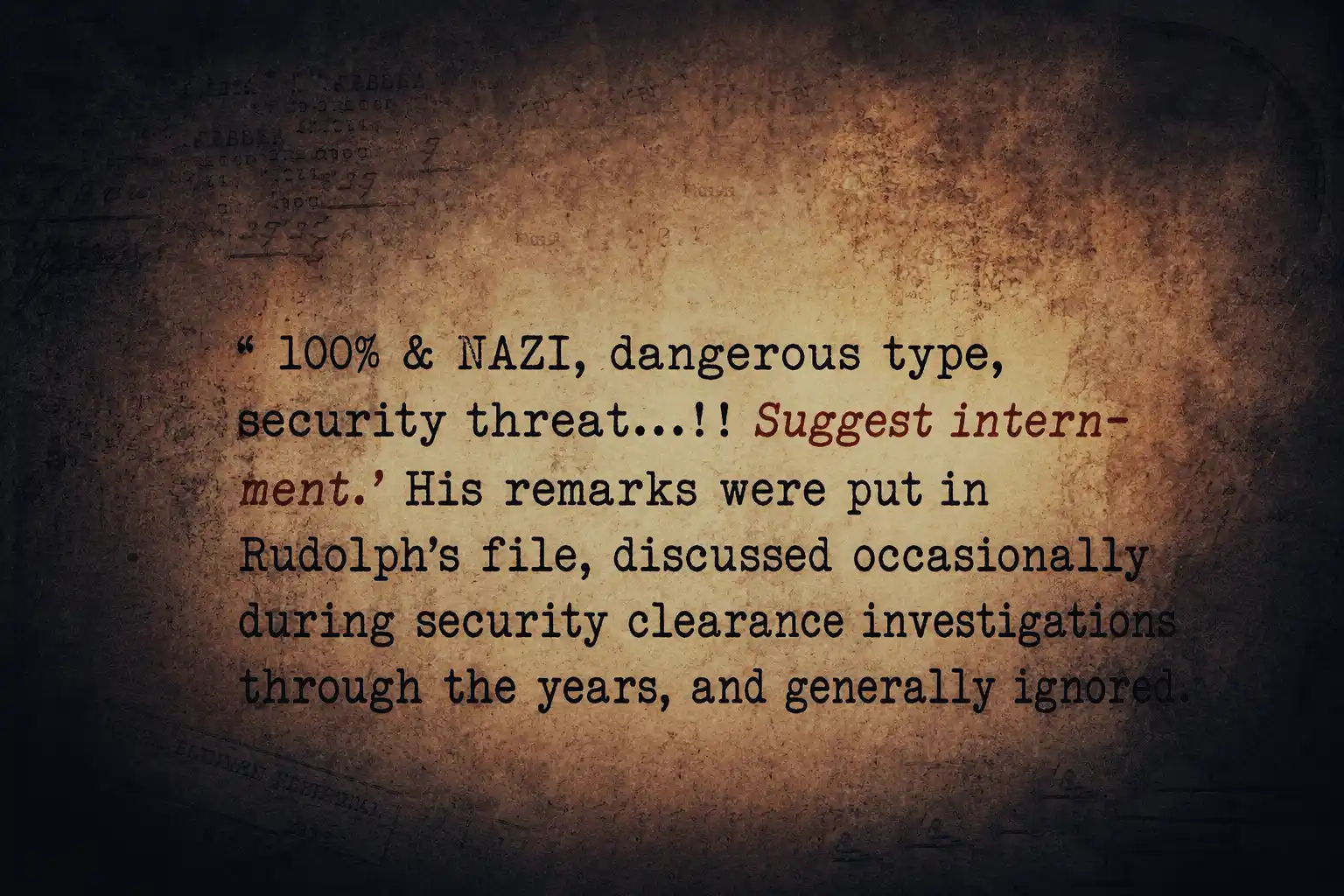
In September 1946, a presidential directive banned any ‘ardent Nazi’ from entering the United States. By 1948, men whose own files described them as ‘100% NAZI, dangerous type, security threat…!! Suggest internment’ were arriving in America with State Department visas. A memorandum signed by a Navy deputy director on 18 November 1947 explains how the second sentence became possible.
Data Manifest
- Primary Investigation: The systematic alteration of security dossiers by US military intelligence to bypass the 1946 presidential directive banning former Nazi scientists from entering the United States.
- Key Anomalies Documented: Contradictory primary and secondary security reports held simultaneously for the same individuals; missing European Command return cables; the CIA's deliberate removal of original file numbers prior to declassification.
- Primary Sources Utilised: The 18 November 1947 Rozamus Memorandum; 1947 primary Counterintelligence Corps field reports; 1947 secondary Joint Intelligence Objectives Agency security certifications; and the 2007 Final Report of the Interagency Working Group.
Terminology
- Counterintelligence Corps (CIC): A US Army unit that gathered field-level intelligence on enemy agents and security risks, responsible for the initial post-war interrogations.
- European Command (EUCOM): The US Army military headquarters that administered the occupation zone in Germany and received the order to 're-evaluate' the security reports.
- Joint Intelligence Objectives Agency (JIOA): The American military body that managed the recruitment of German scientists and processed the controversial dossiers.
- Office of Military Government, United States (OMGUS): The American body running the US-occupied zone of Germany that conducted the primary background checks.
- Truman Directive: The formal written policy from September 1946 that strictly banned 'ardent Nazis' from entering America.
The Truman Directive and the 1946 Ban on Nazi Scientists
On 22 December 1945, President Harry S. Truman issued his first post-war directive on immigrant visas. The order was aimed mostly at the displaced-persons crisis in Europe, but it set the tone for strict legal processing of any post-war entrant to the United States.
The military side of the picture followed four months later. On 26 April 1946, the Joint Chiefs of Staff issued directive JCS 1067/14 to General Dwight D. Eisenhower. The order told the Army to preserve German research records and detain German scientists for intelligence work, with one written exception: anyone classified as a war criminal.
Two priorities, on a collision course.
Between 3 and 6 September 1946, Truman approved the expanded terms of what was now called Operation Paperclip, the formal programme to bring German specialists to the United States. The exclusion clause carried no waivers. Anyone the Commanding General of US Forces European Theater found to have been ‘more than a nominal participant’ in the Nazi Party, or an active supporter of Nazism or militarism, was barred from entry under the programme.
That absolute language was not written in ignorance. The physical evidence was already in American hands. US troops had liberated the Mittelbau-Dora concentration camp on 11 April 1945, the underground complex where slave labourers drawn from Buchenwald had built V-2 rockets and V-1 flying bombs.
Among the material captured in Germany sat a fourteen-ton dossier of rocket-research notes compiled at Peenemünde between 1932 and 1945, hidden by Wernher von Braun in a disused mineshaft near Dörnten in the Harz mountains and surrendered intact to US forces. Washington therefore knew which personnel it was excluding when Truman signed in September 1946, and knew which body of knowledge it forfeited if the ban held.
The Exclusion Clause
- No waivers were permitted under the expanded terms of Operation Paperclip approved between 3 and 6 September 1946.
- Anyone the Commanding General of US Forces European Theater found to have been 'more than a nominal participant' in the Nazi Party, or an active supporter of Nazism or militarism, was barred from entry.
1947 State Department Oversight and the Nazi Security Reports
Bosquet Wev, the Navy captain who ran the Joint Intelligence Objectives Agency (the military body that processed German specialists under Operation Paperclip), sent his first batch of dossiers to the State and Justice Departments on 26 February 1947. Each dossier carried the security report compiled by the Office of Military Government in Germany, the American occupation authority that vetted every recruit.
Those reports were not subtle. Wernher von Braun was classified as a ‘potential security threat… wanted for denazification’, the Allied programme set up after 1945 to remove former Nazis from positions of influence. Arthur Rudolph, the engineer who had run V-2 production at Mittelwerk, drew a blunter assessment: ‘100% NAZI, dangerous type, security threat…!! Suggest internment’.
The State Department put a lawyer on the case.
Samuel Klaus was forty-two, a Hebrew scholar who had previously run Operation Safehaven, the wartime programme set up to track Nazi assets smuggled into neutral countries. He sat on the agency’s board as the State Department’s representative, read the security reports, and refused the visas.
Klaus argued the recruits were ardent Nazis under the plain terms of the Truman directive. He was not satisfied with their sworn personal statements either, because the statements did not match the underlying reports.
The contradictions came to a head on 26 May 1947. Herbert Cummings, assistant chief of the State Department’s Bureau of Foreign Activity Correlation, wrote that someone was ‘cooking the records’ and accused the War Department of trying to ‘dump’ unvetted individuals into the civilian visa system.
The raw material under all this was Counterintelligence Corps field paper, drafted in occupied Germany from immediate post-war interrogations, captured Nazi documents, and statements taken from local witnesses. Those reports were rough and close to the events. Polishing them away required active work upstream.
The formal minutes of the 26 May 1947 meeting at which Cummings raised the alarm have not been recovered. What survives is his line about ‘cooking the records’. The rest of the argument in that room is lost to the archive.
1947 Process Breakdown
-
26 February 1947
Dossiers Submitted
Bosquet Wev sends the first batch of German specialist dossiers to the State and Justice Departments. Included are blunt security reports compiled by the occupation authority in Germany.
-
Spring 1947
Visas Blocked
Samuel Klaus reads the primary security reports and blocks the recruits' visas, arguing they meet the criteria for 'ardent Nazis' under the explicit terms of the Truman directive.
-
26 May 1947
The Cummings Note
Herbert Cummings accuses the War Department of trying to push unvetted individuals into the civilian system, recording in writing that someone was 'cooking the records'.
The ‘Dead Nazi Horse’ Argument
On 2 July 1947, Wev drafted an internal memorandum that escalated the argument inside Washington. He wrote that returning the scientists to Germany presents a far greater security threat to this country than any former Nazi affiliations which they may have had. In the same cable, he labelled the State Department’s adherence to the Truman directive ‘beating a dead Nazi horse’ and accused the civilian side of sabotaging the programme.
The State Department did not move. Visa refusals continued through the summer and into the autumn, on the basis of the same primary security reports.
The 2 July cable circulated inside the Joint Intelligence Objectives Agency. It was not a request to Truman for a written waiver. The President was not asked to amend the directive he had signed ten months earlier.
The July document supplied the ideological cover. Operational orders waited another four months.
Priority Briefings
New investigations, evidence checks, and unresolved questions from Veriarch, sent directly to your inbox.
The Rozamus Memorandum of 18 November 1947
The intervention arrived on 18 November 1947. Walter Rozamus, Deputy Director of the Joint Intelligence Objectives Agency, wrote a memorandum to the Intelligence Division of the General Staff Army. That single document is the only Tier 1 piece of paper in this investigation.
Three things, on one sheet.
Rozamus identified, by name, the dossiers that contained derogatory intelligence. He acknowledged in writing that this intelligence would block immigration under the September 1946 Truman directive.
Then things changed. He ordered the European Command, the US Army headquarters in occupied Germany, to ‘re-evaluate’ those security reports and revise the ‘ardent Nazi’ classification.
Von Braun’s dossier was named two weeks later, not in the Rozamus memorandum itself. A follow-up letter from Wev to the European Command on 4 December 1947 singled out von Braun, alongside a second scientist named Herbert Axster, for withholding from the State Department.
At no point did the agency go back to Truman. No written waiver of the directive was ever requested. JIOA went straight at the paperwork the State Department was reading.
The gap in the record begins here. Direct field cables from the European Command confirming receipt of the Rozamus order are absent from the surviving source material. Internal traffic showing how the rewrite was actually carried out is not in the public archive either.
The reports were demonstrably altered because the visas later went through.
How that alteration was done sits in a documentary blank. The surviving paper does not say whether the original investigators in Europe rewrote their own reports under pressure from Washington, or whether agency staff in Washington drafted replacement summaries themselves and signed them off down the chain. Without the European Command return cables, the question of authorship cannot be settled.
The Alteration Process Chain
Counterintelligence Corps generates raw, derogatory field reports based on interrogations and captured documents.
Joint Intelligence Objectives Agency submits the first batch of specialist dossiers.
State Department screening board receives and reviews the original field intelligence.
Visas are denied under the absolute terms of the 1946 Truman directive.
Rozamus issues the 18 November 1947 memorandum acknowledging the visa blocks.
European Command is ordered to 're-evaluate' the reports and revise the 'ardent Nazi' classifications.
Secondary, cleansed dossiers are resubmitted in 1948, and the State Department issues the visas.
Contradictions in the Von Braun and Rudolph Dossiers
Arthur Rudolph’s qualification sheet from 1947 carried one of the bluntest assessments in the Operation Paperclip archive. The investigating officer wrote, in full: ‘100% NAZI, dangerous type, security threat…!! Suggest internment’. Field language, not bureaucratic varnish.
A few months later, the same agency produced a different document about the same man. The secondary summary placed in his dossier for visa approval stated that the ‘subject is not a war criminal’, that he had been an SS officer, but that no information indicated he had been an ardent Nazi. The security certificate appended to the front of the file went further. It certified that nothing in his records indicated ‘a war criminal, an ardent Nazi or otherwise objectionable’.
Both pieces of paper sat in the same dossier.
Von Braun’s file followed the same arc. The Office of Military Government’s 1947 report classified him as a ‘potential security threat… wanted for denazification’ on account of his Nazi Party membership. After the Rozamus order, a revised assessment recorded that he ‘may not constitute a security threat to the U.S.’, and his visa moved.
The contradictory assessments came out of the same chain of agencies inside a window of months. In some cases, weeks. No investigating officer who wrote ‘Suggest internment’ has retracted that finding on the public record.
The secondary certifications all leaned on a single phrase. Every certifying officer signed off on a document declaring that ‘available records’ showed nothing damaging, while the primary Counterintelligence Corps intelligence sat in the same folder on different paper.
The wording of those certifications has never been formally repudiated by the men who signed them. The names of those signing officers, where they survive in the IWG-released material, sit on pages from which the original file numbers have been stripped. Reconstructing who signed what, and when, cannot be done in full from the public archive.
The certified text remains on file. The men who signed it never went back to mark it false.
Dossier Contradictions
| Subject | Primary Field Record (1947) | Secondary Visa Certification (Post-Intervention) |
|---|---|---|
| Arthur Rudolph | '100% NAZI, dangerous type, security threat...!! Suggest internment' | 'Subject is not a war criminal... no information is available to indicate that he was an ardent Nazi' |
| Wernher von Braun | 'Potential security threat... wanted for denazification' | 'May not constitute a security threat to the U.S.' |
| General Policy | Exclusion clause bans anyone found to be an active supporter of Nazism or militarism. | 'Available records' certified as showing nothing damaging. |
The 1948 Visa Crisis and the 1984 Department of Justice Reckoning
The revised dossiers reached the State Department in 1948. Derogatory classifications had been stripped or softened. Visas began to issue.
Samuel Klaus was removed from the screening board the same year, taking with him the principal internal critic of the secondary records. Cummings remained in post but no longer had Klaus alongside him.
The next public chapter was thirty-six years late. In 1979 the Department of Justice set up the Office of Special Investigations to look into Nazi war criminals living in the United States. By 1984, that office had completed its inquiry into Arthur Rudolph’s role in the persecution of slave labourers at Nordhausen.
Rudolph surrendered his US citizenship the same year and left the country to avoid prosecution.
That single act validated the 1947 primary intelligence. It also confirmed that the 1947 secondary dossier, the one certifying that ‘available records’ showed nothing damaging, had been false on its face. The investigating agency had been holding both records in 1947 and had certified the wrong one.
Wernher von Braun died in 1977. No equivalent Department of Justice ruling was ever issued against him, and his secondary file has never been formally tested.
That trailing thread sits open on the public record.
Support the Archive
Help fund the retrieval, hosting, and preservation of Veriarch investigations.
Stripped File Numbers and the CIA’s Missing Records
In 2007, the final report of the Nazi War Crimes and Japanese Imperial Government Records Interagency Working Group made a specific finding on the released Paperclip pages. The Central Intelligence Agency, it recorded, had ‘removed all file numbers on the released pages‘ before declassification.
That severs the routing chain. Without the original file numbers, no researcher outside the agency can establish where a given page came from, who held it, or where it sat in the agency’s internal system.
The files released to the public are not ‘intact, original files’. They are compiled folders, assembled from disparate pages to satisfy disclosure requests.
A physical audit of the original 1947 JIOA-to-State Department dossier handover is therefore impossible from the public material. There is no folder to inspect for staple marks, removed pages, anomalous redactions, or out-of-order paper. The 1947 folder, as a physical object, has been disaggregated.
Before 2005, multiple agencies relied on ‘sources and methods’ exemptions to redact material under the disclosure programme. Congressional pressure later lifted many of those redactions. An unknown remainder has not been lifted.
So the public archive sits in a particular shape. The Tier 1 documents that confirm the order to alter records, the Wev cable of 2 July 1947 and the Rozamus memorandum of 18 November 1947, are visible. The European Command return traffic that would show who carried that order out and how is not.
Whether the missing cables remain inside classified Central Intelligence Agency holdings, or whether they were destroyed before the 2005 declassification round, is not recorded in the public archive.
Source
Sources include: the final report to Congress of the Nazi War Crimes and Japanese Imperial Government Records Interagency Working Group (2007); primary source reproductions and analysis from ‘Bulletin of the Atomic Scientists’ (April 1985); the academic thesis ‘Preexamination and Its Alternatives’ (Harvard DASH); and historical documentation published by the U.S. Army Center of Military History.
Claim-Source Matrix
| Core Finding | Primary Source Document | Status |
|---|---|---|
| President Truman expands Operation Paperclip with a strict ban on ardent Nazis and active militarists entering the US. | Foreign Relations of the United States, 1946, Volume V (3-6 September 1946) | Confirmed |
| Herbert Cummings records that someone was 'cooking the records' in May 1947. | Internal State Department notes (cited in Hunt, 1985) | Confirmed |
| The 18 November 1947 memorandum explicitly orders the 're-evaluation' of security reports to revise the 'ardent Nazi' classifications. | Rozamus Memorandum to the Intelligence Division (cited in Hunt, 1985) | Confirmed |
| Arthur Rudolph's primary intelligence file recommended internment and labelled him '100% NAZI'. | 1947 Counterintelligence Corps primary qualification sheet | Confirmed |
| The CIA removed all file numbers on the released pages prior to their declassification, severing the routing chain. | Nazi War Crimes and Japanese Imperial Government Records Interagency Working Group Final Report (2007) | Confirmed |
What we still do not know
- Whether the original field investigators recanted their own findings under pressure, or whether the replacement summaries were drafted entirely in-house in Washington.
- How many original 1945 Counterintelligence Corps interrogation transcripts survived the recall process triggered by the Rozamus memorandum.
- Whether the files were specifically routed around remaining internal critics at the State Department in 1948 after Samuel Klaus's removal.
- Herbert Cummings's full account of the 26 May 1947 meeting.
- Whether the missing European Command response cables remain classified within the Central Intelligence Agency, or if they were destroyed before 2005.
Comments (0)