
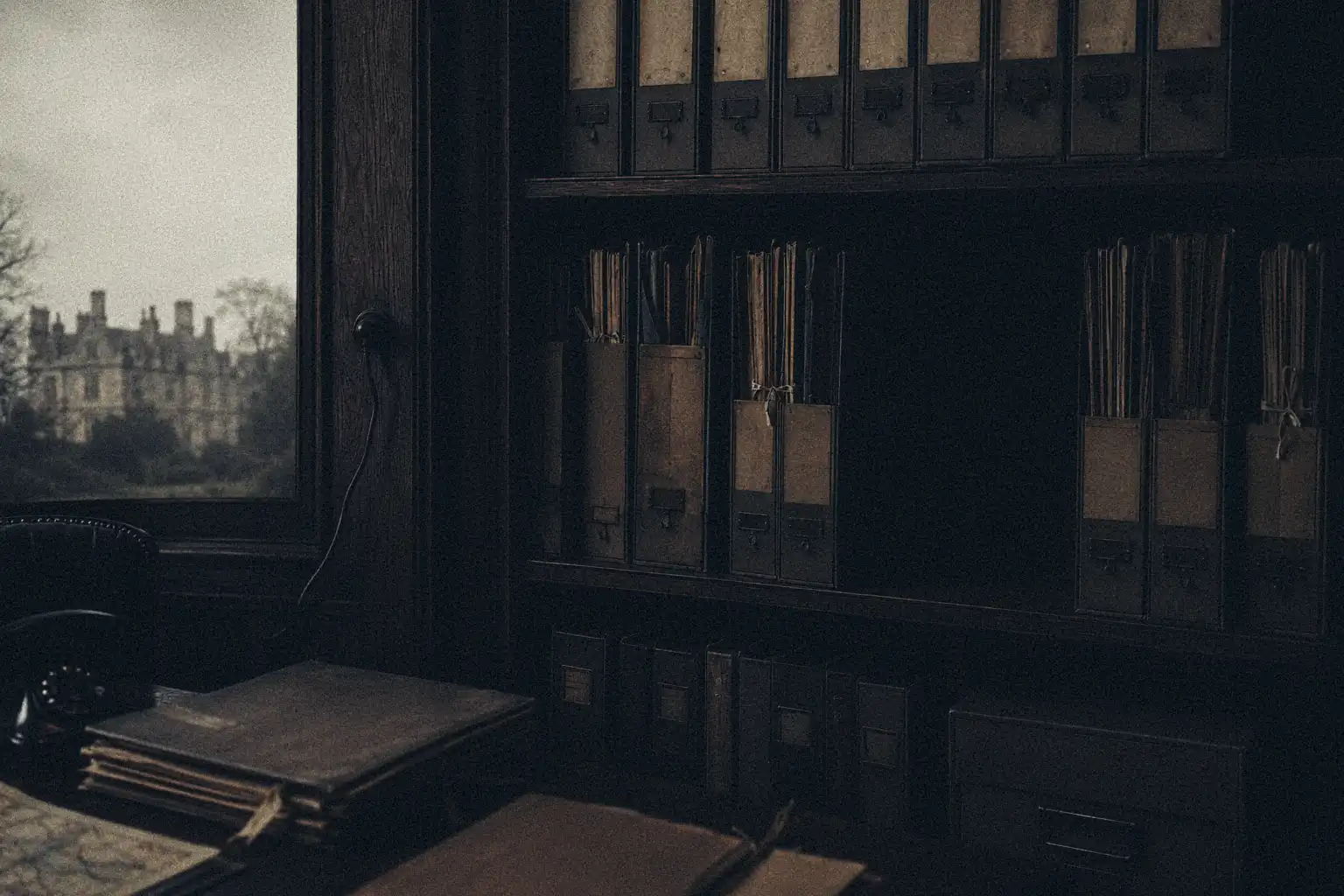
Rudolf Hess spent thirteen months at a British intelligence facility equipped with hidden microphones. The surviving archives contain related records, but the raw Camp Z operational output has not been located.
Data Manifest
- Primary Investigation: The missing operational records generated during Rudolf Hess's thirteen-month detention at Camp Z, including guard logs, surveillance transcripts, property inventories and wax audio discs.
- Key Anomalies Documented: Several categories of Camp Z material have not been located in released public archives, while related Hess records survive across MI5, Foreign Office and War Office archival series.
- Sources Utilised: MI5's published account of wartime file retention and destruction; MI5's institutional identification of Hess files KV 2/34 to KV 2/38; secondary historical accounts describing Denys Felkin's 23 May 1941 report in FO 1093.
Glossary
- CSDIC: Combined Services Detailed Interrogation Centre, the organisation associated with the microphone and transcription operation described at Camp Z.
- Petrie Directive: A 1945 MI5 internal instruction issued by Director-General David Petrie governing the retention and destruction of wartime files.
- Weeding: The wartime and post-war review of files to decide which records should be retained and which could be destroyed.
Origins of the Camp Z Operational Records
On 10 May 1941, Rudolf Hess parachuted from a Messerschmitt Bf 110 into a field at Floors Farm near Eaglesham, south of Glasgow. He gave his name as Alfred Horn, recorded locally in some Home Guard and secondary accounts as ‘Albert Horn’, and asked to see the Duke of Hamilton. Hess was at that point Deputy Führer of Nazi Germany.
Eight days later, Lieutenant Colonel A. Malcolm Scott received orders to take command of a facility being prepared for the prisoner at Mytchett Place in Surrey. The house was designated Camp Z. Hess arrived there in late May 1941 and remained for thirteen months. On 26 June 1942 he was moved to Maindiff Court Hospital in Abergavenny. According to the British Modern Military History Society, the transfer was driven by the cost and logistical burden of maintaining a bespoke security establishment for a single detainee.
Within that thirteen-month window, Camp Z was equipped with hidden microphones. Several categories of material associated with the operation have not been located in the released archives.
Camp Z: From Detention to Archive
-
10 May 1941
Hess lands in Scotland
Rudolf Hess parachutes near Eaglesham, gives the name Alfred Horn and asks to see the Duke of Hamilton. -
18 May 1941
Camp command arranged
Lieutenant Colonel A. Malcolm Scott receives orders to take command of the facility being prepared at Mytchett Place. -
23 May 1941
A separate intelligence record survives
Denys Felkin of AI1(K) files a Hess assessment that survives in the Foreign Office archives under FO 1093. -
Late May 1941
Hess enters Camp Z
Hess arrives at Mytchett Place. Hidden microphones installed by J.F. Doust and his engineers are already part of the operation. -
16 June 1941
Security arrangements change
After Hess's suicide attempt, J.R. Rees files an assessment for MI6 recommending armoured glass. -
26 June 1942
Camp Z detention ends
Hess is transferred to Maindiff Court Hospital after thirteen months at Camp Z. -
1945
Petrie issues a file-retention directive
MI5 is instructed both to remove superfluous material and to preserve records of historical interest and material showing how policy and principle were decided. The full unredacted directive has not been located. -
November 1945
CSDIC closes wartime operations
Personnel return to their primary intelligence branches. -
1999
MI5's internal history is released
The official history drafted in 1944 to 1945 enters the public record and refers to the complex administrative background to wartime file weeding.
Surveillance Operations and Recording Equipment
Before Hess arrived, the intelligence technician J.F. Doust and a team of engineers wired the house with hidden microphones. Helen Fry’s account in Spymaster records the installation as ready by the time the prisoner was in residence.
Three minders were assigned. Thomas Kendrick, running the Combined Services Detailed Interrogation Centre under the codename Colonel Wallace, was seconded from MI6. Frank Foley, the SIS German expert, was the second. The third is recorded only as Captain Barnes.
Standard CSDIC transcription protocol, described in The History of MIS-Y covering the equivalent Anglo-American practice, required recordings to be transcribed in the original language in two copies, original and carbon, and submitted to a Chief Monitor who kept a detailed log. Direct declassified CSDIC procedural rules for Camp Z itself have not been located, but the wider practice provides a comparator for the records that may have been generated at Mytchett Place.
At least one Hess intelligence report from this early period does survive elsewhere. On 23 May 1941, Denys Felkin of AI1(K) filed a brief assessment from Trent Park. That report is in the Foreign Office archives at FO 1093. It shows that Hess-related intelligence was, from the outset, entering more than one departmental registry.
Priority Briefings
New investigations, evidence checks, and unresolved questions from Veriarch, sent directly to your inbox.
Complexity of Intelligence Chain of Custody
Camp Z was not a single-agency operation. Its paperwork was generated by staff answering to different masters.
On 29 May 1941, Scott reported to his superior Norman Coates on Hess’s mental state, and Coates arranged for the military consulting psychiatrist J.R. Rees to visit. On 16 June 1941, after Hess threw himself over a balcony banister in an attempted suicide, Rees filed an assessment for MI6 recommending armoured glass.
Kendrick and Foley were MI6. Scott and Coates were military. The microphones and transcribers were CSDIC. MI5 holds the surviving declassified Hess personal files. The available evidence does not identify any one of these bodies as the natural archival home of the raw operational output.
Camp Z Was Not a Single-Agency Record Chain
Operational Roles
Surviving Record Locations
The Petrie Directive and Historical Record Destruction
In 1945, MI5’s Director-General David Petrie issued a formal internal directive on the retention and destruction of wartime files. MI5’s own public statement, published on mi5.gov.uk under ‘British Intelligence in the 21st Century’, is the source presently available for its wording.
The directive contained two distinct instructions. The destruction clause stated that there was a paramount necessity to restrict Service records to matters which were now its proper concern, and that superfluous information impeded work rather than assisted it. The preservation clause instructed that, in reviewing papers for destruction, due regard must be given to preserving information of historical interest and to material that might show how matters of policy and principle were decided.
In November 1945, CSDIC formally closed its wartime operations. Personnel, Kendrick included, returned to their primary intelligence branches.
MI5 today acknowledges publicly that its approach to file destruction after both World Wars was inconsistent, and that material was destroyed which the Service would rather have retained.
The full unredacted Petrie text has not been located in either the KV 4 or KV 5 series. The available extract does not show whether Petrie defined ‘superfluous’ in any operational way or left that judgement to individual registry clerks.
Support the Archive
Help fund the retrieval, hosting, and preservation of Veriarch investigations.
Current Status of Camp Z Intelligence Archives
MI5 confirms that files relating to Hess’s arrival and detention are held at the National Archives under references KV 2/34 to KV 2/38. The Felkin AI1(K) report of 23 May 1941 is held in FO 1093. The War Office WO 208 series routinely housed CSDIC reports and interrogation transcripts of comparable prisoners.
Despite these records, several categories of Camp Z material have not been located in any released public archive. The raw daily guard logs from Mytchett Place have not been located. Itemised property inventories compiled after Hess’s capture on 10 May 1941 have not been located in the released public files.
CSDIC surveillance transcripts covering the thirteen-month detention have not been located. The wax audio discs produced by the microphones inside the house have not been traced.
The 1999 release of the internal official history of MI5, drafted in 1944 to 1945, itself refers to the complex and obscure administrative reasons behind wartime weeding decisions. Absence from released public archives is not proof of destruction. The material may sit in retained SIS files, in GCHQ historical holdings or in other closed departmental collections that have not been declassified.
Historical Perspectives on Missing Operational Data
The current record supports three working explanations for the gap.
One explanation is data siloing. Camp Z was staffed by MI6 through Foley, commanded by the military through Scott, and monitored by CSDIC through Kendrick. As Stephen Tyas has noted in work on Allied intelligence use of German POWs, CSDIC intelligence was typically routed to the War Office, the Air Ministry and Naval Intelligence rather than into MI5’s registry. On this reading, the raw Camp Z logs may never have entered MI5’s holdings at all, and would therefore have fallen outside the scope of the 1945 Petrie review.
Evidence mishandling under the Petrie review offers another possibility. Registry clerks working to the destruction clause may have classified daily guard shift records, dietary records and untranslated transcripts as administrative scaffolding and destroyed them, while retaining polished summaries of the kind now available in KV 2/34 to KV 2/38. This reading depends on how individual clerks interpreted ‘superfluous’ in the absence of a defined term.
A third possibility is destruction at decommissioning. Routine paperwork may have been destroyed when the facility closed in June 1942, before Petrie’s directive was drafted. No Camp Z handover document has yet been located, and no applicable local destruction procedure has been identified.
Evidence that could discriminate between these three explanations has been identified but not found. The MI5 registry indices for the KV 2/34 to KV 2/38 series could show whether the logs were ever entered into the registry and later struck through. The June 1942 Camp Z handover documents could show whether local paperwork was incinerated on site.
Three Working Explanations for the Record Gap
| Working Explanation | What the Article Proposes | Evidence That Could Test It |
|---|---|---|
| Data siloing | Raw Camp Z material may have followed MI6, military or CSDIC record routes and never entered the MI5 registry, placing it outside the later Petrie review. | MI5 registry indices for KV 2/34 to KV 2/38 could show whether the missing records were ever entered. |
| Petrie review | Registry staff may have treated daily logs, routine records or untranslated transcripts as 'superfluous' while retaining more polished summaries. | Registry entries, strike-throughs, dates or signatures could establish whether Camp Z records were reviewed and removed. |
| Destruction at decommissioning | Routine local paperwork may have been destroyed when Camp Z closed in June 1942, before the Petrie Directive existed. | The missing June 1942 Camp Z handover documents could record instructions for retention, transfer or destruction. |
Source Box
Sources include: Rudolf Hess personal files KV 2/34 to KV 2/38 held by The National Archives; Denys Felkin’s 23 May 1941 AI1(K) report in Foreign Office series FO 1093; MI5’s 2001 lecture ‘British Intelligence in the 21st Century’, including David Petrie’s 1945 file-retention instructions; the 1946 US War Department record ‘Origin of the Interrogation Centers for the Interrogation of Prisoners of War’, used as a comparator for detailed interrogation procedure; Helen Fry’s ‘Spymaster: The Man Who Saved MI6’ and ‘The Walls Have Ears’; and Linda Parker’s account ‘Rudolph Hess and his Trip to Scotland’ for the British Modern Military History Society.
Claim-Source Matrix
| Core Finding | Primary Source Document | Status |
|---|---|---|
| MI5's surviving declassified Rudolf Hess personal files are held under references KV 2/34 to KV 2/38. | National Archives, KV 2/34 to KV 2/38 | Located |
| A Hess intelligence assessment dated 23 May 1941 survives in a separate Foreign Office registry. | Denys Felkin AI1(K) report, FO 1093 | Located |
| MI5's published account records both the Petrie retention review and the Service's later acknowledgement that post-war destruction practices were inconsistent. | MI5, 'British Intelligence in the 21st Century' | Located |
| Equivalent wartime interrogation procedure required original-language transcripts, duplicate copies and a Chief Monitor's detailed log. | 1946 U.S. Interrogation Center Standard Operating Procedures, Section C.14.a | Comparator located |
What We Still Do Not Know
- The full unredacted text of the 1945 Petrie Directive, including whether it exempted records concerning high-value prisoners or defined 'superfluous' for registry staff.
- MI5 registry indices for KV 2/34 to KV 2/38 may show entries for Camp Z guard logs, property inventories or CSDIC transcripts, but we do not know whether such entries exist, were struck through or carry a date and signature.
- No location has been established for the CSDIC wax audio discs or duplicate paper transcripts generated by the microphones at Mytchett Place between May 1941 and June 1942.
- Itemised property inventories compiled after Hess’s capture on 10 May 1941 have not been located in the released public files, leaving the first departmental chain of administrative custody unresolved.
- June 1942 Camp Z handover documents have not been found, so their instructions for transporting, retaining or destroying local administrative files remain unknown.
- Comparable raw guard logs and CSDIC transcripts from other high-value detainees at sites such as Trent Park or Latimer House have not yet established whether the Camp Z gap was unusual or part of a wider retention pattern.
Comments (0)