
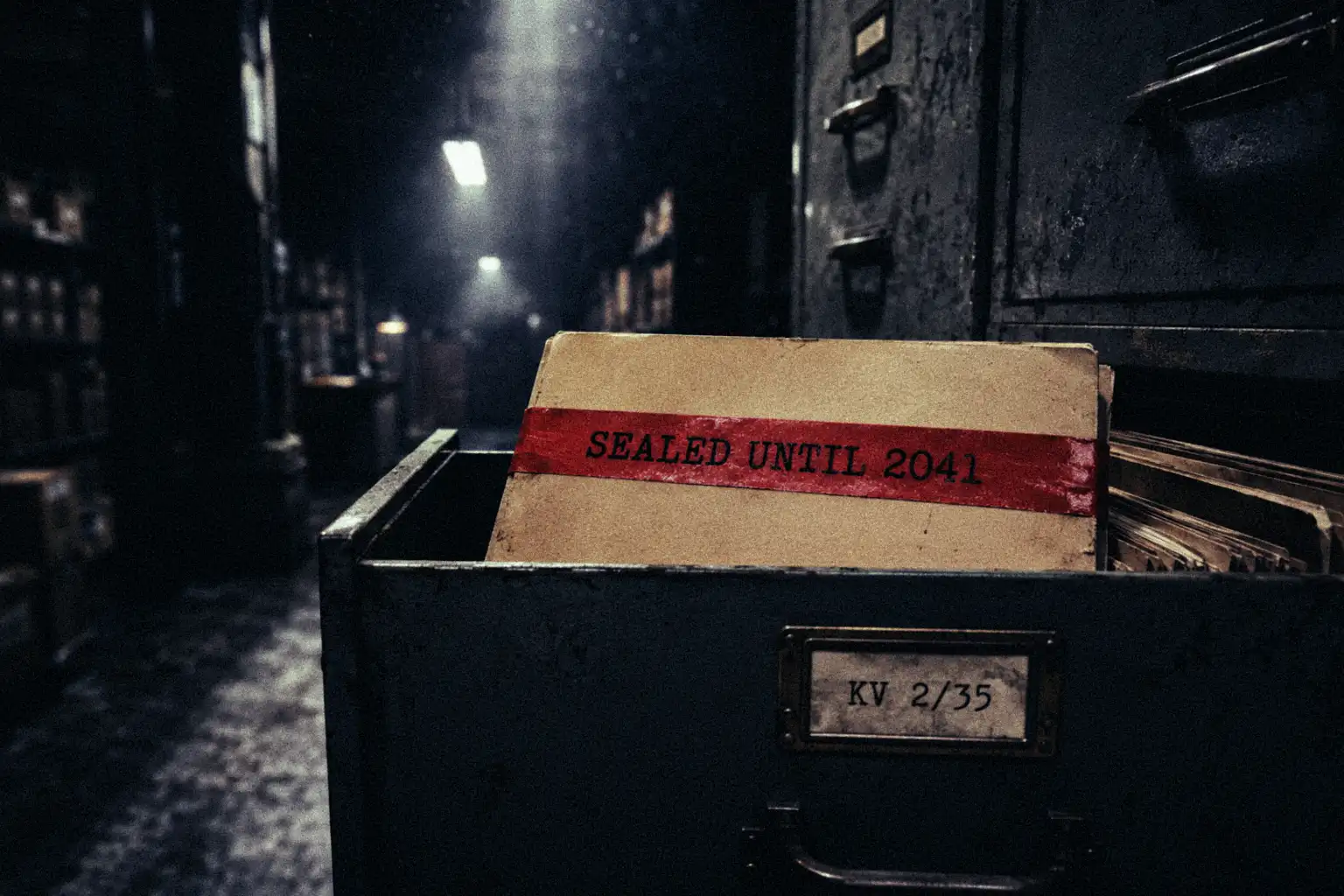
Rudolf Hess’s 1941 flight to Scotland is one of World War II’s most enduring enigmas. Yet, beneath the headlines of that night, a deeper Rudolf Hess archive persists. A trail of missing and inaccessible WWII records leaves important parts of the historical sequence unresolved.
On 10 May 1941, a German aircraft landed in a Scottish field. Within a month, the Lord Chancellor of Great Britain was sitting in a Surrey safe house under a false name, accepting typed peace terms from the pilot.
The same government was publicly calling him delusional.
DATA MANIFEST
- Primary Investigation: The paper trail, restricted archival silos, and broken chain of custody relating to Rudolf Hess's flight to Scotland on 10 May 1941 and his subsequent detention by British authorities.
- Key Anomalies Documented: The missing Giffnock police property intake form from 11 May 1941; an 18-day delay before MI5 formally interrogated the first civilian translator, Roman Battaglia; the destruction of Camp Z daily operational logs under the 1945 Petrie Directive; the absence of the original typed peace protocol from the PREM 3 registry; and a 100-year statutory hold sealing remaining files until 2041.
- Primary Sources Utilised: The National Archives catalogues (FO 371 series, KV 2/34 to KV 2/38, and PREM 3/219); MI5 records ('British intelligence in the 21st century'); Smithsonian Magazine; and 'Spotlight On: Rudolf Hess' (The National Archives, 2018).
Case Terminology
- 100-year statutory hold: A rule in the British archives that keeps certain sensitive files sealed for a full century instead of the standard 30 years, used when release is judged to threaten national security or international relations.
- Camp Z: The codename for Mytchett Place, a fortified country house in Surrey where Hess was held under joint MI5 and MI6 control from May 1941 onward.
- Giffnock intake: Refers to the original property list recorded by police when Hess was first detained at Giffnock police station on 11 May 1941. The absence of this document is a key anomaly in the Hess timeline.
- KV 2 series: The catalogue prefix used by the National Archives for MI5 personal files on persons of security interest. The Hess records sit at KV 2/34 to KV 2/38.
- Lord Chancellor: The senior legal officer of the British government, sitting in the Cabinet. In 1941 the post was held by John Simon, 1st Viscount Simon.
- Petrie directive: A 1945 order by MI5 Director-General David Petrie which authorised the systematic weeding of wartime files, leading to the destruction of operational logs, including those for Camp Z.
- PREM 3: The National Archives reference series for the Prime Minister's Office papers (1940–1945). These files contain high-level summaries of the Hess affair as briefed to Winston Churchill.
- Pseudonym (interrogation use): A cover name adopted by intelligence or government staff during questioning, kept on the transcript instead of the real name to limit leaks. Lord Simon used 'Dr Guthrie' at Camp Z on 9 June 1941.
- Weeding (archival): The bureaucratic process of reviewing files and destroying ones judged to have no future operational use. Not a leak or a cover-up, but a sanctioned method of clearing space in registries.
The Missing Giffnock Police Intake Records
Hess’s aircraft was a Messerschmitt Bf 110. Departing Augsburg at 17:45 on 10 May 1941, he flew alone, navigating by paper chart. His target was a blue-pencilled circle on a map sitting over Dungavel Castle, the Duke of Hamilton’s estate in Lanarkshire.
That target was missed by a few miles. At around 23:00, out of fuel, he bailed out and landed at Floors Farm, near Eaglesham. A local worker named David McLean confronted him with a pitchfork, and he identified himself as ‘Captain Alfred Horn’.
Then the paperwork started.
Hess was taken to the Busby Home Guard headquarters, then to the local police station at Giffnock, arriving shortly after midnight on 11 May 1941. Standard British police procedure required a duty sergeant to fill out a property intake form, listing every item taken off the prisoner. This is the ordinary paperwork of any civilian arrest.
The original Giffnock intake form is not in the Scottish regional archives.
What survives is a list compiled later, from secondary histories and contemporary press reporting. He was carrying a leather flying suit marked with the rank of captain, a gold wrist watch, a gold compass, a Leica camera, maps, money, a torch, photographs of himself and his young son, and a collection of 28 different medicines including dextrose tablets and homeopathic remedies. Every item on that list comes from accounts written after the police paperwork should have done the work first.
Before the military arrived to take control, a Royal Observer Corps officer named Major Graham Donald conducted his own interview at the station. No transcript of that conversation appears in any public archive.
The missing receipt sits exactly at the point where local police custody ends, and military intelligence begins.
Most likely, intelligence officers collected the paperwork from Giffnock on 11 May 1941 and absorbed it into the military chain. The original receipt has not since reappeared in either the Scottish records or the National Archives catalogue.
Custody Chain Timeline
-
10 May 1941, 17:45
Departure
Hess departs Augsburg in a Messerschmitt Bf 110, navigating alone by paper chart.
-
10 May 1941, ~23:00
Bailout and Capture
Aircraft runs out of fuel. Hess bails out over Floors Farm, Eaglesham, and is confronted by local worker David McLean.
-
11 May 1941, ~00:00
Giffnock Police Station Intake
Hess arrives at Giffnock police station. Standard police procedure requires a property intake form. The original intake form is not present in the Scottish regional archives.
-
11 May 1941
Military Intelligence Transfer
Military intelligence arrives and assumes control of the prisoner. The police paperwork is absorbed into the military chain.
The Lord Chancellor and the ‘Disordered Mind’
The public story began on 13 May 1941. Three days after the landing, Winston Churchill briefed the House of Commons on the German visitor in Scotland. Churchill’s first public framing of Hess was dismissive.
Behind the dismissal, the British psychiatric service moved in fast. Dr J R Rees and colleagues examined Hess and labelled him mentally unstable, and their assessments were leaked to the press. By mid-May, the public was reading about a man with a long history of delusion.
Direction then changed.
On 9 June 1941, Lord Simon, the Lord Chancellor of Great Britain and the most senior legal officer in the government, travelled to Camp Z in Surrey under the cover name ‘Dr Guthrie’. Beside him was Ivone Kirkpatrick, the Foreign Office’s leading expert on Nazi Germany, using the name ‘Dr Mackenzie’. Together they sat down with Hess, who handed them a typed document containing peace proposals he had initialled multiple times.
That same day, after reading the transcripts of the interrogation, Churchill wrote a private memo describing Hess as comparable to a ‘mentally defective child’.
It was not in his 13 May briefing to the Commons. The memo was written in private on 9 June 1941, the very day Lord Simon was in Surrey accepting Hess’s typed peace terms under a pseudonym.
Whatever his mental state, the flight itself demonstrated considerable technical competence. Hess had flown a twin-engined fighter-bomber alone, at night, across the North Sea, evading British radar, and reached his target zone within walking distance of Dungavel Castle. Whatever purpose the public framing served, the surviving material cited here does not establish that the Ministry of Information constructed it specifically to neutralise Hess’s peace terms.
That typed protocol is now a problem. An auction-house description records that Hess initialled the document multiple times. The original is not in the public PREM 3 registry, attested only by a commercial sale lot record.
Public Framing vs. Internal Reality
| Subject Area | Public Statement (May 1941) | Internal Record (May - June 1941) |
|---|---|---|
| Mental Capacity | Publicly briefed as a man with a long history of delusion and mental instability. | Described as comparable to a "mentally defective child" in a private memo from Churchill only after reading interrogation transcripts on 9 June. |
| Navigation & Capability | Dismissed publicly as a disordered mind. | Successfully flew a twin-engined fighter-bomber alone at night, evading radar to reach the target zone. |
| Peace Terms | Neutralised in the press to a public still being bombed. | Handed typed peace proposals, initialled multiple times, directly to senior British officials. |
| Official Receiver | Handled as a delusional prisoner of war. | Interviewed at a Surrey safe house by Lord Simon (Lord Chancellor) under the pseudonym 'Dr Guthrie'. |
Hidden MI5 Hess Files and Diplomatic Silos
Records of the Hess affair did not sit in one drawer. They sat in three.
The Foreign Office held its set under the catalogue prefix FO 371. Ivone Kirkpatrick filed his diplomatic reports there, along with the analysis of the peace terms and the geopolitical fallout across Europe. To the Foreign Office, Hess was a problem of statecraft.
MI5 held its own set under the prefix KV 2, a National Archives catalogue series used for personal files on persons of security interest. Those records occupy KV 2/34 to KV 2/38.
These files contain the raw interrogation notes, the security assessments of Camp Z, and the file on the first civilian translator to speak to Hess, Roman Battaglia, at KV 2/35. To MI5, Hess was a domestic threat to manage.
The Prime Minister’s Office held its set under PREM 3/219. That file contains the high-level summaries that reached Churchill’s desk, including the notes from Lord Simon’s June interview. To the PM’s office, Hess was a political problem requiring selective briefing.
By the end of May 1941, the Ministry of Information, the Foreign Office, MI5 and MI6 were all claiming jurisdiction over the same prisoner. Each department opened its own files. None opened a shared one.
No surviving inter-departmental file ties the three silos together. KV files sit under stricter access rules than either the FO or PREM series at the National Archives. A researcher today must clear three separate access regimes to read across the case, and there is no working index that maps one silo’s entries against the others.
The Three Archival Silos
Jurisdiction claimed by three departments, with no shared inter-departmental file.
Foreign Office (FO 371)
A problem of statecraft.
Ivone Kirkpatrick's diplomatic reports, analysis of peace terms, and geopolitical fallout.
MI5 (KV 2/34 to 2/38)
A domestic threat to manage.
Raw interrogation notes, security assessments of Camp Z, and files on civilian translators.
Prime Minister's Office (PREM 3/219)
A political problem requiring selective briefing.
High-level summaries reaching Churchill's desk, including notes from Lord Simon's interview.
The Eighteen-Day Delay and the Battaglia Interrogation
Battaglia was a Glasgow civilian. He spoke fluent German. On the night of 10 to 11 May 1941, while Hess was still at the Giffnock police station, Battaglia was brought in as the first interpreter and conducted the first in-depth conversation with the prisoner.
MI5’s first formal interrogation of Battaglia did not happen for another 18 days.
Lieutenant John Mair of MI5 sat down with Battaglia at Glasgow Police Headquarters on 29 May 1941. The typed record of that interview survives in the National Archives under reference KV 2/35. Mair’s main line of questioning was whether Hess had flown of his own volition, or under orders from the German government.
Our reading of the gap is that MI5 was working backwards, trying to establish what Hess had said in his first civilian hours before London’s intelligence machinery took over. That is the researcher’s analytical inference, not a stated MI5 objective recorded in the file.
What is documented is the timing. Eighteen days elapsed between Battaglia’s first contact with the prisoner and the formal MI5 record of what Battaglia knew. During those 18 days, Hess was moved to the Tower of London, then to Camp Z in Surrey, while the first interpreter went unheard at the official level.
KV 2/35 is a typed report that sits in the public file. No equivalent record exists for the corresponding period at Camp Z.
Support the Archive
Help fund the retrieval, hosting, and preservation of Veriarch investigations.
The 1945 Petrie Directive and the 2041 Seal
By 1945, MI5 was drowning in paper. Wartime had produced millions of pages of logs, intercepts, guard schedules and routine reports. David Petrie, the Director-General, ordered a clear-out.
That clear-out had a technical name. Weeding, in archival use, means the bureaucratic process of reviewing files and destroying ones judged to have no future operational use. It is sanctioned record destruction, signed off by archivists, and not the same thing as a leak or a cover-up.
Under Petrie’s 1945 directive, large volumes of MI5 working files were weeded out. Camp Z’s daily operational logs have not been located in the released record, but the available evidence does not establish whether they were destroyed under Petrie’s weeding policy, disposed of earlier, or retained elsewhere. Those logs would have named every officer, psychiatrist and politician who walked into the building on any given day during Hess’s captivity.
Without them, the granular chain of custody at Camp Z is gone.
For the records that did survive the 1945 cull, there is a second barrier. An unspecified volume of interrogation transcripts, psychiatric evaluations and diplomatic correspondence relating to Hess remains sealed under a 100-year statutory hold, a rule that keeps sensitive files closed for a century rather than the standard 30 years. Scheduled release date 2041.
Britain’s archival authorities have not published the specific reason for extending the seal that far.
Archival Barriers: Weeding and Statutory Hold
David Petrie, Director-General of MI5, issues a 1945 directive to clear out redundant working files.
Sanctioned archival weeding destroys large volumes of daily operational logs.
Camp Z's daily logs are destroyed, removing the granular record of officers and visitors who interacted with Hess.
Surviving interrogation transcripts and psychiatric evaluations are placed under an extended seal.
Files remain closed under a 100-year rule, far exceeding the standard 30-year archival release schedule.
Assessing the Cadogan Document Anomaly
On the question of deliberate alteration, the only substantive lead in the Hess files comes from a single piece of German academic analysis. In a 1994 paper published in Vierteljahrshefte für Zeitgeschichte, Rainer F Schmidt argued that Alexander Cadogan, the Permanent Under-Secretary at the Foreign Office, may have deleted or altered a clause in Ivone Kirkpatrick’s memorandum of 12 May 1941.
According to Schmidt, the deleted clause recorded a specific Hess condition that any peace proposal would only be considered if negotiated with an English government other than Churchill’s.
That allegation rests on Schmidt’s reading of the documentary record. Schmidt’s reading is not an established, audited fact in the British archives.
As of 2026, no archive in the public catalogue holds the original unedited Kirkpatrick draft.
Source
Sources include: ‘KV series: Files on Rudolf Hess, 1941’ and the ‘Spotlight On: Rudolf Hess’ video transcript from The National Archives; public policy records regarding archival weeding from MI5; the ‘Churchill at War: The Prime Minister’s Office Papers, 1940-1945 Author Index’ published by Cengage; the ‘List of sealed archives’ registry; and academic analysis from ‘Vierteljahrshefte für Zeitgeschichte’ (1994).
Claim-Source Matrix
| Core Finding | Primary Source Document | Status |
|---|---|---|
| Hess navigated a Messerschmitt Bf 110 by paper chart to a landing zone near Dungavel Castle on 10 May 1941. | Smithsonian Magazine | Confirmed |
| Churchill wrote that Hess was comparable to a "mentally defective child" in a private 9 June 1941 memo after reading interrogation transcripts. | The Walls Have Ears | Confirmed |
| MI5's raw interrogation notes and security assessments of Camp Z are housed in the KV 2/34 to KV 2/38 series. | Spotlight On: Rudolf Hess | Confirmed |
| Alexander Cadogan may have deliberately deleted a clause in Kirkpatrick's 12 May 1941 memorandum regarding peace terms. | Vierteljahrshefte für Zeitgeschichte (Schmidt, 1994) | Confirmed (Attributed View) |
What we still do not know
The evidentiary gaps in the Rudolf Hess case remain substantial. Several critical items and explanations are absent from the public record.
- The typed peace protocol that Hess initialled at Camp Z on 9 June 1941 has not been located within the PREM 3 registry. Its existence is confirmed only by an auction house record.
- It remains unclear whether the Giffnock police kept a copy of the property intake form from 11 May 1941 or if the military collected all documentation immediately.
- The specific MI5 officer responsible for signing the 1945 destruction order for the Camp Z guard logs under the Petrie directive remains unidentified in open files.
- There is no internal explanation for the 18-day interval between Roman Battaglia's initial conversation with Hess and Lieutenant John Mair's formal interrogation of him on 29 May 1941.
- The National Archives has provided no detailed reasoning for maintaining the 100-year statutory hold until 2041, particularly given that the primary participants in these events have passed away.
- The allegation regarding Alexander Cadogan's alteration of Ivone Kirkpatrick's memorandum from 12 May 1941 cannot be confirmed. The original, unedited version of that document is missing from the FO 371 and PREM 3 catalogues.
Comments (0)