
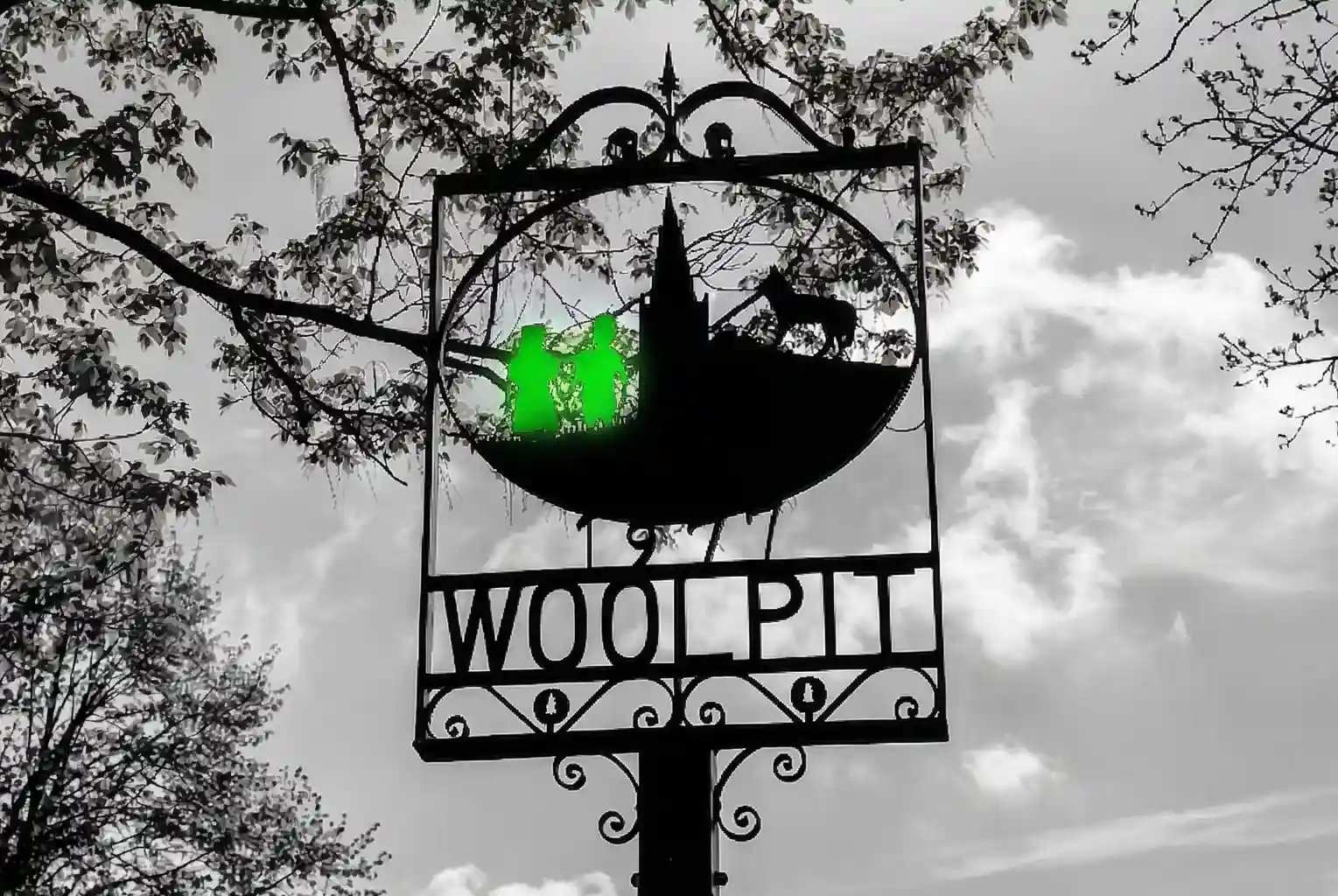
Two medieval historians tell the same strange story, but they do not tell it in quite the same way. William of Newburgh and Ralph of Coggeshall both describe two children appearing near Woolpit in Suffolk, UK, with green skin, unknown speech and a baffling refusal to eat ordinary food. But they both never matched on several key details. They differ on the date, the children’s arrival, the nature of their homeland and the girl’s later life. Since the story depends on such a small source base, those differences carry real weight.
Data Manifest
- Primary Investigation: Examining the 12th-century historical accounts of two green-skinned children appearing near Woolpit in Suffolk, UK, and testing later refugee and folkloric theories against the surviving medieval records.
- Key Anomalies Documented: William of Newburgh and Ralph of Coggeshall contradict each other on the arrival date (reign of King Stephen versus an unstated chronology), the arrival route (wolf pits versus a subterranean cave), the surviving girl's later life (marriage in King's Lynn versus years in Sir Richard de Calne's household), and the description of St Martin's Land.
- Primary Sources Utilised: William of Newburgh's historical account (written in the 1190s); Ralph of Coggeshall's historical account (written in the early 13th century); Domesday Book settlement records for Woolpit (1086).
Glossary of Contextual Terms
- The Anarchy: A period of political instability, shifting loyalties, and private warfare spanning the reign of King Stephen from 1135 to 1154.
- Wolf pits: Physical trenches dug into the medieval landscape to trap wolves, serving a practical purpose while also marking the boundary between managed village fields and uncontrolled ground.
- Chlorosis: An older medical classification often used to describe anaemia that presents with a pale or faintly greenish appearance in the skin.
What the Earliest Sources Say
William wrote in the 1190s. Ralph wrote a little later, probably in the early 13th century. Neither claimed to have seen the children.
William presents the story as something he heard from reliable informants. Ralph anchors it more firmly to Sir Richard de Calne and the household where the children were said to have lived. Since no independent local record confirms the event, that difference in sourcing is important.
On the basic sequence of events, William and Ralph are much the same. Near Woolpit, during harvest, villagers came upon two children, a brother and sister, whose skin was green. Their clothes were unfamiliar, their speech could not be understood, and they turned away the food set before them. Raw broad beans were the first thing they would eat. In both versions the boy later died, while the girl survived long enough to learn English and explain, in some form, where they said they had come from.
That is the smallest stable version of the story. Everything beyond it is less secure. The children’s appearance, speech and diet are firm because both writers report them. Their exact route into Woolpit is less firm. The date is less firm. Even the surviving girl’s later life changes depending on which historian you follow.
The Shared Core Narrative
| Narrative Element | Documented Agreement |
|---|---|
| The Subjects | Two children, one boy and one girl. |
| Location Found | Near the village of Woolpit in Suffolk. |
| Physical Anomaly | Skin possessed a distinct green colour. |
| Communication | Spoke a language unknown to the locals. |
| Initial Diet | Refused ordinary food, eating only raw broad beans. |
| Outcome | The boy died shortly after; the girl survived, learned English, and lost her green colour. |
Where William and Ralph Separate
William dates the story to the reign of King Stephen, from 1135 to 1154, in the period later called the Anarchy. Ralph is less exact, which makes the chronology harder to pin down. In William’s version, the children are found near the wolf pits from which Woolpit took its name. Ralph adds a darker route, with the children wandering through a subterranean passage or cave before they arrive in Suffolk.
William says the girl later married a man from King’s Lynn. Ralph says she remained in Richard de Calne’s household for years and describes her behaviour in moral rather than neutral terms. Their description of the children’s homeland also shifts. William describes St Martin’s Land as a twilight place, with a broad river and a brighter land beyond it. Ralph’s version is narrower and stranger, with the children speaking of a dim country where everything seemed green. That is more than a variation in wording. It changes the feel of the story and the kind of explanation a reader is likely to reach for.
Where the Accounts Diverge
Key narrative differences between the two primary chronicles.
William of Newburgh (c. 1190s)
Places the event explicitly during the reign of King Stephen (1135–1154).
Appeared suddenly by the wolf pits after hearing bells.
Married a man from King's Lynn and lived a conventional life.
A twilight realm with a broad river separating them from a luminous land.
Ralph of Coggeshall (c. 1220s)
Chronology is unfixed, potentially implying a later date.
Followed cattle through a long subterranean passage or cave.
Worked as a servant for Sir Richard de Calne; described as "wanton and impudent".
A dim country where everything, including the environment, was green.
Woolpit and 12th-Century Suffolk
The setting helps explain why the story took hold. Woolpit was a real village in Suffolk, recorded in the Domesday Book in 1086 as a substantial settlement in the hundred of Thedwastre, held by the abbey of Bury St Edmunds. The village name derives from Old English words for a wolf pit, a pit dug to trap wolves. In a medieval landscape, such a feature was practical, but it also marked a boundary between the managed world of fields and village and the less controlled ground beyond.
Bury St Edmunds sat only a few miles away and dominated the region. Its abbey was wealthy, politically influential and a major pilgrimage centre. That proximity matters because the story takes place near one of the great monastic centres of East Anglia, not in some isolated rural corner. When the children speak of hearing bells, the sound belongs to that world.
William’s date also places the tale in a period of instability. King Stephen’s reign was marked by shifting loyalties and private warfare. That is not proof that the children were refugees, or that the story began in violence. But it does make the appearance of frightened strangers easier to picture. It may also help explain why a historian chose to preserve an episode in which the normal order of village life briefly gave way.
Another piece of local context is the Flemish presence in East Anglia.
Flemish settlers, traders and mercenaries formed part of the region’s wider history. That fact later encouraged historians to ask whether the children might have been foreign orphans rather than supernatural visitors. It is a serious question, but context comes before explanation. A background condition is not the same thing as proof.
The Geography of the Mystery
The story is deeply anchored in the landscape of 12th-century East Anglia. The key locations shape how the narrative could be interpreted by contemporaries and modern historians alike:
- Woolpit: The discovery site, named for literal 'wolf pits' used for trapping. This creates a natural threshold between the safe village and the wild landscape.
- Bury St Edmunds: A few miles west. A wealthy, politically dominant monastic centre and pilgrimage site. The "bells" the children heard likely refer to this abbey.
- Wykes (near Bardwell): The manor of Sir Richard de Calne, where Ralph of Coggeshall reports the children were taken.
- Fornham St Martin: A nearby village often cited by rationalist historians as the true origin of "St Martin's Land" and the site of a bloody battle in 1173.
- King's Lynn: A port town in Norfolk, about 40 miles away, where William claims the surviving girl eventually married.
The Flemish Refugee Theory
The best-known historical explanation came much later.
In 1998, the researcher Paul Harris argued that the children may have been Flemish refugees, perhaps linked to the violence surrounding the Battle of Fornham in 1173, when forces loyal to Henry II defeated an invading army that included large numbers of Flemish mercenaries near Bury St Edmunds. The geography makes the theory appealing. Fornham St Martin lay close enough to be folded into a garbled memory of St Martin’s Land. East Anglia had Flemish communities. A pair of orphaned children speaking Flemish and hiding in unfamiliar countryside is easier to picture than visitors from a twilight realm.
To explain the green skin, Harris and others suggested chlorosis, an old medical term often used for anaemia with a pale or faintly greenish appearance. The idea is simple enough, a poor diet changed the children’s colouring, and better food gradually restored it. On that reading, the beans are simply the first familiar food the two hungry children recognised.
That makes sense up to a point, but the sources do not fit it neatly. William dates the story to King Stephen’s reign rather than the 1170s. A later theory may prefer a different date, but the historian still says what it says. The language problem also remains. East Anglia was not isolated from continental Europe, and Richard de Calne was hardly the sort of man to be baffled by every foreign tongue. It is possible that traumatised children spoke in a way nobody around them could understand. It is much harder to prove that this is what happened.
The same difficulty applies to the children’s clothing. Both William and Ralph call the material unknown to the villagers. That may reflect a translation choice or a later sharpening of the detail, but either way it does not fit into a simple refugee explanation.
The historian and former Museum of London curator John Clark, whose 2018 book is the fullest modern study of the subject, has been especially careful on these points. He takes the historical context seriously, but he is sceptical of forcing the story into one rational scheme by brushing aside awkward details. That caution shows the Woolpit story has attracted a habit of overconfident solving. Once one feature seems to fit, researchers often smooth away the rest.
Testing the Flemish Refugee Theory
| Theory Component | Supporting Evidence | Evidential Friction |
|---|---|---|
| Political Context | Strong High Flemish presence in East Anglia; Battle of Fornham in 1173 saw mercenaries killed and scattered. | Conflict William of Newburgh places the event during Stephen's earlier reign (1135–1154), decades before the battle. |
| St. Martin's Land | Plausible Fornham St Martin is very close to Woolpit and the battle site. | Conflict Requires assuming traumatised children garbled a local village name into a vast twilight realm. |
| Unknown Language | Plausible They were speaking a Flemish dialect unfamiliar to rural peasants. | Weak Sir Richard de Calne and educated clerics would likely have recognised a European Germanic dialect. |
| Green Skin | Plausible Chlorosis (anaemia) caused by malnutrition can cause a greenish pallor. | Weak The chroniclers insist their "entire bodies were green", a severe description for standard malnutrition. |
Green Skin, Beans and Unknown Speech
Three features have done more than any others to keep the case alive. The children’s skin, their beans and their language.
The green colour is the easiest detail to repeat and the hardest to pin down. A modern reading may picture a vivid painted green. The medieval texts may support something less dramatic, perhaps a greenish tinge or unhealthy cast. A symptom that sounds bizarre in a modern paraphrase may look different in a closer translation. Even so, chlorosis does not settle the matter. The diagnosis belongs to a much later medical vocabulary, and scholars like John Clark disagree over how neatly it can be pushed back into a 12th-century episode involving a boy as well as a girl.
Arsenic poisoning has also appeared in later retellings, usually tied to a tale of attempted murder and inheritance. That is weaker in the evidence available here. It belongs more to modern reconstruction than to the early sources.
The broad beans are firmer as fact than as meaning. Both historians describe the children fixing on raw beans when other food failed to tempt them. Hungry children who recognise one food and reject another do not need a supernatural explanation. Yet beans also picked up symbolic weight in later folklore writing.
The prominent 20th-century folklorist Katharine Briggs and others noted associations between beans, the dead and the underworld in European tradition. That is useful as a later cultural reading. It does not prove that William or Ralph meant the episode in that way.
The language sits in the same awkward place between event and interpretation. Both historians present it as unintelligible. That supports foreignness, but not any one foreign language. Flemish is the preferred modern candidate because of the regional context. Trauma is another possibility. Stress can affect how children speak. They may fall silent, become hard to follow, or cling to speech patterns that outsiders cannot make sense of. The 12th-century sources do not let us say what language they spoke, and later certainty is doing more work than the evidence allows.
The Three Core Anomalies
Skin Colour
Documented: Described as fully green or tinged green all over. Faded after eating a normal diet.
Inferred: Modern readings suggest chlorosis (iron-deficiency anaemia), though pushing this diagnosis into a 12th-century context is debated.
Broad Beans
Documented: Refused all food until raw broad beans were presented, which they eagerly consumed.
Inferred: Could be the only familiar crop to starving children. Later interpreted as a folkloric symbol, as beans were heavily associated with the dead.
Unknown Speech
Documented: Spoke a language entirely unintelligible to the villagers and local gentry.
Inferred: Often claimed to be Flemish, though severe trauma or a private twin language (cryptophasia) are also functional possibilities.
How Folklore Reshaped the Story
It is easy to see why later audiences read the story as folklore. Green skin and strange speech are classic markers of a fairy legend, and readers naturally linked the Woolpit children to the medieval Otherworld. They treated the wolf pits as physical doorways into a hidden realm outside ordinary human space. Ralph’s account encourages this exact reading by including the long subterranean journey and the altered light.
William and Ralph were historians, not Victorian folklore collectors. They recorded what they treated as a wondrous event. Later readers then sorted the story into fairy tradition. The 19th-century folklorist Thomas Keightley provided the decisive shift with his English translation in ‘The Fairy Mythology’ in 1850. Once the tale entered that shelf of literature, it was far more likely to be read as a fairy legend than as a difficult medieval report.
That shift helps explain why symbolic readings grew stronger. Green became fairy green. Beans became underworld food. St Martin’s Land became a hidden realm just beside the human one. Some of those readings are thoughtful and worth weighing. They show how the story worked in later culture. They do not tell us what happened near Woolpit in the 12th century. John Clark has put this neatly in public talks by noting that the story may be a historical report clothed in language that later readers found folkloric. That is a more careful position than treating it as either a plain fact or a simple fairy tale.
The Making of an Otherworld Story
A literal trapping ditch becomes interpreted as a subterranean portal to the fairy realm.
A physical anomaly becomes heavily linked to the traditional colour of fairies and nature spirits.
A specific agricultural crop becomes retroactively linked to ancient European beliefs about the "food of the dead".
A traumatised description of a dim location is codified into the classic "twilight realm" of the Otherworld.
How Later Centuries Reused the Story
The story’s later life is almost as revealing as its medieval origin.
The Elizabethan antiquarian William Camden mentioned it in ‘Britannia’ in 1586, helping to preserve the account for early historians. The scholar Robert Burton then folded the tale into speculation about worlds beyond our own in his 1621 book ‘The Anatomy of Melancholy’. By 1638, Bishop Francis Godwin was using the children to add historical weight to his early science fiction narrative ‘The Man in the Moone‘. By the 19th century, the Green Children had become familiar material for local folklore and children’s literature.
Later writers kept reworking the story. Some turned it into a fairy narrative. Some read it as a veiled account of refugee children. The astronomer Duncan Lunan pushed it into science fiction, suggesting an extraterrestrial origin and imagining St Martin’s Land as a livable twilight zone on another planet. Those readings are part of the story’s afterlife, as they show how readily the children could be adapted to new ideas. They are much less useful as evidence for the original episode.
A further difficulty is that later versions can start to look like confirmation when they are really repetition. The supposed Spanish parallel from the 19th century is a good example, since it appears to depend on retelling rather than an independent source. Once a story becomes portable, it can surface in new places without telling us anything new about its origin. Similarity may show that the pattern travelled. It does not show that the events behind it were the same.
The Evolution of the Legend
-
c. 1190s – 1220s
The Monastic Chronicles
William of Newburgh and Ralph of Coggeshall record the arrival of the children as a contemporary marvel.
-
1586 & 1621
Antiquarian Curiosity
William Camden preserves the story in Britannia. Robert Burton later speculates the children "fell from Heaven" in The Anatomy of Melancholy.
-
1850
The Folklore Codification
Thomas Keightley includes the tale in The Fairy Mythology, firmly anchoring it in the public consciousness as a fairy legend.
-
Late 20th Century
Science Fiction & Speculation
Writers like Duncan Lunan push the story into speculative territory, proposing extraterrestrial origins and interdimensional portals.
-
1998
The Rationalist Revival
Paul Harris publishes the Flemish refugee hypothesis, attempting to ground all anomalies in 12th-century political violence.
What Still Cannot Be Settled
After all the comparisons, the limits of the medieval record remain firm. No contemporary administrative document confirms the children’s arrival, and no named person outside the historical tradition can be shown to have dealt with them.
The case survives in a small bunch of details that two writers chose to preserve. They agree on enough core facts to demand attention but disagree on enough points to prevent a neat historical solution. Whether the children were displaced outsiders or something else entirely, the surviving evidence simply stops before we can reach a definitive answer.
Sources
Sources include: the foundational 12th- and 13th-century chronicles, specifically William of Newburgh’s ‘Historia rerum Anglicarum’ and Ralph of Coggeshall’s ‘Chronicon Anglicanum’; the 1086 Domesday Book entry for Woolpit; early modern antiquarian texts, notably William Camden’s ‘Britannia’ (1586) and Robert Burton’s ‘The Anatomy of Melancholy’ (1621); 19th-century folklore codifications, including Thomas Keightley’s ‘The Fairy Mythology’ (1850); and contemporary historical scholarship, primarily Paul Harris’s 1998 Flemish refugee hypothesis and John Clark’s 2018 historiographical critique, ‘The Green Children of Woolpit’.
Claim-Source Matrix
| Core Finding | Primary Source Document | Status |
|---|---|---|
| Two children with green skin, unfamiliar clothes, and unknown speech appeared near Woolpit during harvest; they rejected food until eating raw broad beans. The boy died, while the girl survived and learned English. | William of Newburgh (1190s) and Ralph of Coggeshall (early 13th century) | Stable agreement across both early medieval historians. |
| The children arrived during the reign of King Stephen (1135 to 1154), a period of civil war later called the Anarchy. | William of Newburgh (1190s) | Contested; Ralph of Coggeshall provides a less exact chronology. |
| The children arrived after wandering through a dark subterranean passage or cave. | Ralph of Coggeshall (early 13th century) | Uncorroborated by William of Newburgh, who records them being found near the wolf pits. |
| The surviving girl remained in Sir Richard de Calne's household for years and exhibited moral misbehaviour. | Ralph of Coggeshall (early 13th century) | Contested; William of Newburgh records that she married a man from King's Lynn. |
| St Martin's Land was a twilight place with a broad river and a brighter land beyond it. | William of Newburgh (1190s) | Contested; Ralph of Coggeshall describes a narrower dim country where everything seemed green. |
| The children were Flemish refugees from the 1173 Battle of Fornham suffering from chlorosis (anaemia causing a greenish skin tint). | Paul Harris (1998) | Chronologically incompatible with William of Newburgh's dating to King Stephen's reign (1135 to 1154); does not explain the unknown clothing material or unintelligible speech in 12th-century East Anglia. |
What We Still Do Not Know
- Surviving Girl's Identity: The actual identity of the surviving girl, or whether later attempts to connect her to Richard Barre hold any historical weight.
- Clothing Material: Whether the unfamiliar material of the children's clothing was a factual detail recorded from informants or a later literary flourish added by the historians.
- Geographical Origin: Where the children actually originated, given that the Flemish refugee theory cannot clear the timeline hurdles of King Stephen's reign.
- Administrative Corroboration: Why no contemporary administrative document confirms the children's arrival, and why no named person outside the historical tradition can be shown to have dealt with them.
Comments (0)