
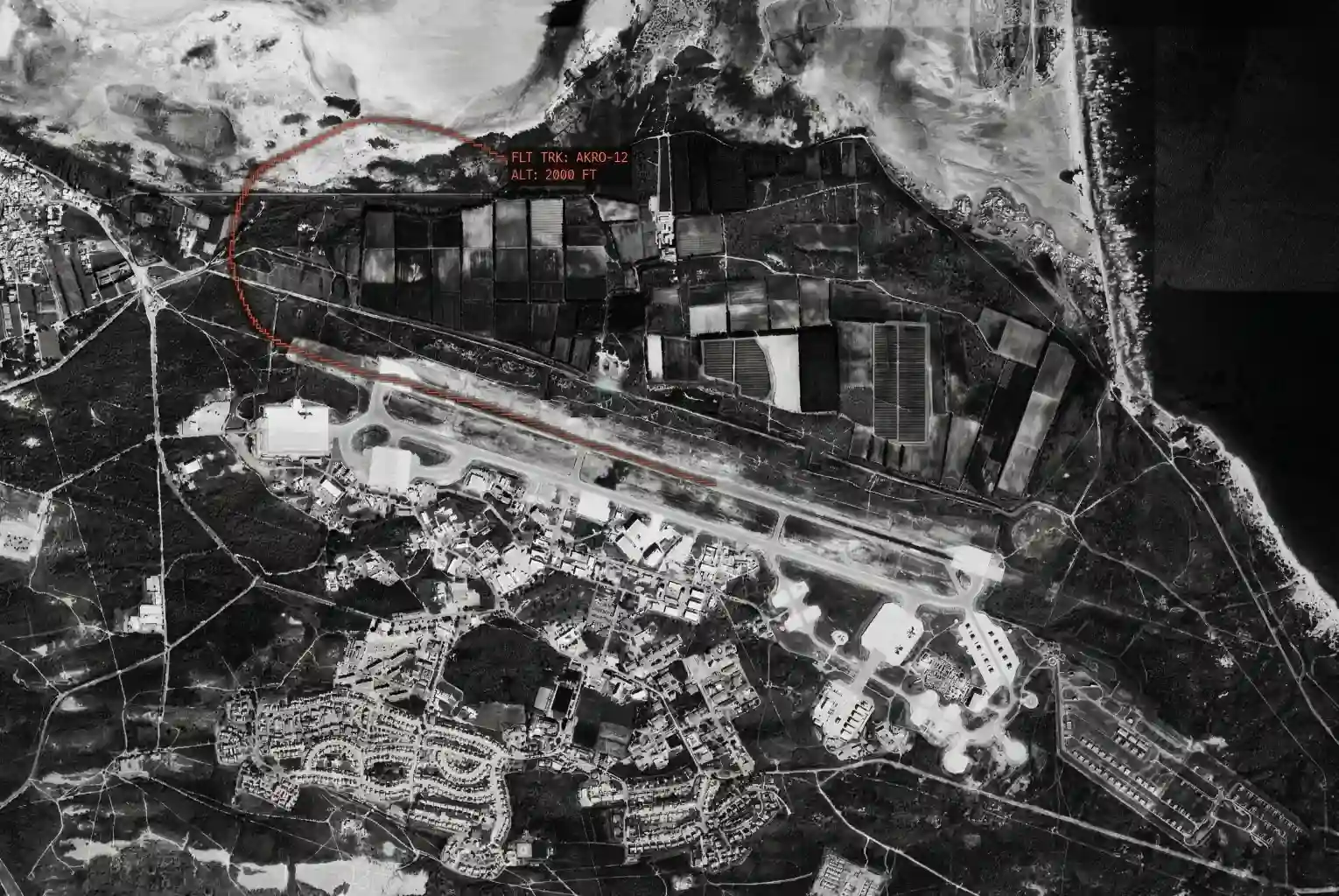
At 21:00 UTC on 1 March 2026, the British Prime Minister authorised the United States to use British bases for defensive purposes in the Middle East. Just 63 minutes later, a drone struck a hangar at RAF Akrotiri. The following day, the Foreign Office issued a blanket denial regarding American access to that specific base. This created an official story that civilian flight trackers would quickly tear apart.
Data Manifest
- Primary Investigation: Examining the contradiction between parliamentary denials of United States military access to RAF Akrotiri and the operational reality documented by open-source flight tracking data, host-nation diplomatic protests, and personnel evacuations during the early 2026 Middle Eastern conflict.
- Key Anomalies Documented: On 3 March 2026, Foreign Secretary Yvette Cooper stated to the House of Commons that the United States had not been granted access to RAF Akrotiri. This statement conflicted with civilian Mode S transponder logs showing a United States Air Force U-2S reconnaissance aircraft landing at the base on 7 March 2026 under 'Operation Olive Harvest', as well as the Ministry of Defence admitting on 13 March 2026 that British military transport flew evacuated American consular staff and contractors from Harir airbase in Iraq directly into RAF Akrotiri.
- Primary Sources Utilised: UK Parliament Hansard transcripts (Commons Chamber debates on 3 March and 17 March 2026); ADS-B Exchange live transponder flight logs (hex code 43C171); the 1960 Treaty of Establishment (Annex B); Ministry of Defence public statements and evacuation records; Republic of Cyprus Ministry of Foreign Affairs readouts (Foreign Minister Constantinos Kombos).
Glossary
| Term | Definition |
|---|---|
| Sovereign Base Areas (SBAs) | British Overseas Territories in Cyprus that remain under full United Kingdom jurisdiction and are not simply leased military facilities. |
| OSINT (Open-Source Intelligence) | Information gathered from publicly available sources, such as civilian flight tracking databases and unencrypted radio transmissions. |
| Procedural Dogma | Rigid adherence to specific administrative rules or narrow definitions that causes an institution to ignore the broader reality of a situation. |
The Sovereign Baseline and ‘Operation Olive Harvest’
The legal foundation of the Sovereign Base Areas shapes this entire conflict. Under the 1960 Treaty of Establishment, Akrotiri and Dhekelia are not leased facilities. They function as British Overseas Territories. Annex B of that treaty grants the UK the right to use these areas for military requirements without restriction. This legal status allows for deep operational integration with United States intelligence assets.
The Republic of Cyprus exercises no operational authority over the bases. This setup constantly causes severe diplomatic headaches whenever the Middle East heats up. Cypriot politicians have frequently characterised the bases as colonial anachronisms.
The United States has maintained a long-standing active intelligence presence at RAF Akrotiri. Specifically, the 9th Reconnaissance Wing operates U-2 spy planes under an initiative known as Operation Olive Harvest. Detachment 1 of this wing relies on the base as a critical node for Eastern Mediterranean surveillance.
The UK government established a clear precedent of keeping the details of these flights intentionally vague during the Gaza war. The base hosted over 600 surveillance flights by Royal Air Force Shadow R1 aircraft and US-contracted assets during that period. The Ministry of Defence (MOD) maintained these flights were solely to locate hostages and views allied intelligence flights as normal background operations entirely separate from active conflicts. Hostile states view these same flights as active war participation.
Jurisdictional Baselines
The structural friction in the Eastern Mediterranean
Republic of Cyprus
Host nation. Exercises zero operational authority over the bases.
Faces intense domestic pressure and protests. Demands base closures.
Sovereign Base Areas (SBAs)
British Overseas Territory. Not a leased facility.
1960 Treaty Annex B grants the UK unrestricted military use.
The Green Light and the Drone Strike
On the evening of 1 March 2026, the Prime Minister released a statement saying that the UK had authorised the United States to use British bases for limited defensive operations. He justified the decision to protect regional allies and the large number of Brits living in the area.
The statement used the plural term for the bases. It made no explicit exclusion for RAF Akrotiri. This is significant because Akrotiri is the primary forward mounting base for British forces in the Eastern Mediterranean.
Just over an hour after that broadcast went out, a Shahed-type loitering munition hit a hangar at the base. The drone bypassed the existing radar network by coming in at an altitude of 1,000 metres, which proved instantly that the installation had a massive blind spot for low-altitude threats.
The impact triggered a massive reactive military escalation. Base authorities ordered a partial evacuation of the facility. By the early hours of 3 March, almost the entire neighbouring civilian village of Akrotiri was fully evacuated. The Ministry of Defence immediately scrambled the air-defence destroyer HMS Dragon to the Eastern Mediterranean. Royal Navy Wildcat helicopters armed with Martlet missiles were deployed specifically to improve counter-drone defences.
The government had only just announced its agreement to integrate more closely with allied forces when, just minutes later, the drone strike hit the base and brutally exposed how vulnerable it was to low-altitude attacks.
The 63-Minute Window
-
1 March 2026, 21:00 UTC
The Broad Authorisation
Prime Minister Starmer issues a recorded statement granting the United States permission to use "British bases" for defensive purposes.
-
1 March 2026, 22:03 UTC
The Hangar Strike
A Shahed-type loitering munition bypasses radar and strikes a hangar at RAF Akrotiri.
-
3 March 2026
The Reactive Deployment
The Ministry of Defence scrambles HMS Dragon and Martlet-armed Wildcat helicopters. Almost the entire civilian village of Akrotiri is evacuated.
The Diplomatic Denial and the Record Divergence
On 2 March 2026, Foreign Secretary Yvette Cooper completely changed course, issuing a site-specific denial regarding American access to Akrotiri. The following day, on 3 March, she formally took that narrative to Parliament, telling the House of Commons that the United States had not been authorised to use the base.
Ministry of Defence officials further solidified this on 5 March. They claimed publicly that United States forces were not operating from the base.
These two statements form the core contradiction of the timeline. The government broadly authorised access, only to deny it for Akrotiri, specifically, the very next day. That reversal only occurred after the base took a physical hit.
The missing internal Foreign Office briefing documents prevent absolute certainty regarding the decision-making process. We lack the unredacted notes provided to the Foreign Secretary prior to her parliamentary appearance. Without these records, we cannot determine what specific operational intelligence she possessed regarding base logistics.
The Privileged Record Divergence
| Date | Actor | Statement | Implication |
|---|---|---|---|
| 1 March 2026 | Prime Minister Keir Starmer | Authorised US to use "British bases" for defensive purposes. | Broad Access |
| 2 March 2026 | Foreign Secretary Yvette Cooper | Stated the US had not been granted access to the base at Akrotiri. | Site-Specific Denial |
| 5 March 2026 | Ministry of Defence Officials | Claimed "US forces are not operating from the base." | Operational Denial |
Caught by Flight Trackers and Challenged in Parliament
The government can lock down its own records, but open-source intelligence networks operate entirely outside government control. They sit there picking up raw transponder pings in real time. On 7 March 2026, those civilian databases logged a United States Air Force U-2S reconnaissance plane landing at Akrotiri.
The U-2S is a dedicated intelligence, surveillance, and reconnaissance platform. It transmits real-time data to allied command centres. Its presence proves that United States forces were actively operating from the base for data-gathering purposes.
Six days later, on 13 March, the Ministry of Defence admitted to an emergency evacuation. American consular staff and contractors had to be pulled out of Harir airbase in Iraq. Because the US lacked available transport, British aircraft flew them directly into RAF Akrotiri.
You cannot receive and process evacuated American personnel on the tarmac without granting them operational access. That basic fact completely dismantled the parliamentary denial from 2 March.
The official story finally collapsed on 17 March. Members of Parliament directly challenged the Foreign Secretary on the ongoing Operation Olive Harvest flights. Once the operational details were on the public record, sticking to a blanket denial was no longer an option.
The Operational Reality
Open-source intelligence dismantling the 5 March operational denial.
Documented USAF Landing
7 March
U-2S ReconnaissancePersonnel Evacuation
13 March
Harir Airbase to AkrotiriThe Baseline Conflict
The Ministry of Defence views Operation Olive Harvest intelligence flights as normal background operations. Open-source trackers logged the U-2S landing two days after officials explicitly claimed US forces were not operating from the base.
Hostile Intelligence and the Diplomatic Friction
The Islamic Revolutionary Guard Corps acted upon the premise of United States access before the British government could manage the narrative. On 2 March, IRGC General Sardar Jabbari threatened to launch missiles at Cyprus. He based this threat on the assertion that United States fighter jets had relocated to the island.
Cypriot Foreign Minister Constantinos Kombos subsequently confirmed the drone striking Akrotiri originated from Lebanon. This highlighted the immediate proximity of the threat to the host nation. The attack sparked intense domestic protests in Cyprus demanding the closure of the bases. Activist groups labelled the installations a launchpad for terror.
The UK government attempted to manage the diplomatic timeline at a deliberate parliamentary pace. But, hostile actors had already cemented the timeline with action. They based this action on their own intelligence assessments of the United States movements.
The Americans have relocated fighter jets to Cyprus. We will launch missiles at Cyprus with such intensity that they will be forced to leave.
IRGC General Sardar Jabbari, 2 March 2026 IRGC General Sardar Jabbari statementChanging the Definition
The account finally shifted on 21 March 2026. To cool off the diplomatic crisis, the Prime Minister got on a call with the Cypriot President. Suddenly, the government stopped issuing absolute denials about American access.
Instead, the Prime Minister offered a very specific promise. The bases would not be used for offensive military operations. That careful change in language shows officials trying to square their earlier absolute denial with the reality of what was actually happening on the base.
It represents a retreat from a rigid position. The new wording finally forced the government to admit what everyone already knew about the intelligence flights and personnel evacuations.
The Semantic Pivot
Foreign Secretary tells Parliament the US had not been authorised to access the base.
OSINT tracks U-2S landings. MoD confirms US personnel evacuated directly into Akrotiri.
Prime Minister assures Cypriot President the bases would not be used for "offensive military operations."
What Best Explains the Contradiction
To be clear, there is no documentary proof of a deliberate conspiracy here. We do not have any internal memos showing ministers planned to deceive Parliament.
What we do have is a massive systemic failure driven by rigid rules. The Foreign Office likely clung to a very strict definition of ‘access’, deciding it only meant launching offensive military strikes. By doing that, they could legally tell the public the base was not being used, shielding themselves from political fallout.
Add in a broken communication chain, and the picture becomes clear. The Ministry of Defence was running the daily logistics. The Foreign Office was handling the PR. The two departments failed to share a common operational map.
The paperwork trick might work in a London office, but it fails instantly in a geopolitical crisis. Open-source trackers and hostile militaries do not care about bureaucratic definitions. By relying on a procedural technicality, the government ended up broadcasting a narrative that the physical evidence tore apart.
Sources
Sources include: official UK parliamentary transcripts (Hansard) for March 2026 detailing statements by the Prime Minister and Foreign Secretary; the 1960 Treaty of Establishment governing the Sovereign Base Areas; Ministry of Defence press readouts and force deployment statements from March 2026; open-source civilian flight tracking logs from ADS-B Exchange documenting United States Air Force movements; official statements and diplomatic protests from the Republic of Cyprus government; broadcast transcripts of Islamic Revolutionary Guard Corps statements; and contemporary international press reporting from outlets including ‘The Guardian’ and the ‘Cyprus Mail’.
Claim-Source Matrix
| Core Finding | Primary Source Document | Status |
|---|---|---|
| Under the 1960 Treaty of Establishment, Akrotiri and Dhekelia function as British Overseas Territories with unrestricted military use rather than leased facilities. | '1960 Treaty of Establishment', Annex B | Verified |
| On 1 March 2026, an Iranian-manufactured Shahed loitering munition launched from Lebanon struck a hangar and runway at RAF Akrotiri after evading low-altitude radar. | Republic of Cyprus Ministry of Foreign Affairs (Foreign Minister Constantinos Kombos statement) | Verified |
| Foreign Secretary Yvette Cooper stated to the House of Commons that the United States had not been authorised to use the base at Akrotiri. | 'Commons Chamber - Hansard - UK Parliament' (3 March 2026 debate; entered in record 7 March 2026) | Verified |
| Open-source civilian transponder databases logged a United States Air Force U-2S reconnaissance aircraft landing at RAF Akrotiri under 'Operation Olive Harvest'. | 'ADS-B Exchange' live flight tracking database (hex code 43C171 logged on 7 March 2026) | Verified (Record Divergence) |
| British military aircraft evacuated American consular staff and contractors from Harir airbase in Erbil, Iraq, directly to RAF Akrotiri due to a lack of United States transport assets. | Ministry of Defence evacuation admission (logged 13 March 2026) | Verified |
| The Prime Minister altered the official position from an absolute denial of American access to an assurance that the base would not be used for offensive military operations. | Prime Minister bilateral call readout with the President of the Republic of Cyprus (21 March 2026) | Verified |
| Unredacted internal Foreign Office briefing notes provided to the Foreign Secretary prior to her parliamentary appearance remain inaccessible to public scrutiny. | Foreign, Commonwealth and Development Office internal records repository | Unresolved Data Gap |
What we still do not know
- The unredacted briefing notes: The exact contents of the intelligence materials provided to the Foreign Secretary prior to her 2 March parliamentary denial.
- The "Lager 462" metadata: The specific flight plan and destination for the United States Air Force assets operating in the Eastern Mediterranean during the 1 March strike window.
- Data-link sharing: Whether Royal Air Force Shadow R1 aircraft shared a common operating picture with United States strike aircraft between 28 February and 2 March 2026.
- The hangar payload: Whether the hangar struck by the loitering munition at 22:03 UTC was housing any United States-owned equipment or munitions.
- The signatory identity: The primary author of the 21 March exclusion memo, which would clarify if the semantic pivot was driven by political appointees or permanent secretaries.
Comments (0)