
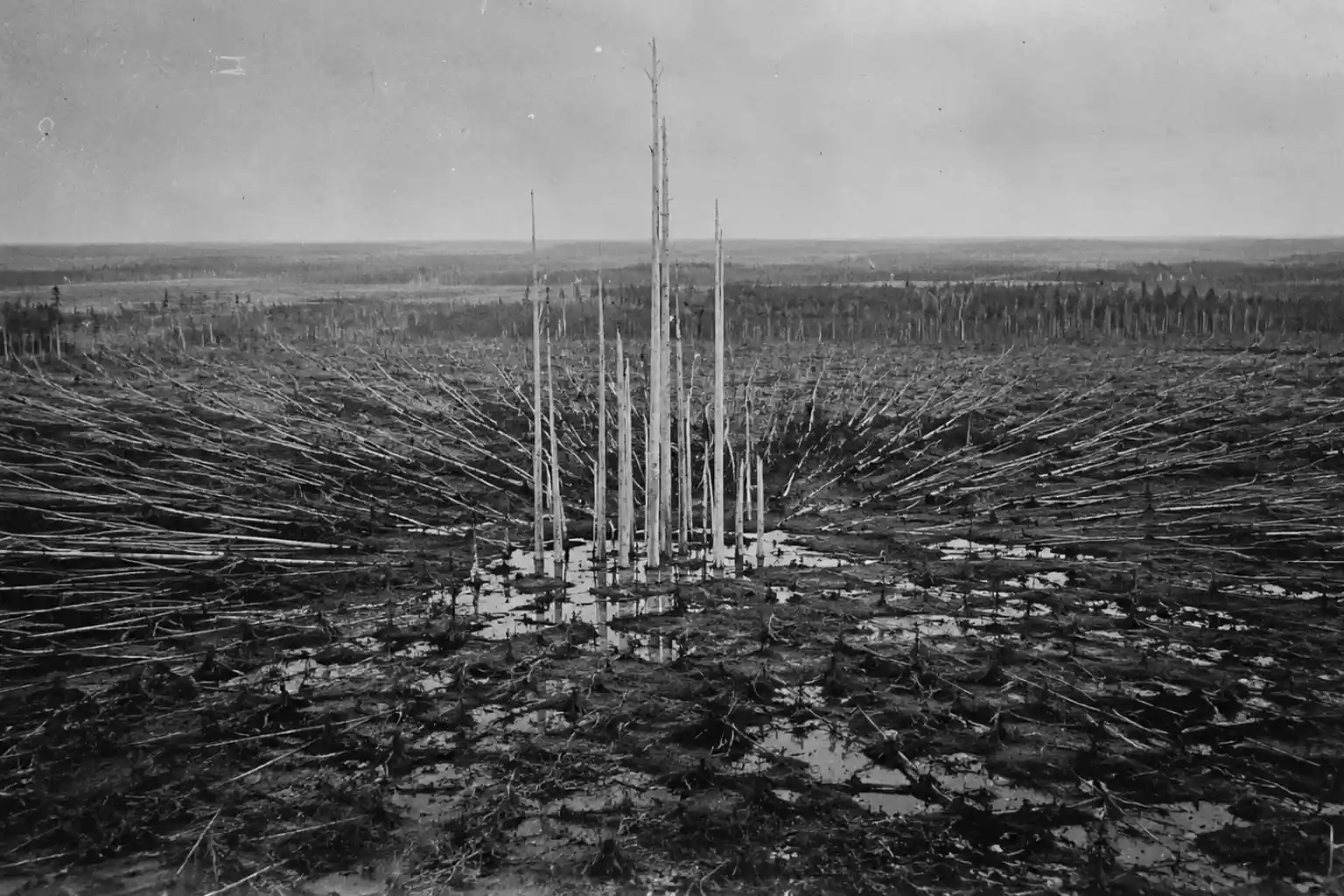
We know a massive explosion happened in the Siberian taiga in 1908. The shock reached the rest of the world long before anyone saw the site. Barographs in Washington registered the pressure wave. People in London sat outside and read newspapers at midnight by the glow of abnormal atmospheric clouds.
The global data proves a catastrophic impact occurred.
But when investigators finally walked into the epicentre 19 years later, they found 20 million flattened trees and zero impact crater. The physical evidence simply stopped making sense the moment they arrived.
DATA MANIFEST
- Primary Investigation: The 30 June 1908 Tunguska event, a 10 to 15 megaton atmospheric detonation over the Siberian taiga that flattened 2,150 square kilometres of forest yet left absolutely no impact crater.
- Key Anomalies Documented: Peat columns containing conflicting chemical markers for both a rocky asteroid and an icy comet; unusual twilight disturbances recorded in Europe a full week before the explosion; completely incompatible eyewitness trajectory reports.
- Primary Sources Utilised: Global seismograph and microbarograph readings; European observatory ledgers; witness testimony from Sergei Semenov; findings from Leonid Kulik's 1927 expedition; scanning electron microscopy of 1908 soil layers.
Glossary
- Airburst: An explosion of a meteor or comet that happens high in the atmosphere, rather than upon hitting the ground.
- Bolide: An extremely bright meteor that often explodes in the sky.
- Noctilucent Clouds: Rare, glowing clouds made of ice crystals that form very high in the Earth's atmosphere and reflect sunlight long after sunset.
- Shocked Quartz: Ordinary sand or rock grains that have been permanently deformed under immense, explosive pressure.
- Taenite: A specific blend of iron and nickel found almost exclusively in meteorites that fall from space.
The Global Shockwave
Let’s look at the actual seismograph readings first. On 30 June 1908, instruments across Eurasia registered a physical shock matching a magnitude 5.0 earthquake. They pinned the detonation at exactly 7:17 AM local time. Those readings anchor the exact coordinates near the Podkamennaya Tunguska River, deep in the taiga.
The physical shock did not stop at the ground. A vast air wave rippled out from the epicentre, triggering microbarographs across Western Europe and propagating across the entire hemisphere.
This was an atmospheric detonation of staggering scale. Modern estimates, drawing on that global barometric data, place the energy output between 10 and 15 megatons of TNT. That is roughly a thousand times more powerful than the atomic weapon dropped on Hiroshima.
The global propagation of this infrasound wave proves a huge atmospheric explosion took place. British meteorologist F.J.W. Whipple left behind specific UK microbarograph recordings, but tracing the exact profile of the primary wave across the rest of the hemisphere relies on fragmented observatory logs from that morning.
Atmospheric Detonation Scale
Modern estimates drawing on global barometric data
Estimated Energy Output
10–15
Megatons of TNT
Comparative Power
1000x
Hiroshima Weapon
The Witness Contradictions
Ground zero was sparsely populated, so we have to rely on the testimonies of people located dozens of kilometres away. Farmer Sergei Semenov provided a vital timeline anchor from his trading post 65 kilometres away. He described an intense wave of heat that felt as though his shirt had caught fire, followed moments later by a blast of air that threw him off his porch.
This separation of thermal radiation and physical shock is the classic signature of an object exploding high in the air.
But then we try to map the object itself, and the physical reality falls apart. We have deeply conflicting trajectory reports from different villages. Some witnesses swore the object flew from southeast to northwest, while others claimed it dropped directly from ‘top to bottom’.
We can’t even agree on the basic shape of the object. An observer up in N-Karelinskoe swore they saw a white-bluish cylindrical ‘pipe’ dropping from the sky.
Meanwhile, people further out reported seeing a diffuse bright ball.
Nobody has managed to build a single, geometrically possible flight path from these testimonies. That missing consensus means the trail back into space goes completely cold.
Witness Contradictions
| Observation Type | Witness Account A | Witness Account B |
|---|---|---|
| Flight Trajectory | Flown from southeast to northwest | Dropped directly from 'top to bottom' |
| Physical Shape | White-bluish cylindrical 'pipe' | Diffuse bright ball |
Kulik’s Ground Zero and the Missing Crater
It took 19 years for a scientist to finally reach the impact zone. Mineralogist Leonid Kulik walked into the Siberian taiga in 1927 and discovered a scene of total devastation. A radial tree fall stretched across roughly 2,150 square kilometres of forest, later mapped into a distinct ‘butterfly’ shape.
Here is the strange part about the exact centre of the blast zone. The trees at the very heart of the devastation simply were not flattened.
Kulik found an 8-kilometre patch where the trees stood perfectly upright, stripped entirely of their branches and bark. These scorched ‘telegraph poles’ prove the destructive force rushed straight down from the sky.
Kulik searched obsessively for a physical rock. He drained bog-filled depressions, like the so-called ‘Suslov’s crater’, hoping to find a chunk of iron. He found nothing but an old tree stump sitting in the mud at the bottom. We know an extensive aerial photographic survey mapped the central zone in 1938. But those 1,500 original high-resolution nitrate negatives are completely missing from the modern archives.
The central paradox of this event was established right there in the mud. A 15-megaton blast hit the ground, yet the primary impact crater simply does not exist.
Support the Archive
Help fund the retrieval, hosting, and preservation of Veriarch investigations.
The Microscopic Schism
Since we lack a giant rock, the investigation has moved down to the microscopic level. Modern researchers pulling peat and soil columns from the 1908 layer found highly specific damage. Scanning electron microscopy revealed a state of permanent crystal deformation known as shocked quartz.
These lattice distortions require intense physical pressure, usually between 2 and 10 Gigapascals.
That level of force normally demands a direct hypervelocity impact. Getting those pressures from a blast 10 kilometres in the sky is physically contradictory.
Look at the chemical traces embedded in that same dirt. An international team found nano-inclusions of troilite and taenite (a specific iron-nickel alloy found in meteorites) trapped inside high-pressure carbon. These are the classic fingerprints of a heavy, rocky asteroid.
But the very same 1908 peat columns hold elevated ratios of carbon-13 and deuterium. Those isotopic signatures are textbook markers for an icy cometary body.
We have the chemical markers for an ice body and a rock body sitting right next to each other in the ground. The exact composition of the object remains locked inside these conflicting soil columns.
The Microscopic Schism
Conflicting material evidence found at the exact same soil depth
Asteroid Model Fingerprints
Lattice distortions requiring 2 to 10 Gigapascals of physical pressure, usually demanding a direct hypervelocity impact.
Nano-inclusions of troilite and taenite trapped inside high-pressure carbon.
Comet Model Signatures
Elevated ratios of carbon-13 and deuterium matching an icy body.
The Asteroid versus Comet Deadlock
Scientists are effectively split between two physical models. Current hydrocode entry simulations strongly support the stony asteroid hypothesis. Plugging the 2013 Chelyabinsk airburst data into the Tunguska models shows a 50-metre rock exploding at altitude perfectly matches the ground damage.
Water presents a major problem for this theory. A rocky asteroid cannot explain the huge injection of water vapour required to create the ‘bright nights’ observed across Europe.
Only the sudden vaporisation of a water-rich comet can generate that volume of high-altitude noctilucent clouds made of ice crystals.
Which brings us to the strangest data point in the entire archive. European observatory ledgers show unusual solar halos and twilight disturbances beginning on 22 June.
That was a full week before the explosion in Siberia.
Neither a standard rock nor an icy comet explains how the atmosphere reacted days before the object actually arrived. That chronological gap breaks both models. We have absolutely zero physical evidence connecting those 22 June European halos to the Siberian blast.
Chronological Anomaly
-
22 June 1908
European Atmospheric Disturbances
Unusual solar halos and twilight disturbances begin across European observatories, a full week before the object arrives.
-
30 June 1908
The Tunguska Detonation
A 15-megaton blast flattens roughly 2,150 square kilometres of Siberian taiga at exactly 7:17 AM local time.
Source
Sources include: ‘The 1908 Tunguska Event and Bright Nights’, arXiv (2025); ‘The 1908 Tunguska event: analysis of eyewitness accounts of luminous phenomena collected in 1908’, arXiv (2023); ‘New Evidence of High-Temperature, High-Pressure Processes at the Site of the 1908 Tunguska Event’, ResearchGate (2025); ‘Tunguska: a cosmic airburst paradigm’, British Astronomical Association; and ‘115 Years Ago: The Tunguska Asteroid Impact Event’, NASA.
Claim-Source Matrix
| Core Finding | Primary Source Document | Status |
|---|---|---|
| 1908 peat layers contain both iron-rich meteoritic minerals and cometary isotopic signatures | New Evidence of High-Temperature, High-Pressure Processes (ResearchGate) | Confirmed |
| Unusual twilight anomalies observed across Europe starting on 22 June, a full week before the blast | The 1908 Tunguska Event and Bright Nights (arXiv) | Confirmed |
| Deeply conflicting trajectory reports ranging from SE-to-NW to top-to-bottom | Analysis of eyewitness accounts of luminous phenomena (arXiv) | Confirmed |
| The 1927 discovery of the 2,150 sq km radial 'butterfly' tree fall | Exploring the site of the Tunguska impact (ResearchGate) | Confirmed |
| The Soviet Committee on Meteorites order the destruction of the 1938 high-resolution aerial negatives in 1975 | None | Unclear/Unsupported |
What we still do not know
- The exact composition of the primary object, as microscopic soil traces point to a rock while atmospheric effects point to ice.
- What actually caused the unusual solar halos and twilight disturbances observed in Europe a full week before the explosion.
- Whether Lake Cheko is genuinely a secondary fragment impact site or simply an older thermokarst depression.
- The actual entry trajectory of the object, as the surviving eyewitness accounts remain geometrically impossible to reconcile into a single flight path.
- How planar deformation features (shocked quartz) formed in the ground when the primary explosion occurred 10 kilometres in the air.
Comments (0)