
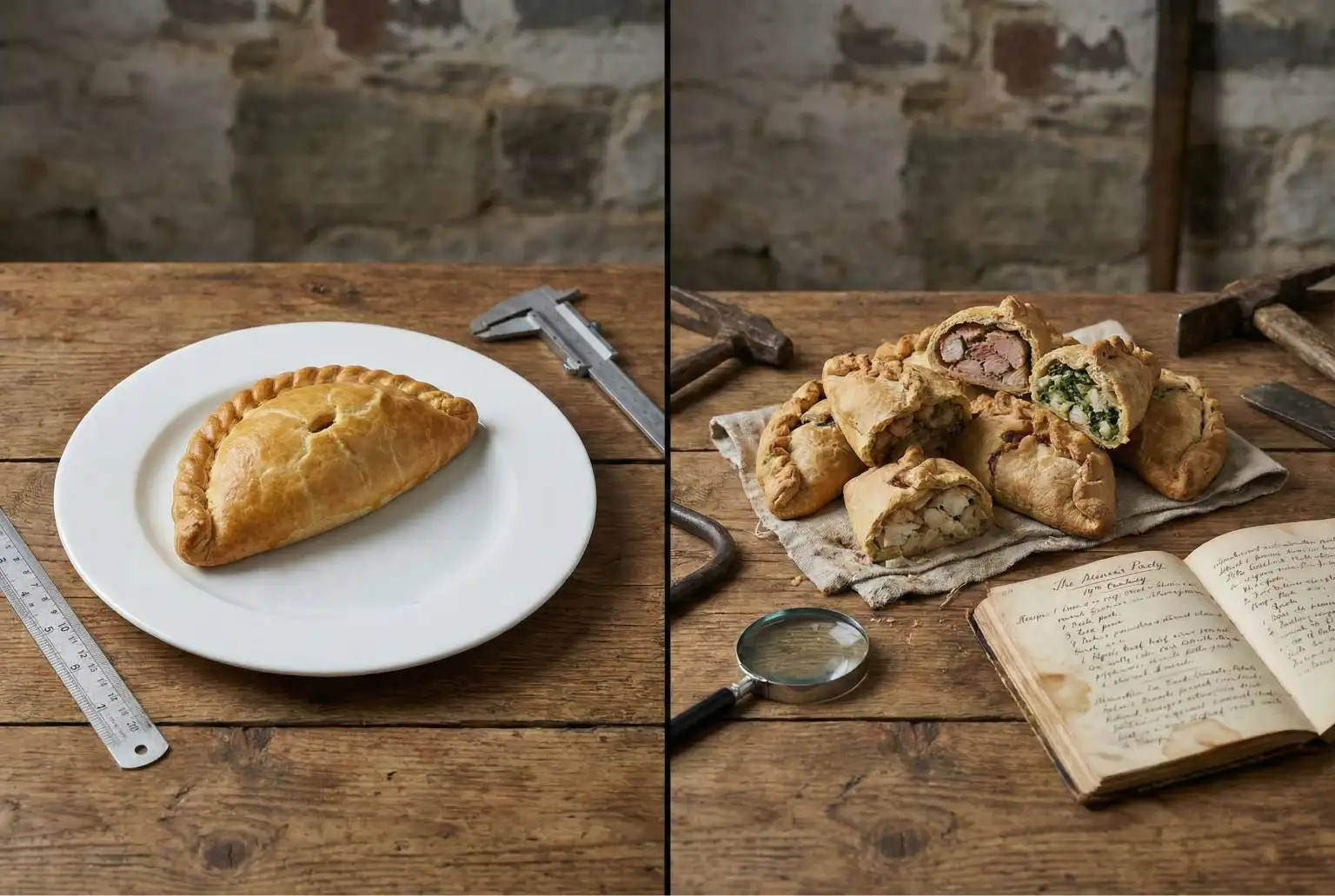
In 2011, the European Commission ruled that a genuine Cornish Pasty must contain beef, swede, potato, and onion. This legal definition, enforced by the Department for Environment, Food & Rural Affairs (DEFRA), was designed to protect a regional heritage product from imitation. But if you took this ‘State Pasty’ back to a tin mine in 1862, the workers likely would not recognise it. They certainly could not have afforded it. A review of over 500 pages of Victorian mining testimonies, wage logs, and primary correspondence reveals that the law designed to protect history has effectively outlawed the miner’s actual daily reality.
Terminology
- Tribute System: A payment method where miners bid for a 'pitch' of the mine and were paid based on the quality of ore extracted rather than hours worked, leading to extreme household income volatility.
- Truck System: A practice where mine owners paid workers in credit restricted to the company store, which often resulted in the purchase of inferior, inflated, or 'tainted' meat.
- Tiddy Oggy: A meatless pasty variation filled with potato, onion, and occasionally cream. Eaten frequently during hard financial times.
- Licky Pasty: A seasonal spring pasty filled predominantly with leeks and sometimes a scrap of bacon, consumed when stored winter root crops were depleted.
What the PGI ‘Cornish Pasty’ Definition Requires
To understand where the history diverges from the law, we must first establish the control constraints. In 2011, the Cornish Pasty was granted Protected Geographical Indication (PGI) status. PGI is a legal status granted by the UK or EU to protect the names of regional foods, requiring them to be made in a specific area using specific methods. This was not merely a label or a marketing exercise. It was a legislative act that froze a specific iteration of a fluid cultural product in time, declaring all other variations illegitimate under the protected name.
The specification registered with the European Commission is explicit regarding ingredients.
To be sold as a Cornish Pasty, the product must contain roughly diced or minced beef, constituting at least 12.5 per cent of the whole pasty. The document explicitly excludes all other meats, such as pork or mutton, from being the primary filling. This creates a ‘Beef Hegemony’ within the legal framework where only one protein is recognised as authentic.
The regulations are equally prescriptive regarding vegetables. The filling must consist of sliced or diced potato, swede (often called turnip in Cornwall), and onion. The vegetable content must make up at least 25 per cent of the pasty. The text strictly forbids carrots, citing them as a deviation from tradition. This rule codifies a specific botanical profile and rejects the opportunistic nature of 19th-century cooking.
The statute also locks down the construction.
To pass the legal test, a pasty must be ‘D’ shaped and crimped on the side. Top crimping is explicitly non-compliant. The official application argues this specific shape isn’t arbitrary. It claims the design evolved to meet the practical needs of the Cornish tin miner working underground. By linking the PGI directly to industrial history, the law insists its definition is authentic because it served a functional purpose for the 19th-century workforce.
The Legal Compliance Checklist
-
Beef (Minced/Diced)
Status: MANDATORY. Must constitute minimum 12.5% of total weight.
-
Pork / Mutton / Fish
Status: FORBIDDEN. Cannot be the primary filling under PGI rules.
-
Swede, Potato, Onion
Status: MANDATORY. Must constitute minimum 25% of total weight.
-
Carrot
Status: FORBIDDEN. Cited as a 'non-traditional' deviation.
The Earliest ‘Cornish’ Recipe is Mutton
The assertion that beef is the sole traditional filling faces immediate challenges from the primary historical record. The earliest known recipe for a ‘pasty’ in Cornwall appears in a letter dated 1746. The correspondence was sent by Jane Barriball to John Tremayne of Heligan, a prominent Cornish estate.
Barriball’s instructions do not mention beef. Instead, she specifies a ‘Leg or Jigget of Mutton’. The meat was to be seasoned with mace, cloves, and allspice. This document establishes that the oldest written record of a Cornish pasty describes a product that would be illegal to sell under that name today. The ‘original’ pasty, insofar as the archival record shows, was a mutton dish.
This trend of non-beef fillings in early records suggests the dish began as a high-status meal rather than a working-class staple. Historical cookery books from the early 18th century, such as Edward Kidder’s receipts from 1720, describe pasties containing venison and lamb. These recipes include complex seasonings like port wine and expensive spices. Such ingredients place the early pasty firmly on the tables of the gentry.
The move to beef came later. It likely marks the moment where the dining habits of the gentry collided with the industrial wages of the 19th century. By insisting that beef is the only ‘real’ filling today, the PGI ignores the mutton evidence sitting in the Heligan archives. It protects a snapshot of the dish from the mid-Victorian era, rather than its actual origin.
The Timeline of Exclusion
-
The First Record
1746Jane Barriball writes to John Tremayne detailing a pasty recipe using a 'Leg or Jigget of Mutton'.
-
The Gentry's Menu
1720Edward Kidder publishes receipts for Venison and Lamb pasties with port wine and spices.
-
The Standardisation Event
2011DEFRA/EU PGI status comes into force, mandating beef and excluding mutton, rendering the 1746 recipe non-compliant.
Could Mining Wages Support Daily Beef?
If we accept the PGI premise that the pasty was the ‘miner’s food’, we must test whether the miner could afford the mandatory ingredients.
In 1850, the average weekly wage for a surface labourer in the Cornish mining industry was approximately 10 to 12 shillings. Income was often erratic due to the Tribute System, a payment method where miners bid for a ‘pitch’ of the mine and were paid based on the quality of ore extracted rather than hours worked. This led to extreme volatility in household income.
Market price catalogues from the same period list beef at 6d (six pence) to 8d per pound. A single pound of beef would therefore cost approximately 5 per cent of a surface labourer’s total weekly wage. For a miner with a family to feed, providing daily pasties containing the requisite amount of quality beef would have been economically damaging. The maths suggests that beef was a luxury, not a daily staple.
The quality of meat available to miners further complicates the PGI’s requirement for ‘roughly diced or minced beef’ of good standing. Many mines operated a Truck System, a practice where mine owners paid workers in credit that could only be spent at the company store. Historical reports on these stores indicate that they often sold inferior goods at inflated prices. Complaints of ‘tainted meat’ and ‘foul and rotten’ provisions were common.
The meat that went into a 19th-century pasty was likely not the prime cuts implied by modern standards. It was whatever low-grade, salted, or preserved meat could be obtained from the truck shop or local market. The PGI definition assumes a level of dietary stability and purchasing power that the historical wage data does not support.
Purchasing Power Audit (1850)
| Metric | 1850 Value | Impact on PGI Compliance |
|---|---|---|
| Average Weekly Wage | 10–12 Shillings | Highly limited disposable income. |
| Cost of Beef (1 lb) | 6d–8d (Pence) | High Cost ~5% of weekly wage per lb. |
| Cost of Pig (Upkeep) | Negligible (Scraps) | Low Cost Pig provided virtually free protein. |
| Economic Feasibility | Low for Beef | Daily beef consumption was mathematically impossible for most families. |
Pork Looks Like the Everyday Protein
While beef was financially out of reach for daily consumption, the pig was ubiquitous. Nineteenth-century cottage economy data indicates that the pig was the primary protein source for the Cornish working class. Miners frequently kept pigs on smallholdings or allotments, feeding them on household scraps and garden waste. The pig was affectionately referred to as ‘the gentleman who pays the rent’, but in dietary terms, it was the engine of survival.
This reality is confirmed by witnesses to the Royal Commission on the Employment of Children in 1842. Testimonies stated that pork was ‘more commonly eaten in the mining districts than beef or mutton, because many of the miners kept their own pigs’. This primary evidence directly contradicts the beef exclusivity of the modern PGI. The daily diet was driven by the ‘Pig Economy’, where protein was home-reared and cured, rather than purchased.
Dr Philip Vincent, a surgeon to the mines in the Camborne district, provided further clarity in his testimony to the Royal Commission on the Condition of Mines in 1862. He described the miner’s diet as irregular and dependent on the pay cycle. ‘One day he will have his beefsteak or his good living,’ Vincent testified, ‘and the next day he will have his porridge… and they only throw in a bone or perhaps a little bit of pork’.
Vincent makes the distinction clear.
Beef was a rarity, saved for paydays, while salted pork was the fuel for the rest of the week. By mandating beef, the PGI defines the pasty by the miner’s occasional luxury rather than his daily survival. The law has effectively taken the special occasion meal and enforced it as the only legal standard.
"One day he will have his beefsteak or his good living, and the next day he will have his porridge... and they only throw in a bone or perhaps a little bit of pork."
Dr. Philip Vincent, Testimony to the Royal Commission on the Condition of Mines, 1862The Pasties the PGI Definition Leaves Out
The strict 12.5 per cent meat rule effectively deletes a major part of the culinary record.
Historical accounts list plenty of pasties that would fail this modern test, mostly because they contained no meat at all. These were the staples of lean months, eaten when the pig was still alive or the money had run out.
The most famous of these is the Tiddy Oggy. ‘Tiddy’ is the Cornish dialect word for potato. This pasty contained no meat at all, filled instead with potato, onion, and perhaps a knob of butter or cream if available. It was the definitive ‘miner’s lunch’ during hard times, yet it cannot legally be sold as a Cornish Pasty under current regulations due to the lack of beef.
Another common variant was the ‘Licky Pasty’, which contained primarily leeks and sometimes a scrap of bacon. These were a staple in the spring when stored root vegetables were running low and new leeks were available. The PGI’s ingredient list fails to account for this seasonal and opportunistic nature of the 19th-century diet.
Then there is the confusion over the swede. The PGI mandates swede, potato, and onion, relying on the fact that ‘turnip’ in Cornish dialect usually meant the yellow Swedish variety. The problem is that the regulations turn this linguistic quirk into a hard rule. This overlooks the opportunistic nature of 19th-century allotments, if white turnips or carrots were what the ground yielded, that is what went into the lunch. The law protects a specific list, but it rejects the reality of a working pantry.
Extinct Species
Historical variants erased by the 12.5% Beef Rule
The Tiddy Oggy
The 'Potato Pasty'. A staple of the poor, now legally non-compliant due to lack of beef.
The Licky Pasty
A spring staple using seasonal leeks. Excluded by the beef mandate.
The Herby Pasty
Utilised parsley, shallots, and wild garlic. Non-compliant due to ingredient list.
What This Means for the ‘Traditional’ Claim
The data indicates that the PGI status for the Cornish Pasty is less a preservation of history and more a ‘Standardisation Event’. It functions as a commercial definition for the 21st-century market rather than an accurate reflection of 19th-century life. The primary driver for the status was economic protectionism against industrial imitators outside Cornwall. To achieve this, the Cornish Pasty Association required a definable, enforceable standard.
They selected the ‘Sunday Best’ version – beef (the aspirational meat) and swede (the distinctive local vegetable). By excluding pork, seasonal greens, and vegetarian fillers, the PGI effectively erases the ‘poverty pasty’ which constituted the actual dietary energy intake of the 19th-century miner for the majority of their working life.
The result is a paradox. The ‘Cornish Pasty’ as defined by law is a legitimate regional product, but it is an upmarket subset of the broader tradition. It represents what the miner wanted to eat, not necessarily what he did eat. The PGI status protects the reputation of the product but sanitises its history, presenting a simulation of a feast-day meal as a daily standard.
The Divergence
Historical Reality (1840-1900)
Pork (The Pig Economy)
Vegetarian/Pork Daily. Beef on Feast Days.
Opportunistic (Allotment/Scraps)
Legal Reality (2011-Present)
Beef Only (12.5% Minimum)
Feast Day Standard codified as Daily Rule.
Prescriptive (Swede/Potato/Onion only)
Sources
Sources include: legal specifications from the 2011 European Commission Protected Geographical Indication (PGI) ruling; the 1746 letter from Jane Barriball to John Tremayne held in Cornish estate archives; 18th-century cookery books including Edward Kidder’s Receipts (1720); primary witness testimonies from the Royal Commission on the Employment of Children (1842) and the Royal Commission on the Condition of Mines (1862); 19th-century mining wage logs and market price catalogues; cottage economy data regarding pig ownership in mining districts; and medical evidence provided by Dr Philip Vincent regarding the diets of miners in the Camborne district
Forensic Claim Matrix
| Public Narrative | Primary Evidence | Status |
|---|---|---|
| Beef is the original, authentic meat filling. | 1746 Heligan letter specifies mutton; 1720 receipts list venison and lamb. | Contradicted |
| Beef was the everyday working-class standard. | 1842 and 1862 Royal Commissions confirm salted pork was the daily fuel due to the local 'Pig Economy'. | Contradicted |
| Carrots deviate from the historical tradition. | 19th-century cottage economy relied strictly on opportunistic root vegetable crops without absolute exclusion. | Unsubstantiated |
| The dish originated as a miner's lunch. | Early 18th-century recipes locate the dish firmly on the tables of the gentry before the industrial wage collision. | Contradicted |
What we still do not know
- The Turnip Transition: When exactly did the yellow swede become the mandatory 'turnip' of the pasty? Early records show white turnips were grown, but the exact date of standardisation remains unclear.
- The Quality of Truck Meat: We lack specific invoices detailing the cut of meat sold in company stores. Was it flank, skirt, or offal? The term 'beef' in 1860 might imply a very different product to 'beef' in 2011.
- The Survival of the Tiddy Oggy: While recipes exist, we do not know when the 'Tiddy Oggy' fell out of favour as a commercial item. Did it disappear because of rising affluence, or was it simply never sold because it was a home-only poverty meal?
Comments (0)