

The European Commission legally declared that a ‘Cornish Pasty’ must be prepared in Cornwall to carry the name. The ruling granted the county an intellectual property monopoly worth approximately £300 million per year, securing the product’s status alongside Champagne and Roquefort cheese. Yet, locked in a municipal vault in Plymouth, a handwritten ledger from 1510 lists the cost of ‘making the pasties’ for a civic feast. This record predates the earliest cited written evidence from Cornwall by 236 years.
We investigate whether the law has protected a unique regional heritage or successfully annexed a shared national history.
Terminology
- PGI (Protected Geographical Indication): A legal status enforcing a rigid definition on food production, locking revenue inside a specific geographic boundary based on assembly location.
- Coffin Pastry: A dense, structural 16th-century pastry designed as a utilitarian baking vessel to preserve meat, rather than for direct consumption.
- Pastillis: The Latin term for pasties, documented in the 1208 Great Yarmouth charter.
- Rutabaga: The botanical name for the swede, a root vegetable adopted in Britain between 1780 and 1800.
What the 2011 Cornish Pasty PGI Rule Actually Protects
To understand the conflict between Devon and Cornwall, we must first audit the legal structure that defines the battlefield.
The Cornish Pasty functions as a piece of intellectual property rather than merely a description of a lunch item. This Protected Geographical Indication (PGI) status, awarded after a nine-year campaign by the Cornish Pasty Association, enforces a rigid definition on the food industry. The 2011 specification sets a compliance test, and producers outside Cornwall cannot use the protected name.
The economic stakes behind this definition are substantial. This is not a cottage industry. Pasty production is the largest manufacturing sector in Cornwall, worth £300 million a year and holding 2,000 permanent jobs. The PGI status serves as a financial firewall. It locks that revenue inside the county, even though the beef and vegetables can legally come from anywhere on earth. The Commission Implementing Regulation (EU) No 717/2011 explicitly states that while the assembly must occur in Cornwall, the beef and vegetables can be imported from anywhere. The ‘link with the geographical area’ relies on the reputation of the bakers rather than the place-based qualities of the raw materials.
This legal rigidity created immediate casualties.
Greggs, the largest bakery chain in the UK, was forced to rename its product to ‘Beef and Vegetable Pasty’ because its centralised production facilities are located outside the county. More significantly, the ruling impacted Devon producers who had used the term to describe the style of the product for decades.
Chunk of Devon, a producer based in Ottery St Mary, had won the Cornish Pasty category at the British Pie Awards in 2009. Following the 2011 enforcement, they were barred from using the name. They rebranded their product to ‘Steak Pasty,’ despite the recipe and method remaining identical. The law polices the map coordinates of the oven, not the quality of the output.

The Plymouth Ledger Entry From 1509 to 1510
The legal monopoly rests on the narrative that the pasty is intrinsically Cornish. But a document identified by historian Dr Todd Gray in 2006 creates a problem for this timeline.
The Audit Book and Receivers Accounts for the Borough of Plymouth (Ref 1/130) contains a specific entry for the financial year 1509–1510. The text, recording the expenses for a civic feast at the Guildhall, lists the costs for labour and materials.
The transcript is explicit. It records 10 pence paid ‘for the Cooke is labour to make the pafties’. It further lists 8 pence ‘for the bakynge ther of’. This entry proves that the word ‘pasty’ and the object itself were established in the Plymouth vernacular during the reign of Henry VIII. This predates the document traditionally cited by the Cornish Pasty Association, the Lescudjack poverty inventory of 1746, by more than two centuries.
A forensic analysis of the ingredients listed in the audit book reveals a dish that differs significantly from the modern miner’s lunch. The filling is identified as ‘venyfun’ (venison) from ‘ij bukks’ (two bucks) gifted by Sir Piers Edgcumbe. The entry also includes ‘a pownde of pep[per]’ costing 14 pence, a sum significantly higher than the cook’s wages. This heavy use of expensive spice and restricted game meat identifies the 1510 Devon pasty as a luxury feast item.
The cost of the flour, recorded at 2 shillings 4 pence, suggests the use of a dense, structural pastry often called a ‘coffin’.
In the 16th century, such pastry was a utilitarian baking vessel designed to preserve the meat, rather than the delicate shortcrust intended for consumption in the modern PGI version. While Devon possesses the earliest written record of the name, the object described is a high-status banquet pie. This complicates the claim that they invented the working-class staple.
Exhibit A: The Plymouth Audit Entry (1509–1510)
Itm for flowre to bake the venyfun of the ij bukks that Maister Eggcomb sende to the towne....... ij s iiij d
Itm for the Cooke is labor to make the pafties....... X d
Itm for a pownde of pep[per] to the same....... Xiiij d
Itm for the bakynge ther of....... viij d
A 1208 Charter Mentions Herrings Baked In Pasties
The investigation reveals a ‘Privileged’ source that predates the claims of both Devon and Cornwall. In 1208, King John granted a town charter to Great Yarmouth in Norfolk. The charter included a ‘fee-farm’ clause, a form of perpetual rent paid to the Crown.
The town was legally obligated to send an annual tribute to the King consisting of ‘One hundred herrings, baked in twenty-four pasties‘. The Latin text refers to these items as pastillis. The logistics were precise. The town delivered the pasties to the Sheriffs of Norwich, who passed them to the Lord of the Manor of East Carlton, who conveyed them to the King.
This charter undermines any claim that the pasty format began in the West Country. It drags the origin point 350 miles east of the River Tamar. The dates are even more damning. 1208 is three centuries older than the Plymouth Audit and five centuries before the first Cornish record. The language also matches the French pasté found in 13th-century cookbooks like Le Viandier. This proves the pasty was not a unique regional invention, but a standard medieval method for baking meat in a crust. The Cornish pasty is just the last survivor of a national habit.
The Pasty Timeline
-
1208 AD
The Norfolk Anomaly
King John grants the Great Yarmouth Charter. The town pays an annual rent to the Crown of "one hundred herrings, baked in twenty-four pasties". This confirms the pasty as a generic national item 302 years before the Plymouth record.
-
1510 AD
The Plymouth Protocol
The Plymouth Audit Book records the cost of "making the pasties" (10d) for a Guildhall feast. The ingredients include venison and pepper, showing the dish existed in Devon 236 years before the accepted Cornish timeline.
-
1746 AD
The Lescudjack Inventory
The earliest cited written record of the pasty appears in Cornwall. This date aligns with the agricultural introduction of the potato and swede, suggesting the 'Cornish pasty' is a specific late-18th-century adaptation of the older medieval dish.
The Vegetable Timeline Problem
Devon wins the battle for the name, but the botanical record supports the Cornish claim to the product. The PGI definition of a Cornish Pasty strictly mandates the inclusion of potato and swede.
The ‘Devon Pasty’ of 1510 failed this standard. The potato was not a widespread field crop for the working class in the South West until the mid-to-late 18th century. The swede, or rutabaga, arrived in Britain even later, around 1780 to 1800. Consequently, the venison pasties recorded in the Plymouth Audit lacked the cheap fuel that defines the modern dish.
The 1746 date cited by Cornish historians aligns with the agricultural adoption of these root vegetables. This suggests that the ‘Cornish Pasty’ as a protected legal entity (beef, potato, swede, onion) is a specific culinary invention of the late 18th century. It evolved from the generic medieval meat pie into a high-calorie miner’s meal only when the new crops became available.
The border conflict exists because both sides are confusing the ancient word with the modern recipe.
Recipe Audit: Botany vs. History
| Component | 1510 Plymouth Protocol (Devon) | 2011 PGI Standard (Cornwall) |
|---|---|---|
| Primary Protein | Venison (Game) "ij bukks" (Two deer) |
Beef (Skirt/Mince) Min. 12.5% meat content |
| Vegetables | Absent Pre-dates potato/swede agriculture |
Mandatory Potato, Swede (Turnip), Onion |
| Seasoning | Heavy Pepper Cost 14d (Luxury import) |
Salt & Pepper Standard seasoning |
| Function | Civic Feast Luxury item for Guildhall |
Working Lunch Miner's staple / Industrial |
Crimp Style and the Problem of Local Variation
With the ingredients established, the ‘Border War’ shifts to the geometry, the crimp.
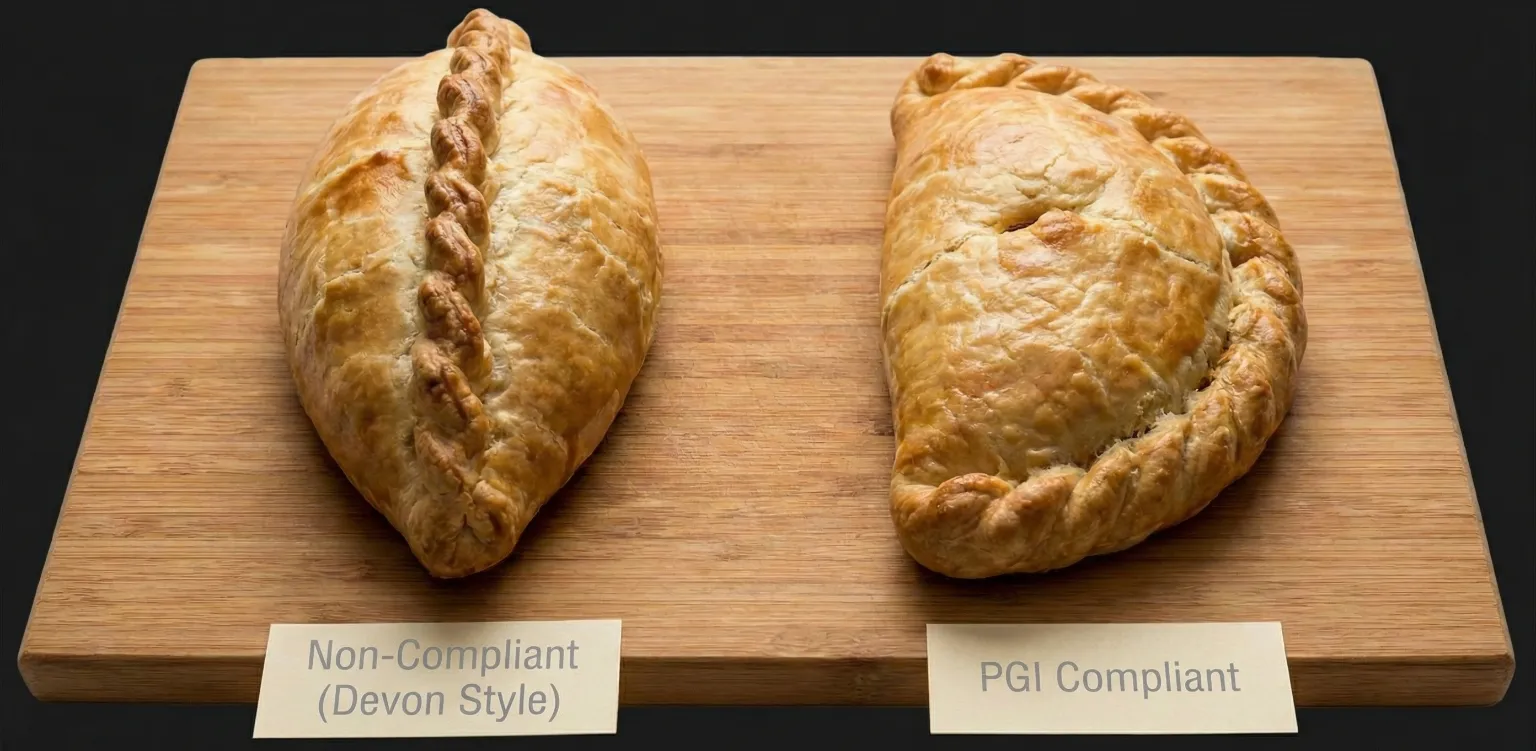
The PGI specification mandates that a Cornish Pasty must be crimped on the side, forming a ‘D’ shape. The ‘Devon Pasty’ is legally and culturally defined by a ‘top crimp’. The justification for the side crimp is the ‘Arsenic Alibi’, the theory that the crust served as a disposable handle for miners. (We debunked this theory in Part 2: The Arsenic Alibi, proving that miners used crib bags rather than discarding crusts).
This distinction appears to be a legal fiction that erases internal Cornish history. Ann Muller, a celebrated pasty maker from the Lizard Peninsula in Cornwall, argues that top crimping was the standard tradition in her family for generations. ’Our grandmothers, great grandmothers, relatives and neighbours all crimped in the same over the top fashion,’ she stated.
Photographic evidence from the late 19th century corroborates this, showing Cornish subjects holding pasties with top crimps. The variation is regional, not county-wide. In farming and fishing communities like the Lizard, where arsenic contamination was not a risk, the top crimp was common. By codifying the ‘side crimp’ as the only authentic method, the PGI application effectively ceded the top crimp to Devon. The regulations simplified a complex map of community traditions into a binary tool for market enforcement.
Who Benefits from the Protected Name?
The exclusion of the top crimp and the Plymouth history serves a clear commercial purpose. The PGI status is a mechanism for economic protectionism. While the application speaks of ‘traditional know-how,’ the specification contains loopholes that favour industrial manufacturing. Specifically, the allowance for ‘minced or roughly cut chunks’ of beef accommodates the machinery of mass production.
Purists and artisanal makers argue that a true pasty requires skirt steak, but insisting on this would hinder the output of the largest factories.
Ginsters, the largest producer of Cornish pasties, is owned by Samworth Brothers, a company based in Leicestershire. Samworth Brothers also produces the Melton Mowbray Pork Pie, another PGI-protected product. Critics during the consultation phase argued that the PGI bid was supported by these industrial giants to lock out national competition.
The Greggs ban proves the barrier works. By blocking national giants, the PGI secures the £300 million market for those inside the county lines. But for small Devon bakers, stripping away the ‘Cornish’ label devastated their tourist trade. This is an economic conflict disguised as a heritage dispute. The prize is not historical accuracy, but the exclusive right to sell a shared tradition.
The Economic Barrier: PGI Financial Flow
How legal status translates into protected revenue and market divergence.
Step 1: The Legal Fortress
EU Law restricts the "Cornish Pasty" name exclusively to producers within Cornwall following specific specs.
Step 2: The Protected Market
Total trade value generated annually by the PGI-protected sector (largest manufacturing sector in Cornwall).
Outcome A: The Protected Zone (Inside the Moat)
Beneficiaries: Cornish ProducersYear-round manufacturing employment secured. Additionally, ~£15m spent annually with local farmers to bolster brand identity (though not legally required by PGI).
Outcome B: The Excluded Competitors (Outside the Moat)
Casualties: Devon Artisans & National ChainsCompetitors (e.g., Greggs, Chunk of Devon) legally barred from using the recognizable brand name, incurring marketing costs and losing tourist revenue.
Sources
Sources include: the Audit Book and Receivers Accounts for the Borough of Plymouth (1509–1510) identified by Dr Todd Gray; the 1208 Town Charter of Great Yarmouth granted by King John; Commission Implementing Regulation (EU) No 717/2011; economic impact reports published by the Cornish Pasty Association; botanical records tracing the introduction of the potato and swede to Britain; medieval culinary texts including Le Viandier; and commercial case histories involving Greggs, Chunk of Devon, and Ginsters.
Claim-Source Matrix
| Source Document | Date | Evidentiary Function |
|---|---|---|
| Great Yarmouth Borough Charter | 1208 | Proves the pasty was a standard medieval method for baking meat in a crust in Norfolk. |
| Plymouth Audit Book (Ref 1/130) | 1510 | Establishes the word and object in the Devon vernacular for civic luxury feasts. |
| Lescudjack Poverty Inventory | 1746 | Aligns with the agricultural adoption of root vegetables in Cornwall. |
| Commission Regulation (EU) No 717/2011 | 2011 | Codifies the specific regional assembly requirements and side-crimp for commercial monopoly. |
What we still do not know
- The Text of the 1746 Document: While the 1510 Plymouth Audit is public, the specific text of the 1746 Lescudjack inventory is not available in accessible digital archives. We cannot currently audit its ingredients list.
- The 'Turnip' Transition: The exact decade when the swede (rutabaga) replaced the white turnip in working-class Cornish diets remains undocumented.
- Medieval Devon Recipes: It is statistically probable that other 'pasty' references exist in unexamined Devon manorial rolls from the 14th century, which could bridge the gap between the 1208 Norfolk charter and the 1510 Plymouth entry.
Comments (0)