
On 27 July 1965, Lyndon B. Johnson told Senator Mike Mansfield in a private phone call that a 150,000-troop deployment to Vietnam would immediately necessitate a second, and eventually a third. Twenty-four hours later, he stood at a White House press conference and announced the first tranche.
Data Manifest
- Primary Investigation: Record-led analysis of private presidential recordings, declassified operational memoranda, and legislative transcripts between 1964 and 1973 to document the gulf between private leadership assessments and public statements during the Vietnam War.
- Key Anomalies Documented: A six-day interval between private admissions of ground unviability and public commitment in 1964; a twenty-four-hour gap between private sinking-cost forecasts and public escalation in 1965; FBI intercept records of back-channel interference in the 1968 Paris peace talks; a fourteen-month dual bookkeeping system and tape-burning protocol during Operation Menu in Cambodia; and a twenty-six-day interval between private acceptance of allied non-survivability and public claims of foreign policy resolve in 1972.
- Primary Sources Utilised: White House dictabelt recordings (27 May 1964); Miller Center Presidential Recordings (21 June 1965; 27 July 1965); FBI wiretap coverage reported via declassified LBJ tapes; the 20 November 1969 General Earle G. Wheeler memorandum initialled by Secretary of Defense Melvin Laird; Nixon Oval Office Tape 760-6 (3 August 1972); and the United States Congressional Record (Senate proceedings, 23 July 1973).
Glossary
- Sortie: One flight by one military aircraft on one mission. A single bomber flying to a target and returning counts as one sortie.
- Sanctuary (military): An area, usually just across a neutral border, where an enemy force can rest, resupply, or hide because the opposing side is publicly barred from attacking it.
- Back channel: An unofficial, private line of communication between two parties, used to bypass official diplomatic or governmental routes.
LBJ Private Doubts on Vietnam War Strategy
President Lyndon B. Johnson placed a phone call to Senator Richard Russell of Georgia at 10:55 a.m. on 27 May 1964. Russell chaired the Senate Armed Services Committee. Johnson’s own dictabelt recording system captured the whole conversation.
Russell told the president the situation in Vietnam was the worst mess he had ever seen. He said the local leadership in South Vietnam lacked responsibility and that the American public was not ready for a large ground deployment. Johnson replied that this had been his own feeling for six months.
That means Johnson had privately doubted the viability of the Vietnam commitment months before presenting the public case in firmer terms.
Six days later, on 2 June 1964, Johnson issued a public statement to the legislature on Southeast Asia policy. He set out four propositions, the first being that America keeps its word. None of the doubts from the Russell call appeared anywhere in the statement.
Johnson’s own recording habit is what preserved the private half of this timeline. The dictabelt was installed for administrative use, not for posterity.
Russell’s warning about the mismatch between American troops and jungle terrain sits on the audio in his voice. Johnson never used it publicly, and no draft speech in the released White House files shows him considering it later.
The Six-Day Gap: Private Assessment vs Public Commitment
-
27 May 1964, 10:55 a.m.
Private Call to Senator Richard Russell
Recorded on the White House dictabelt system. Senator Russell warns that South Vietnam's leadership lacks responsibility and the situation is the worst mess he has seen. President Johnson replies that this had been his own feeling for six months.
-
2 June 1964
Public Statement to the Legislature
Six days after the private call, President Johnson sets out four propositions on Southeast Asia policy, asserting first that America keeps its word. None of the private doubts regarding local leadership or ground viability appear in the text.
President Johnson and the Vietnam Escalation Strategy
Private White House tapes from mid-1965 reveal a president losing faith in the war’s strategic sustainability. Johnson spoke to Senator Birch Bayh on 15 June about the mismatch between American troops and an enemy able to wait out an ambush without food or water. He spoke to Robert McNamara on 21 June about domestic opposition growing as the casualty rate climbed.
Then came the Mansfield call.
On 27 July 1965, Johnson phoned Senator Mike Mansfield and set out the trap in plain language. His words describe a first 150,000 deployment forcing a second. And then a third after that.
He asked what the country would want to do six months down the line.
Twenty-four hours later, Johnson held a mid-day press conference at the White House. He announced an increase in forces from 75,000 to 125,000 personnel and a doubling of the draft call from 17,000 to 35,000 per month. His closing line was ‘We will stand in Viet-Nam’.
The private forecast of endless escalation, mapped out to Mansfield the previous evening, vanished from the official public narrative.
Two archival states sit in parallel. The Miller Center transcript preserves the mathematical warning in Johnson’s own voice, running to several pages. Naval Historical Command’s pamphlet preserves the public press-conference statement, including the troop and draft figures.
27 July vs 28 July 1965: Private Warning vs Public Stand
| Date and Channel | Private Forecast (Mike Mansfield Call) | Public Narrative (White House Press Conference) |
|---|---|---|
| 27–28 July 1965 White House |
Stated that a 150,000-troop deployment would immediately force a second, and eventually a third, asking what the country would want to do six months down the line. | Announced an increase from 75,000 to 125,000 personnel and a doubling of the monthly draft call to 35,000, closing with the statement 'We will stand in Viet-Nam'. |
Anna Chennault and the Paris Peace Talks Interference
Peace talks in Paris were making real progress by the summer of 1968. Hanoi was signalling concessions that would have allowed Johnson to call a full bombing halt.
Anna Chennault, a senior Nixon campaign adviser, acted as the primary intermediary. She acted as a back channel, an unofficial private line of communication used to bypass formal diplomatic routes. Smithsonian Magazine’s coverage of declassified Johnson tapes reports that in July 1968 the South Vietnamese ambassador visited Nixon’s New York apartment and was told Chennault spoke for the campaign.
The instruction came in late October. Chennault approached the South Vietnamese embassy in Washington and told the government to pull out of the Paris talks. She told them to refuse Johnson and wait for a Nixon deal.
South Vietnam pulled out on the eve of Johnson’s planned bombing halt announcement. Federal Bureau of Investigation wiretaps on the Saigon embassy and on Chennault’s own telephones caught the delivery of the message. Johnson chose not to expose the interference publicly. Smithsonian’s account of the declassified tapes says he expected Hubert Humphrey to win the election anyway, and that disclosure would have required admitting that the United States had been spying on the South Vietnamese ambassador. On the tapes, he used the word ‘treason’ to describe what Nixon had done.
The intercepts confirm the delivery of the message. The written instructions Chennault carried to the embassy, whether on paper or dictated to her by phone from campaign leadership, do not appear anywhere in the declassified file chain.
Back-Channel Routing: Paris Peace Talks Interference
South Vietnamese ambassador visits Richard Nixon's New York apartment and is informed that senior adviser Anna Chennault speaks for the campaign.
Anna Chennault instructs the South Vietnamese embassy to pull out of the Paris talks, refuse President Johnson, and wait for a deal under Nixon.
Federal Bureau of Investigation wiretaps on the Saigon embassy and Chennault's telephones capture the delivery of the instruction. President Johnson privately terms the action 'treason' on White House recordings but does not disclose it publicly to protect wiretap sources.
Operation Menu and Secret Cambodia Bombing Records
Operation Menu ran until 26 May 1970. Over those fourteen months, the Strategic Air Command flew 3,630 sorties, or bomber flights, and dropped more than 100,000 tons of explosives on North Vietnamese sanctuaries just inside Cambodia’s border.
These sanctuaries gave North Vietnamese forces places to rest resupply and hide just beyond the publicly declared limits of the war.
The request came from General Creighton W. Abrams, the senior American commander in Vietnam. Nixon authorised the use of B-52 heavy bombers against sanctuaries inside a country the United States publicly treated as neutral. Neither the Cambodian leadership nor the American legislature was told.
After the first strikes, the operational record split between the actual target data and falsified paperwork sent through official channels.
Every B-52 returning from a Cambodian mission carried flight computer tapes with the actual target coordinates and ordnance data. Declassified accounts of Operation Menu procedure describe a logistics officer named Major Knight collecting those tapes and destroying them in an incinerator. He then telephoned an anonymous official in Saigon with the phrase ‘The ball game is over’.
Air Force administrators back at the Pentagon received a separate, falsified set of paperwork. Those documents showed the bombs falling on routine targets inside South Vietnam. The Congressional Record confirms this was a designed system rather than an occasional lapse.
The written authorisation surfaced later. On 20 November 1969, seven months into the operation, General Earle G. Wheeler generated a top-secret memorandum recommending that B-52 strikes on Cambodian targets be paired with cover strikes on South Vietnam and Laos. The memorandum’s stated purpose was to provide ‘a resemblance to normal operations, thereby providing a credible story for replies to press inquiries’.
Secretary of Defense Melvin Laird initialled and approved the recommendation.
On 30 April 1970, Nixon addressed the American public on television to announce a ground operation in Cambodia. He told the country, as reproduced in the Congressional Record: ‘For five years, neither the United States nor South Vietnam has moved against these enemy sanctuaries because we did not wish to violate the territory of a neutral nation’.
The 3,630 sorties and 100,000 tons of explosives had crossed that border and struck those sanctuaries during the fourteen months immediately before he spoke.
The Wheeler memorandum survived because it was kept in classified files rather than in operational storage. The primary flight computer tapes it authorised did not survive at all. The memorandum’s full distribution list is not mapped in the released documents, and the lower-level commanders and database managers who processed the false entries are not fully identified.
Operation Menu: Dual Bookkeeping Chain (1969–1970)
100,000 tons of ordnance across 3,630 sorties concealed from the legislature and public
Real Operational Track
B-52 heavy bombers strike sanctuaries inside neutral Cambodia. Flight computer tapes record actual coordinates and ordnance expenditure.
Major Knight collects flight computer tapes on return and burns them in an incinerator, telephoning an anonymous official in Saigon with the code 'The ball game is over'.
Falsified Pentagon Track
A separate, falsified set of paperwork is generated and submitted to Air Force administrators, recording bombs falling on routine targets inside South Vietnam.
General Earle G. Wheeler generates a top-secret memorandum recommending cover strikes in South Vietnam and Laos to provide 'a credible story for replies to press inquiries'. Initialled and approved by Defense Secretary Melvin Laird.
Nixon and Kissinger Decent Interval Strategy Analysis
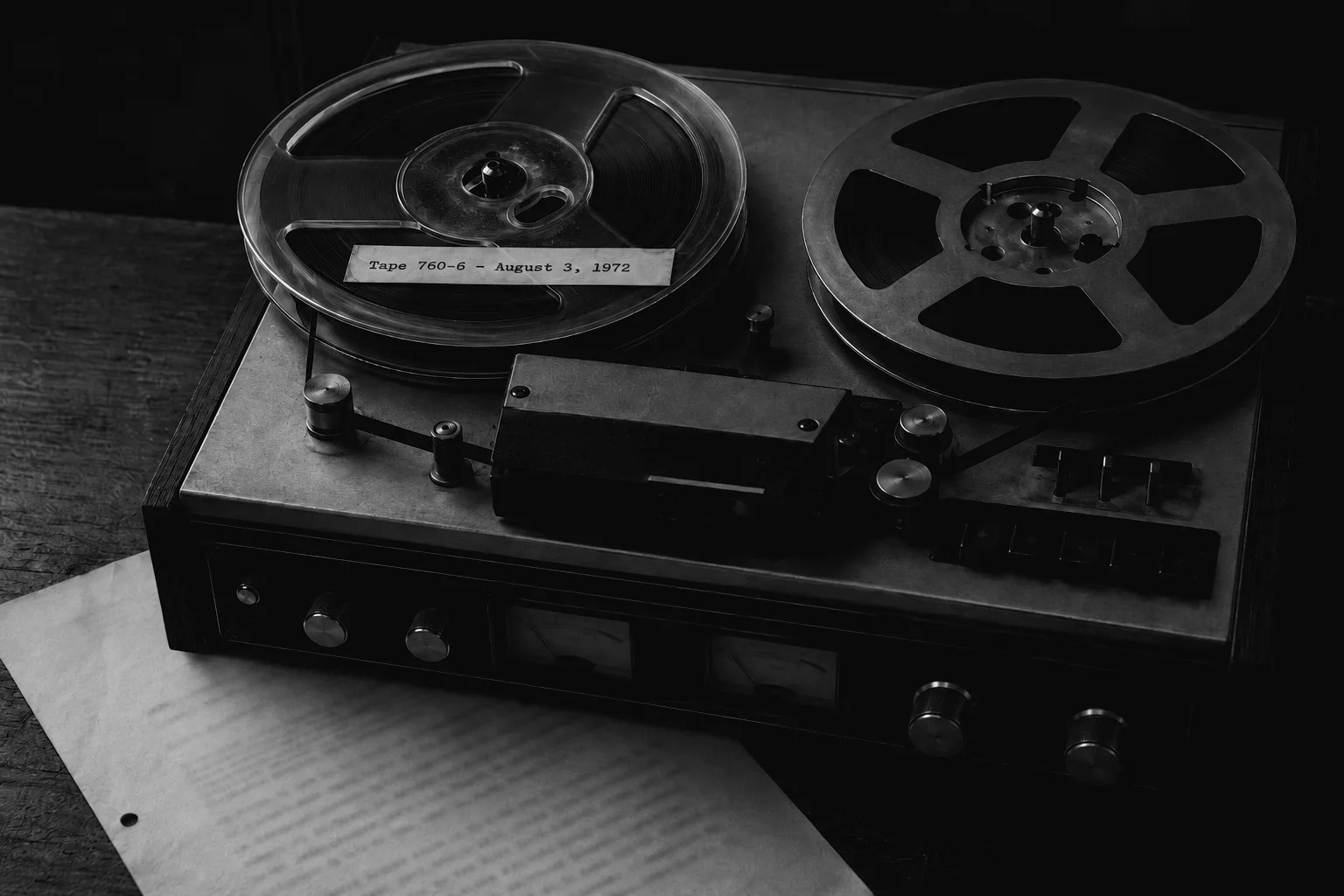
The Nixon Oval Office taping system recorded a conversation between the president and Henry Kissinger on 3 August 1972, between 8:28 a.m. and 8:57 a.m. It appears in the Nixon Presidential Recordings as Tape 760-6. On that tape, Nixon told Kissinger, ‘South Vietnam probably can never even survive anyway‘.
Kissinger’s reply set out the political solution. He proposed a formula that would hold the situation together for a year or two. If the war was settled in October 1972, he argued, by January 1974 ‘no one will give a damn’.
Twenty-six days later, on 29 August 1972, Nixon held a press conference at the Western White House. He told the country that accepting defeat in the region would lead to ‘the destruction of the ability of the United States to conduct foreign policy in a responsible way’.
The Oval Office recording system had been installed in 1971 and ran automatically. Nixon and Kissinger were not adjusting their language for a listener. Tape 760-6 is what they said to each other in the room.
No declassified strategic directive has been located that explicitly turns the January 1974 collapse date into policy.
The 26-Day Interval: Private Assessment vs Public Resolve
- 3 August 1972 (8:28 a.m. – 8:57 a.m.): On Oval Office Tape 760-6, President Nixon tells Henry Kissinger, 'South Vietnam probably can never even survive anyway'. Kissinger proposes a formula to hold the situation together for a year or two, noting that if the war is settled in October 1972, by January 1974 'no one will give a damn'.
- 29 August 1972 (Western White House Press Conference): Twenty-six days later, President Nixon publicly states that accepting defeat in the region would lead to 'the destruction of the ability of the United States to conduct foreign policy in a responsible way'.
Senate Investigation into the Cambodia Bombing Operation
Senate Armed Services Committee hearings on the Cambodia bombing opened in July 1973. The investigation had been triggered by internal Air Force personnel who came forward with the actual operational history.
Committee testimony walked through the incinerator procedure. Air Force personnel confirmed the burning of flight computer tapes and the parallel set of falsified reports sent to the Pentagon. The 20 November 1969 memorandum initialled by Melvin Laird was read into the record.
On the funding side, the Senate Appropriations Committee held its own vote. The result was 24 to 0 to cut off all money for continuing the bombing campaign over Cambodia.
One archival detail matters here. The audit had to reconstruct the operational record from surviving falsified paperwork cross-referenced against the memory of the personnel who had generated it. Where the primary flight tapes had been destroyed, the committee relied on the officers who had run the incinerator.
The technical history of who wrote the software or administrative protocols that made the dual bookkeeping possible sits outside the 1973 hearing transcript.
1973 Senate Armed Services Committee Hearings: Record vs Official Stance
| Subject Area | Prior Official Position | Evidence Entered into Record (July 1973) |
|---|---|---|
| Cambodian Air Operations | Public assertion by President Nixon on 30 April 1970 that neither the United States nor South Vietnam had moved against sanctuaries in neutral Cambodia over the prior five years. | Testimony confirming 3,630 B-52 sorties and over 100,000 tons of explosives dropped on Cambodian sanctuaries between 18 March 1969 and 26 May 1970. |
| Documentation and Reporting | Official paperwork showing bombing strikes confined to routine operational targets within South Vietnam. | Air Force personnel confirmed the dual bookkeeping system and the incinerator procedure run by Major Knight to burn flight computer tapes. |
| Administrative Authorisation | No public disclosure of cover operations or falsification instructions. | The 20 November 1969 General Earle G. Wheeler memorandum, initialled by Defense Secretary Melvin Laird authorising cover strikes to provide 'a credible story for replies to press inquiries', was read into the record. |
Support the Archive
Help fund the retrieval, hosting, and preservation of Veriarch investigations.
Source Box
Sources include: White House dictabelt recordings from the Lyndon B. Johnson administration (27 May 1964); Miller Center Presidential Recordings, University of Virginia (1965); declassified Lyndon B. Johnson audio recordings regarding the 1968 Paris peace talks interference; declassified United States Air Force operational procedures and the 20 November 1969 memorandum signed by Secretary of Defense Melvin Laird; Nixon Presidential Recordings (Tape 760-6, recorded 3 August 1972); and the United States Congressional Record, Senate proceedings (23 July 1973).
Claim-Source Matrix
| Core Finding | Source / Evidence | Status |
|---|---|---|
| 21 June 1965 call: Johnson privately acknowledges growing domestic opposition and strategic difficulties to Robert McNamara. | Conversation with ROBERT MCNAMARA, June 21, 1965 | Miller Center | Confirmed (Unprivileged) |
| Late October 1968: Anna Chennault instructs the South Vietnamese embassy to pull out of the Paris peace talks and wait for a Nixon administration deal. | Nixon Prolonged Vietnam War for Political Gain... (Smithsonian Magazine) | Confirmed (Unprivileged) |
| Operation Menu (18 March 1969 – 26 May 1970): 3,630 sorties and over 100,000 tons of explosives dropped on Cambodian sanctuaries. | Congressional Record (1973) Page 25274; Time Magazine More Revelations on Bombing | Confirmed (Privileged) |
| Major Knight collects B-52 flight computer tapes, burns them in an incinerator, and telephones Saigon with the phrase 'The ball game is over'. | Operation Menu - Wikipedia; The Shadow War in Cambodia (Air & Space Forces Magazine) | Confirmed (Unprivileged) |
| 20 November 1969 memorandum by General Earle G. Wheeler recommends cover strikes to provide 'a credible story for replies to press inquiries'; initialled by Melvin Laird. | Time Magazine - More Revelations on Bombing (Para 2) | Confirmed (Privileged) |
| 30 April 1970 televised address: Nixon publicly claims neither the United States nor South Vietnam has moved against enemy sanctuaries in Cambodia for five years. | Congressional Record Page 25275 (GovInfo archive) | Confirmed (Privileged) |
| 3 August 1972 Oval Office Tape 760-6: Nixon tells Henry Kissinger, 'South Vietnam probably can never even survive anyway'. | The Limits of Airpower or the Limits of Strategy... (NDU Press Notes, Para 34) | Confirmed (Unprivileged) |
| July 1973 Senate hearings: Air Force personnel testify to burning flight computer tapes and maintaining dual bookkeeping; Appropriations Committee votes 24 to 0 to cut Cambodia bombing funding. | Congressional Record Page 25274; Time Magazine; CORE Scholar Wright State thesis Page 62 | Confirmed (Privileged) |
What We Still Do Not Know
- Who inside the Pentagon designed the technical protocols for the dual bookkeeping system before Operation Menu began in March 1969, and at what command level the mechanism was formally signed off.
- Did the Senate or House Armed Services Committees held fragmentary evidence of the Cambodia bombing between March 1969 and early 1973, before Air Force personnel came forward.
- Which senior staff in Kissinger's office received the 3 August 1972 Decent Interval instruction, and whether written directives were drafted to align military operations with the January 1974 collapse date.
- Physical routing slips for the 20 November 1969 memorandum authorising the cover strikes remain unmapped. The lower-level commanders and database managers who received the falsification instructions are not fully identified.
- What exact intelligence reached Johnson in late October 1968 that confirmed Anna Chennault was acting on direct orders from the Nixon campaign leadership, rather than on her own initiative.
- The Chuck Robb audio recording made on 31 July 1968, classified as a private family record, remains unreleased. Its ground-level content is not in the archive.
Comments (0)