
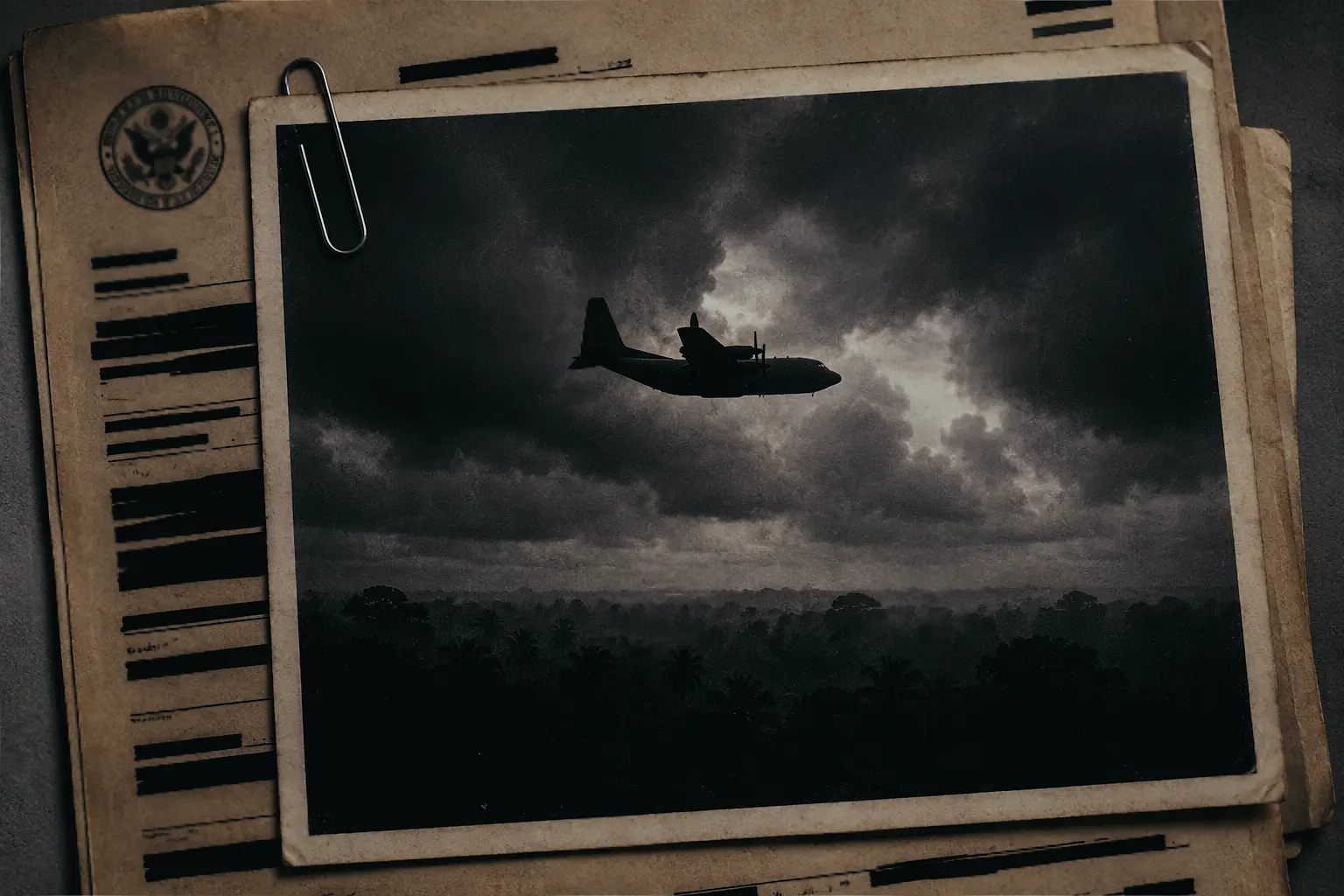
By the time Secretary of Defense Melvin Laird sat before the Senate Foreign Relations Committee in April 1972, pilots had flown over 2,600 classified cloud-seeding sorties. When pressed on whether the military had altered weather over North Vietnam, Laird issued a categorical denial. The statement was entirely inaccurate, resulting from a structural breakdown in the transfer of classified historical records.
DATA MANIFEST
- Primary Investigation: An examination of the contradiction between Secretary of Defense Melvin Laird's 1972 congressional denial of military cloud-seeding operations and the internal operational history of Operation Popeye.
- Key Anomalies Documented: Secretary Laird categorically denied weather modification activities over North Vietnam, despite the 54th Weather Reconnaissance Squadron flying over 2,600 classified sorties. The record divergence stemmed from a structural breakdown in the transfer of classified historical records.
- Primary Sources Utilised: Declassified military operational flight logs, the 13 January 1967 State Department authorisation memorandum, transcripts of the 18 April 1972 Senate Foreign Relations Committee hearings, and Melvin Laird's 28 January 1974 formal correction letter.
Terminology
- Cloud seeding: The process of dropping chemicals into clouds to force them to produce rain.
- Silver iodide: A chemical compound used by the military as the primary agent to stimulate precipitation during the operation.
- Compartmented programme: A highly classified project where information is strictly limited only to people who directly need it to do their jobs.
- Sortie: A single mission or flight by a military aircraft.
- ENMOD: The 1978 international treaty that made it illegal to modify the environment or the weather as a weapon of war.
The Science of Weather Modification
The capability to conduct military weather modification emerged from a prolonged, state-sponsored research cycle driven by the Naval Ordnance Test Station at China Lake, California.
We began with Project Cirrus, a military-sponsored programme that ran from 1947 to 1951 and established the foundational science of using chemical agents to alter cloud structures. During this period, the United States Patent Office began receiving formal applications related to weather control. For example, US Patent 2550324A, filed in May 1948 by Harvey M. Brandau, detailed a process for clearing the atmosphere of moisture particles to dissipate clouds and fog.
By August 1953, the US government had established the Advisory Committee on Weather Control to assess the effectiveness of weather-modification procedures. That marked the formal institutional recognition of weather modification as a valid field of state-sponsored research.
A significant technological leap occurred in 1961.
Scientists and engineers at China Lake developed a new method for generating and dispersing silver iodide nuclei. This delivery device, designated as the Cyclops device, was first deployed in September 1961 during Hurricane Esther under the auspices of Project Stormfury.
Project Stormfury, a joint initiative between the Department of Commerce and the Department of Defense, represented the experimental, unclassified face of weather modification, establishing a public record of research focused on hurricane mitigation.
But then the technology transitioned from experimental research to a proven, deployable military asset.
In October 1966, a classified test phase for military cloud seeding, designated as Project Popeye, was authorised by the Department of State and the Department of Defense. More than 50 cloud-seeding experiments were conducted over a strip of the Laos Panhandle, specifically east of the Bolovens Plateau in the valley of the Se Kong River. The military assessed these initial tests as highly successful, noting that 82 per cent of the seeded clouds produced rain within a brief period. The tests were deemed so effective that rainfall continued as clouds moved eastward, inundating a United States Special Forces camp with nine inches of rain in four hours.
During this same period, Pierre St. Amand, the head of the Earth and Planetary Sciences Division at the Naval Weapons Center, testified before the Senate Commerce Committee. During these October 1966 hearings, the capability of the United States military to alter the environment was discussed openly.
St. Amand noted that the Naval Ordnance Test Station aimed to give the armed forces the capability of modifying the environment to their advantage. This testimony serves as a definitive Moment of Knowledge for the legislative branch regarding the theoretical military applications of the technology, occurring just as the classified Popeye tests were being executed.
The original transcript of St. Amand’s testimony remains available as a faded, typed public record, yet it drew little public scrutiny at the time.
Parallel Development of Weather Modification
-
1947–1951
Project Cirrus
Military-sponsored programme establishes the foundational science of using chemical agents to alter cloud structures.
-
May 1948
US Patent 2550324A
Patent filed detailing a process for clearing the atmosphere of moisture particles to dissipate clouds and fog.
-
September 1961
Project Stormfury
The Cyclops device is deployed during Hurricane Esther, establishing a public record of unclassified weather modification research.
-
October 1966
Project Popeye Tests
Classified military cloud-seeding experiments authorized and executed over the Laos Panhandle, achieving an 82 per cent success rate.
-
October 1966
Senate Commerce Committee Testimony
Pierre St. Amand testifies openly about the capability of the military to alter the environment, marking a moment of knowledge for the legislative branch.
The Deployment of Operation Popeye
Following the success of the 1966 tests, a highly classified memorandum was drafted by Hamilton, the Laos Country Director at the Department of State. This document, a yellowing carbon copy dated 13 January 1967, was sent from Deputy Under Secretary of State for Political Affairs Foy D. Kohler to Secretary of State Dean Rusk. It formally requested approval to initiate Phase II of Project Popeye.
The memorandum explicitly states the objective was to produce sufficient rainfall to interdict or interfere with truck traffic along the infiltration routes in North Vietnam and southern Laos. It also acknowledged the severe geopolitical risks of the operation, noting that the political consequences of ‘first use’ could prove highly relevant to future efforts to control the technique by international agreement. To maintain civilian oversight, the Department of State stipulated several conditions for approval.
These included limiting authorisation to marked operational areas.
Instructing Ambassador Sullivan to consult with Lao Prime Minister Souvanna Phouma, and requiring the Department of Defence to provide weekly operational summaries and special incident reports to the State Department so that side effects could be evaluated.
On 20 March 1967, the 54th Weather Reconnaissance Squadron began operational cloud-seeding missions over Southeast Asia. The missions utilised silver iodide and lead iodide dispersed from WC-130 weather reconnaissance and RF-4C aircraft. The operational area spanned parts of Laos, Cambodia, and North Vietnam. The internal military goal was to extend the monsoon season by 30 to 45 days to soften road surfaces, cause landslides along the Ho Chi Minh Trail, and maintain saturated soil conditions beyond the normal time span. The squadron operated under the unofficial slogan ‘make mud, not war’.
Between 1967 and 1972, the military flew more than 2,600 cloud-seeding sorties, expending nearly 50,000 seeding units. Concurrently, the Naval Weapons Center at China Lake continued to file patents related to the technology. For example, US Patent 3915379A, relating to a weather modification process using pyrotechnic samples to seed supercooled clouds, was developed by inventors including Pierre St. Amand and Charles Stanifer, and assigned to the United States Navy. This demonstrates a continuing formalisation of the technology within the government patent system, running parallel to the highly classified field operations. The flight logs themselves remain bound in stained, declassified military ledger books, tracking the precise coordinates of each dropped unit.
Aggregate Operational Footprint (1967–1972)
| Operational Era | Targeted Areas | Total Sorties Flown | Seeding Units Expended |
|---|---|---|---|
| 1967–1972 | Parts of Laos, Cambodia, and North Vietnam | More than 2,600 | Nearly 50,000 |
Exposing the Secret War
The strict compartmentation of the programme began to fracture in March 1971. Investigative journalist Jack Anderson published a syndicated newspaper column alleging that the military was conducting a secret rainmaking operation over the Ho Chi Minh Trail under the code name ‘Intermediary-Compatriot’. Anderson alleged that those who flew the rainmaking missions believed they had increased precipitation over the jungle roadways, causing flooding conditions. The Department of Defense refused to confirm or deny the allegations, citing classification rules, and stated that answers to congressional queries on the subject were classified.
Which brings us to 18 April 1972. Secretary of Defense Melvin Laird testified before the Senate Foreign Relations Committee regarding foreign assistance acts and military operations. During a sharp exchange, Committee Chairman J. William Fulbright pressed Laird on the issue of weather control activities. Fulbright asked why Laird declined to discuss weather control activities in North Vietnam while freely discussing B-52 flights over the same territory.
Laird replied: ‘We have never engaged in that type of activity over North Vietnam’.
The statement entered the privileged congressional record. It stands in direct contradiction to the internal operational history, which confirms that elements of Operation Popeye were conducted over North Vietnam in 1967 and 1968, as outlined in the 13 January 1967 memorandum and subsequent military flight logs. This marks the primary Moment of Record Divergence, where the public narrative completely separated from the archived reality. The microfilmed press archives from March 1971 show Anderson’s column appearing next to local advertisements, a mundane setting for a leak that cracked open a top secret military operation.
The Moment of Record Divergence
- 13 January 1967 (Classified Memo): The Department of State explicitly drafted authorization for Phase II of Project Popeye to produce sufficient rainfall to interdict truck traffic along infiltration routes in North Vietnam and southern Laos.
- 18 April 1972 (Public Testimony): When pressed on whether the military had altered weather over North Vietnam, Secretary of Defense Melvin Laird issued a categorical denial: "We have never engaged in that type of activity over North Vietnam."
Policy Delays and the Classification of Weather Warfare
Senator Claiborne Pell chaired hearings before the Subcommittee on Oceans and International Environment on 26 and 27 July 1972 to discuss Senate Resolution 281, a proposed treaty prohibiting environmental warfare. Benjamin Forman, Assistant General Counsel for the Department of Defense, appeared as the primary military witness. When asked specifically whether Operation Popeye and Intermediary-Compatriot were coordinated with the State Department, Forman refused to answer. He stated: ‘Senator, all I know of those operations is what I have read in the papers and the Congressional Record in the last 6 months or so, speaking personally’. When Pell confronted Forman with a specific page from the Pentagon Papers referencing Operation Popeye, Forman again stated he was not free to comment on the validity of the statement.
This hearing established a formal classification barrier between the Department of Defense and the Senate committee, further entrenching the record divergence. Pell noted that the military establishment had steadfastly opposed the development of any policy regarding environmental prohibitions to keep all their options open.
A January 1974 National Security Council memorandum proves the Executive Branch deliberately delayed policy decisions to preserve operational flexibility. This internal study confirms the military application of weather modification was a subject of intense internal policy review, leading to National Security Decision Memorandum 165. The Executive Branch took no public action on Senate resolutions urging a treaty against weather warfare until the 1974 Pell hearings forced the issue. The declassified NSC study contains several passages with heavy black ink redactions obscuring the debate surrounding the preservation of tactical flexibility.
Structural Breakdown of Historical Records
Cloud-seeding elements of Operation Popeye are conducted over North Vietnam in 1967 and 1968. Sortie data and locations are recorded in classified ledger books.
Staff officers omit the 1967 and 1968 North Vietnam sortie data from the briefing materials prepared for Secretary of Defense Melvin Laird prior to his Senate testimony.
Secretary Laird testifies before the Senate Foreign Relations Committee blind to the historical missions authorized by his predecessors, resulting in an entirely inaccurate public record.
From War to Treaty
Melvin Laird, having left the office of Secretary of Defense and then serving as Counsellor to the President for Domestic Affairs, dispatched a letter to Senator Fulbright dated 28 January 1974. In this document, Laird formally corrected his 18 April 1972 testimony.
He wrote: ‘During my appearance I responded to your question concerning weather modification with the statement “we have never engaged in that type of activity over North Vietnam.” That statement represented, first, my knowledge that I had never approved operations over North Vietnam and secondly, my understanding of activities authorized by preceding Secretaries of Defense. I have just been informed that such activities were conducted over North Vietnam in 1967 and again in 1968. I want to take this opportunity to both express my regret that this information was not available to me at the time of my appearance before your Committee and to provide you with this information’.
Following Laird’s correction, the Department of Defense provided a Top Secret briefing to Senator Pell’s Subcommittee on Oceans and International Environment on 20 March 1974. Dennis J. Doolin, Deputy Assistant Secretary of Defense for East Asia and Pacific Affairs, provided charts detailing the specific areas of operations in Laos and North Vietnam starting in 1967, the sorties flown, and the units expended. This briefing was then declassified and published in May 1974, fully aligning the public congressional record with the internal operational history and closing the record divergence.
The public revelation of Operation Popeye directly catalysed international legal action.
On 10 December 1976, the General Assembly of the United Nations approved the Convention on the Prohibition of Military or Any Other Hostile Use of Environmental Modification Techniques, commonly known as ENMOD. The treaty stipulated in Article I that each state party undertakes not to engage in military or any other hostile use of environmental modification techniques that have widespread, long-lasting, or severe effects as a means of destruction, damage, or injury to any other state party.
The ENMOD Convention officially entered into force on 5 October 1978. The United States Senate gave its advice and consent to ratification on 28 November 1979 by a vote of 98 to 0, effectively closing the policy debate initiated by Senator Pell in 1972. The UN treaty records show the final depository papers stamped and filed in Geneva, a bureaucratic conclusion to the secret weather war.
Formal Retraction: 28 January 1974
- "During my appearance I responded to your question concerning weather modification with the statement 'we have never engaged in that type of activity over North Vietnam.'"
- "That statement represented, first, my knowledge that I had never approved operations over North Vietnam and secondly, my understanding of activities authorized by preceding Secretaries of Defense."
- "I have just been informed that such activities were conducted over North Vietnam in 1967 and again in 1968. I want to take this opportunity to both express my regret that this information was not available to me at the time of my appearance before your Committee and to provide you with this information."
Source
Sources include: declassified Department of State memorandums from the Office of the Historian (1964-1968); official patents for weather modification filed with the United States Patent Office (US2550324A and US3915379A); military technical reports on Project Cyclops from the Defense Technical Information Center; unredacted congressional transcripts from the Senate Foreign Relations Committee and the Subcommittee on Oceans and International Environment (1972-1974); and the official text of the ENMOD Convention from the United Nations Office for Disarmament Affairs.
Claim-Source Matrix
| Core Finding | Primary Source Document | Status |
|---|---|---|
| October 1966 Project Popeye test reports confirm the military achieved an 82 per cent success rate in creating rain over the Laos Panhandle. | Historical Documents - Office of the Historian | Confirmed |
| 13 January 1967 memo establishes the formal request to begin Phase II of Project Popeye to interdict truck traffic. | Historical Documents - Office of the Historian | Confirmed |
| Secretary of Defense Melvin Laird inaccurately denied North Vietnamese cloud seeding operations in 1972. | 18 April 1972 Senate Testimony Transcript | Confirmed |
| 28 January 1974 letter to Senator Fulbright formally corrects the 1972 testimony and admits to the North Vietnam operations. | CHRG-93shrg29544O Senate Hearings Transcript | Confirmed |
What we still do not know
- Identities of the staff officers who omitted the 1967 and 1968 North Vietnam sortie data from Secretary Laird's April 1972 briefing materials.
- Location and contents of the weekly operational summaries required by the State Department to monitor the early cloud-seeding tests.
- Exact internal routing slips that would identify which Department of Defense officials approved the initial January 1967 authorisation memo.
- Unredacted names of modern intelligence analysts currently reviewing the historical data on the protected Intellipedia pages.
Comments (0)