
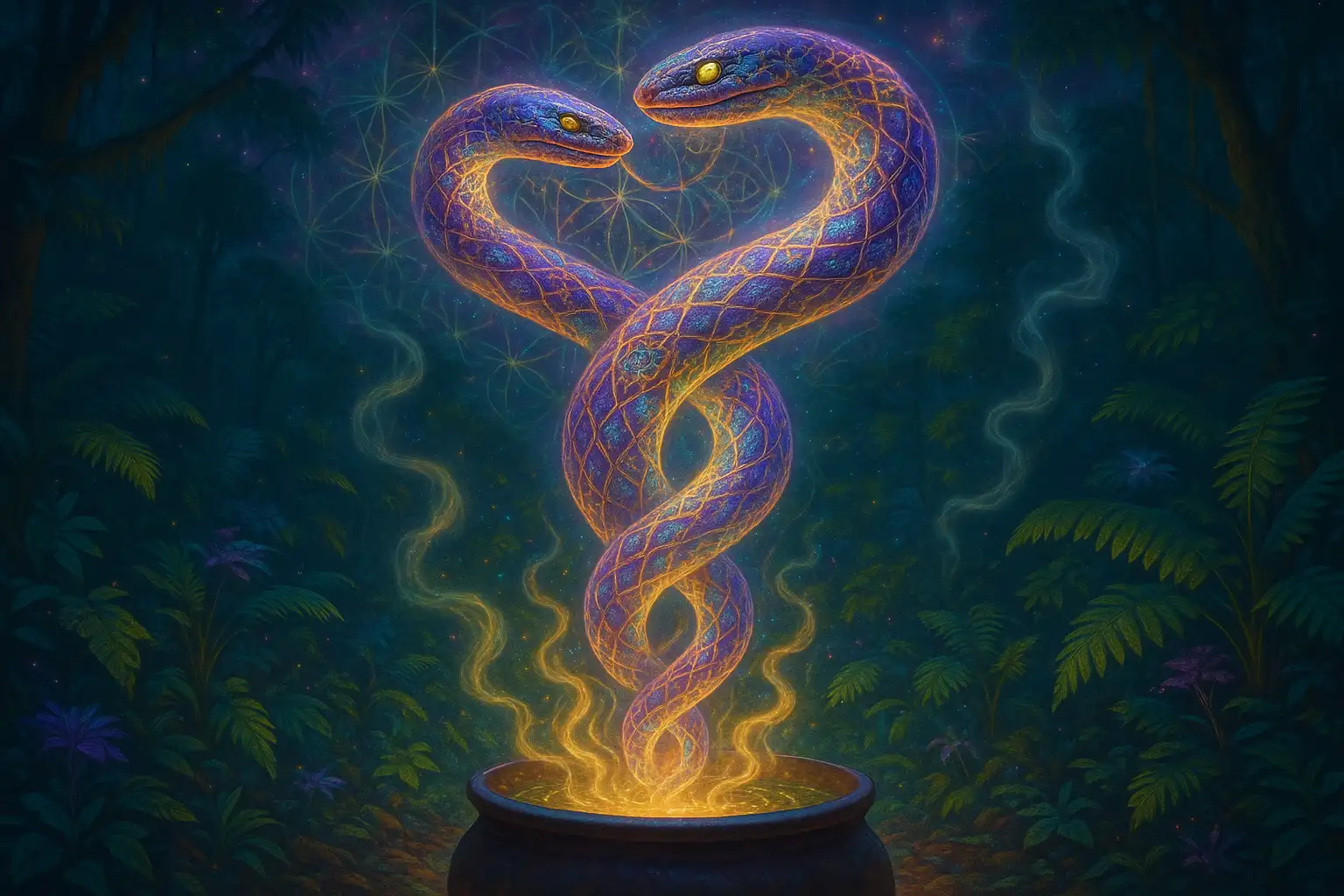
Jeremy Narby’s 1998 trade book ‘The Cosmic Serpent: DNA and the Origins of Knowledge’ argues that Amazonian shamans have long observed the double-helix structure of DNA in ayahuasca visions. The book was published by Tarcher/Putnam and marketed to general readers. Its central claim depends on a specific reading of the older field record.
That record does not read the way the book requires.
Data Manifest
- Primary Investigation: An audit of the evidence chain behind Jeremy Narby's 1998 claim that Amazonian shamans have long observed the DNA double helix in ayahuasca visions.
- Key Anomalies Documented: The absence of any helical serpent motif in the pre-1953 ethnographic baseline. The deliberate omission of the DNA analogy from Narby's 1989 Stanford dissertation. The thirty-five year gap between the discovery of DNA and Amaringo's 1988 artistic collaboration with Luis Eduardo Luna. The release of the finished argument through a trade imprint without peer review.
- Primary Sources Utilised: Villavicencio, 'Geografía de la República del Ecuador' (1858); Karsten, Smithsonian Bureau of American Ethnology Bulletin 79 (1923); Karsten, 'The Head-Hunters of Western Amazonas' (1935); Watson and Crick, Nature (April 1953); Luna and Amaringo, 'Ayahuasca Visions' (1991); Narby, 'Le Serpent Cosmique' (Georg Éditeur, 1995); Narby, 'The Cosmic Serpent' (Tarcher/Putnam, 1998).
Glossary
- Ethnography: The systematic written study of a specific culture, usually based on long-term first-hand fieldwork.
- Double helix: The twisted two-strand ladder shape of the DNA molecule, first formally described by Watson and Crick in 1953.
- Peer review: The process where independent experts check a piece of research before it is published, to test its accuracy and reasoning.
- Trade book: A commercially published book aimed at general readers, sold through ordinary bookshops rather than academic channels, and normally released without peer review.
Early Ayahuasca Vision Records Before DNA
The earliest documented Western account of ayahuasca vision content comes from Manuel Villavicencio, who served as governor of Ecuador’s eastern provinces. He published ‘Geografía de la República del Ecuador’ in 1858. His book described the visions in specific terms.
Villavicencio wrote of great cities, lofty towers, beautiful parks and encounters with wild beasts. The 1858 book is held in the Royal Collection Trust catalogue and remains the anchor point for pre-1953 Amazonian visionary evidence. No twin serpents appear in his list.
Then came the Karsten record.
The Finnish anthropologist Rafael Karsten spent years among the Jivaro of eastern Ecuador in the 1920s and 1930s. In 1923 he published Smithsonian Bureau of American Ethnology Bulletin 79, ‘Blood Revenge, War, and Victory Feasts Among the Jibaro Indians of Eastern Ecuador’. His subjects reported seeing distant relatives and sweethearts.
They also reported seeing swine and chickens.
Karsten’s 1935 volume, ‘The Head-Hunters of Western Amazonas’, reinforced this pattern across a wider geographical range. He noted the homogeneity of the reports across the population. His subjects’ visions leaned domestic and pragmatic, not molecular.
The physical bulletin sits in the archive.org repository as a scanned Smithsonian document, its title page and contents pages viewable page by page. Nothing in either the 1923 or the 1935 record describes a twin luminous serpent, a double strand or any structure that could be mapped to molecular biology. The absence is direct and traceable across two independent observers, sixty-five years apart.
Watson and Crick would not publish the double helix in Nature until April 1953. Any specific visual analogue of that structure appearing in the ayahuasca record after that date carries the risk of retrospective contamination, because the image entered global circulation almost immediately. Before 1953, the archive contains cities, chickens, sweethearts and pigs.
What Villavicencio and Karsten preserved contains no such structure. The archive stops there.
Documented Ayahuasca Vision Content by Ethnographic Record
| Observer | Population | Vision Content | Reference to Helical Serpents |
|---|---|---|---|
| Villavicencio, 1858 | Amazonian visionaries, eastern Ecuador | Great cities, lofty towers, beautiful parks, wild beasts | None |
| Karsten, 1923 and 1935 | Jivaro of eastern Ecuador | Distant relatives, sweethearts, swine, chickens, domestic animals | None |
| Narby, 1998 | Ashaninca of the Pichis Valley (reported) | Twin luminous serpents read as the DNA double helix | Central to the claim |
Jeremy Narbys Stanford Dissertation and the Missing DNA Claim
Between 1984 and 1986, Narby lived among the Ashaninca of the Pichis Valley in the Peruvian Amazon. He was a Stanford doctoral candidate. His stated focus was practical: resource use, land rights and the working logic of indigenous farming.
He was also, by his own account, a Marxist anthropologist who considered the study of mythology ‘useless and reactionary’.
During that fieldwork, local shamans told him their botanical knowledge came from plant-induced visions. He was invited to drink ayahuasca himself. At the time, he filed the accounts under ‘not useful’. In 1989, Stanford awarded him a PhD in anthropology. The dissertation dealt with Ashaninca resource use. It did not deal with ayahuasca visions. Nor did it propose that shamans could see DNA.
The omission was deliberate. Narby has since written, in the 1998 book itself, that including the hallucinatory origins of Ashaninca ecological knowledge would have undermined his political and materialist argument in support of land rights. His committee never saw the theory that would later fill a trade paperback.
The full text of the 1989 dissertation is not in the accessible digital archive. What survives publicly is a set of secondary summaries and Narby’s own retrospective account of what he chose to leave out. Nobody has audited the footnotes line by line to confirm whether an early or nascent form of the DNA hypothesis sits in an appendix, unread since submission.
1989 Dissertation vs 1998 Book
What made it into the Stanford thesis, and what waited nine years for a trade paperback.
1989 Stanford Dissertation
Ashaninca resource use, land rights, and the working logic of indigenous farming.
Rational ecological knowledge, framed to support the land-rights case.
Filed under 'not useful' and left out. No DNA analogy.
1998 Cosmic Serpent
Origins of shamanic knowledge, framed as direct DNA perception.
Twin luminous serpents in ayahuasca visions equate to the DNA double helix.
Shamans communicate with DNA through biophotonic emissions in a defocalised state.
How Amaringo Paintings Entered the Cosmic Serpent Evidence Chain
Pablo Amaringo trained as a shaman long before he picked up a brush. He came to painting late. The ACA Galleries archive and the Penguin Books New Zealand author record place his intensive artistic output firmly after 1988, not before.
Then came the meeting.
In 1988, Amaringo met Luis Eduardo Luna, a Colombian-Finnish anthropologist working on Amazonian ethnobotany. Luna encouraged him to commit his ayahuasca visions to canvas. Together they founded the Usko-Ayar school of painting in Pucallpa, Peru.
Their joint book, ‘Ayahuasca Visions’, appeared in 1991. From that point on, Amaringo’s imagery began surfacing in the psychedelic and anthropological literature as evidence of what Amazonian shamans actually see.
Narby’s 1998 book leans hard on Amaringo. It reproduces the twin-serpent canvases as live proof, treating them as the visible face of what shamans have long seen. Then the dates catch up with the argument.
By the time Amaringo first sat with Luna in 1988, the double helix had been in general circulation for thirty-five years. The image sat in school textbooks, on magazine covers, in the opening credits of popular science shows. Whatever passed between the anthropologist and the painter in the studios of Pucallpa, it did not pass in isolation from that visual culture.
No production log in the accessible archive dates the first twin-helical-serpent painting on Amaringo’s canvas. Nobody has reconstructed the exact order in which particular motifs entered the Usko-Ayar output. The paintings that later served as evidence for the 1998 book cannot currently be placed in a chronology that rules out what Luna showed him.
From the Double Helix to the Cosmic Serpent
-
April 1953
Watson and Crick describe the double helix
The DNA structure enters the peer-reviewed record in Nature and moves rapidly into textbooks, magazine covers and popular science broadcasts.
-
1953 to 1988
Thirty-five years of global DNA imagery in public circulation
The double helix sits in school textbooks, magazines and television before the Amaringo collaboration begins.
-
1988
Amaringo meets Luna in Pucallpa
The Colombian-Finnish anthropologist Luis Eduardo Luna encourages Pablo Amaringo to paint his ayahuasca visions. Together they found the Usko-Ayar school.
-
1991
'Ayahuasca Visions' published
Luna and Amaringo release their joint book. Amaringo's imagery starts entering the psychedelic and anthropological literature.
-
1998
'The Cosmic Serpent' released in English
Tarcher/Putnam publishes the English translation. Amaringo's twin-serpent canvases are reproduced as visible evidence of the DNA analogy.
How The Cosmic Serpent Reached Readers Without Peer Review
The DNA hypothesis reached print in French first. ‘Le Serpent Cosmique’ came out in 1995, three years ahead of the English edition. That French version already carried the finished argument: the twin luminous serpents of ayahuasca visions were, the book said, literal perceptions of DNA.
The English translation followed in 1998.
Tarcher/Putnam took it on, an imprint whose late-1990s catalogue leaned into popular titles on consciousness and spirituality. The book was pitched at general readers.
No academic journal, biological or anthropological, was ever asked to review it under standard double-blind conditions.
The central claim was stated plainly. Amazonian shamans, the book argues, see DNA in the form of twin luminous serpents. That visual correspondence, the text proposes, is how indigenous populations came by their detailed botanical knowledge in the first place.
A second claim rides alongside the first. Shamans, the book says, talk to DNA itself, through biophotonic light emissions, tiny signals given off by living cells, while in what the text calls a defocalised state of consciousness.
Peer-reviewed molecular biology does not treat those emissions as any kind of information channel.
Tarcher/Putnam’s 1996 to 1998 editorial correspondence is not in the accessible archive. No dated file has surfaced showing whether an in-house fact-checker questioned the DNA analogy, whether an outside biologist was ever asked to look, or whether the marketing team pushed back on the stronger claims. The reader has only the finished paperback.
The Publication Path of the DNA Analogy
1984 to 1986: Ashaninca fieldwork in the Pichis Valley. Local shamans describe plant-induced visions as the source of their botanical knowledge.
1989: Stanford PhD awarded. The ayahuasca material and any DNA analogy are omitted from the dissertation by Narby's own later account, to protect the land-rights argument.
1995: 'Le Serpent Cosmique' appears in French, three years before the English edition. The finished DNA argument is now in print for the first time.
1998: Tarcher/Putnam publishes the English trade edition. No academic journal is asked to review the DNA analogy under standard double-blind conditions.
Source Box
Sources include: Manuel Villavicencio’s ‘Geografía de la República del Ecuador’ (1858), held by the Royal Collection Trust; Rafael Karsten’s Smithsonian Bureau of American Ethnology Bulletin 79, ‘Blood Revenge, War, and Victory Feasts Among the Jibaro Indians of Eastern Ecuador’ (1923), and ‘The Head-Hunters of Western Amazonas’ (1935); Watson and Crick’s April 1953 paper in ‘Nature’; Jeremy Narby’s ‘Le Serpent Cosmique’ (Georg Éditeur, 1995) and ‘The Cosmic Serpent: DNA and the Origins of Knowledge’ (Tarcher/Putnam, 1998); Luis Eduardo Luna and Pablo Amaringo’s ‘Ayahuasca Visions’ (North Atlantic Books, 1991); biographical records held by ACA Galleries and Penguin Books New Zealand on Pablo Amaringo; the Wikipedia biographical entry on Jeremy Narby; and Alanna Mitchell’s ‘Plants with Soul’ in ‘The Walrus’ (July 2006).
Claim-Source Matrix
| Core Finding | Primary Source Document | Status |
|---|---|---|
| The earliest Western record of ayahuasca vision content describes cities, towers, parks and wild beasts. No helical serpents. | Villavicencio, 'Geografía de la República del Ecuador' (1858) | Confirmed |
| Jivaro vision reports across the 1923 and 1935 records list relatives, sweethearts, swine and chickens. No helical serpents. | Karsten, Smithsonian Bureau of American Ethnology Bulletin 79 (1923); Karsten, 'The Head-Hunters of Western Amazonas' (1935) | Confirmed |
| The double helix enters the peer-reviewed record in April 1953 and moves rapidly into popular circulation. | Watson and Crick, Nature (April 1953) | Confirmed |
| Narby's 1989 Stanford dissertation omits the ayahuasca vision material and the DNA analogy by his own retrospective account. | Narby, 'The Cosmic Serpent' (Tarcher/Putnam, 1998); Stanford doctoral records (1989) | Confirmed |
| Pablo Amaringo's intensive artistic output begins after his 1988 meeting with Luis Eduardo Luna, thirty-five years after the discovery of DNA. | ACA Galleries biographical records; Penguin Books New Zealand author record; Luna and Amaringo, 'Ayahuasca Visions' (1991) | Confirmed |
| The DNA hypothesis reaches print in the 1995 French edition, then the 1998 English trade release, without standard double-blind peer review. | Narby, 'Le Serpent Cosmique' (Georg Éditeur, 1995); Narby, 'The Cosmic Serpent' (Tarcher/Putnam, 1998) | Confirmed |
| The book's secondary claim that shamans communicate with DNA through biophotonic emissions is not treated as an information channel by peer-reviewed molecular biology. | Narby, 'The Cosmic Serpent' (Tarcher/Putnam, 1998) | Confirmed |
What We Still Do Not Know
- Whether Narby's 1989 Stanford dissertation contains any footnoted or appendix-level reference to the DNA hypothesis. The full text has not been publicly audited line by line.
- Which specific scientific textbooks, journal articles or visual aids Luis Eduardo Luna shared with Pablo Amaringo between their 1988 meeting and the 1991 co-publication of 'Ayahuasca Visions'.
- The exact date the first twin-helical-serpent motif appeared on Amaringo's canvases. The Usko-Ayar school production logs remain unlocated.
- Did Tarcher/Putnam's 1996 to 1998 editorial correspondence contain any internal challenge to the DNA analogy from in-house fact-checkers or external biological reviewers. The file is not in the accessible archive.
- How the unedited 1984 to 1986 Pichis Valley field notebooks describe the shamans' original vision content, and whether they contain any pre-1998 sketches referencing helical geometry.
- Whether any pre-1953 indigenous Amazonian artefacts held in South American museum archives depict intertwined helical structures, or whether every documented instance of that motif post-dates the discovery of DNA.
Comments (0)