
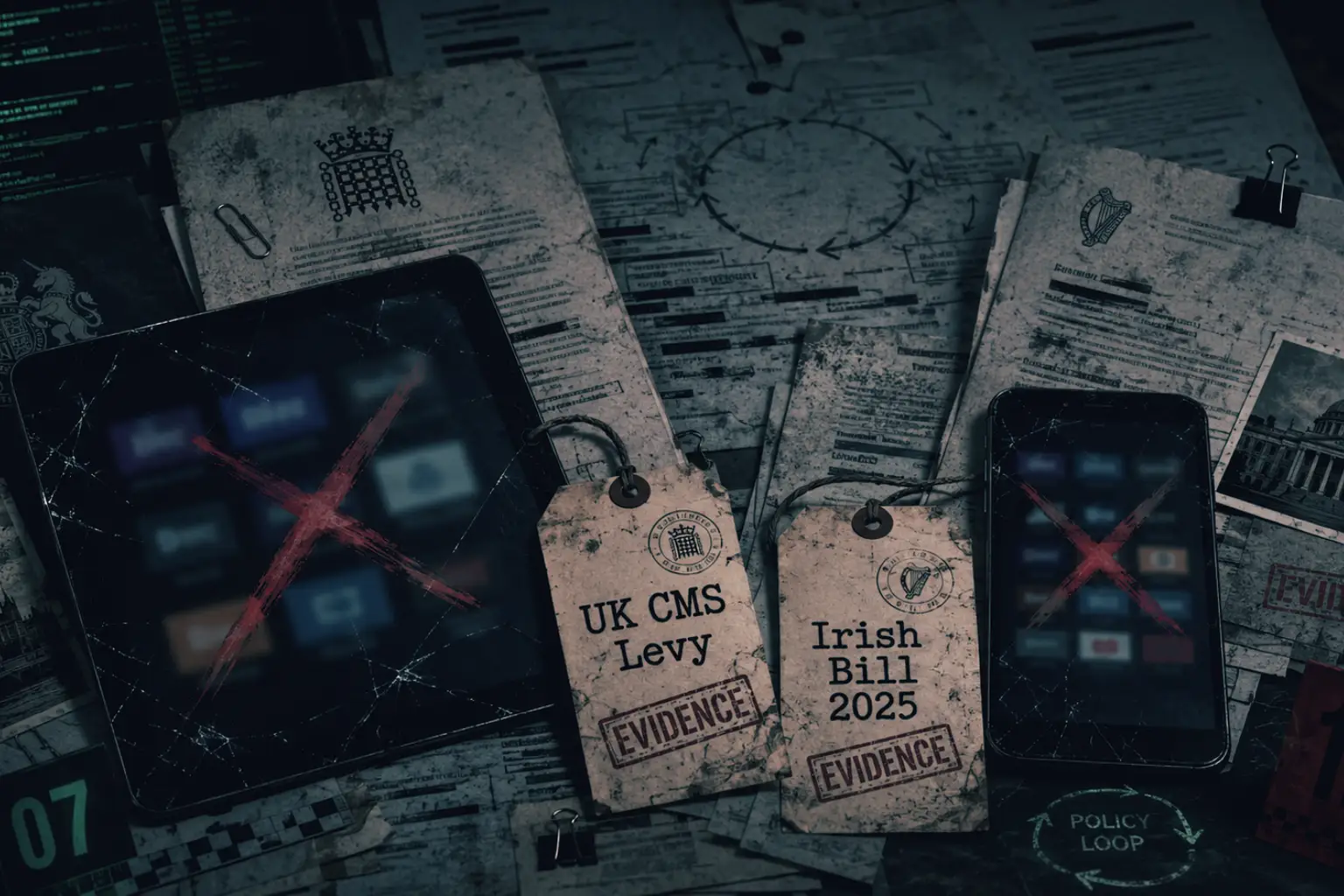
Back in April 2025, people freaked out over rumours that the government was going to tax Netflix subscriptions to pay for the BBC. But the reality buried in the actual policy documents is much more straightforward. Broadcasting bosses have zero interest in taxing individual streaming apps. They want a flat household tax simply for owning a screen.
Data Manifest
- Primary Investigation: The BBC's proposed universal household tax and the statutory breakdown of the 2003 linear broadcasting licence fee system.
- Key Anomalies Documented: The failure of 2016 secondary legislation to capture non-live third-party platforms; the legal exit of 3.6 million households causing a £1.2 billion revenue deficit; and the public conflation of the UK BFI levy and the Irish Broadcasting Bill 2025 with domestic BBC funding.
- Primary Sources Utilised: 'A BBC For All' policy submission; Communications Act 2003; Explanatory Memorandum to S.I. 2016/704; BBC Accounts and Trust Statement 2024-25; Irish Broadcasting Bill 2025; UK CMS Committee Report April 2025; and Hansard Parliamentary Records (1946 and 1957).
Reference Terminology
- Linear Broadcasting: Watching television programmes at the exact scheduled time they are transmitted to the general public.
- Video-on-Demand: A system that allows viewers to choose and watch video content whenever they want, rather than following a set schedule.
- Secondary Legislation: Rules created by government ministers under powers given to them by an existing Act of Parliament, allowing laws to be updated without a full parliamentary vote.
- Excise Tax: A specific duty charged by the government on particular goods or services, applied as an extra cost on top of a standard price.
- Royal Charter: A formal document issued by the monarch that sets out the rules, purpose, and legal independence of an organisation like the BBC.
The 1946 Permanence and the 1957 Conflation
Database searches of the parliamentary logs from June 1946 establish the original £2 television licence as a permanent extension of the Wireless Telegraphy Act, though a physical audit of the unabridged transcripts is still required.
No minister stood up during those sessions and promised the public a temporary start-up measure. That persistent historical myth stems from a later date entirely.
On 23 May 1957, during debates on the Finance Bill, parliament reviewed a distinct £1 ‘Television Duty’.
MPs at the time explicitly called this excise tax, an extra cost placed on top of a standard price, a temporary need. Public memory has simply merged the permanent 1946 broadcast licence with a forgotten 1957 Treasury surcharge. It remains an open question whether any sealed Treasury impact assessments from those 1957 debates exist that might explain how this temporary duty was absorbed into the permanent fee structure.
Statutory Milestones vs Public Memory
-
June 1946
The Original £2 Licence
Established as a permanent extension of the Wireless Telegraphy Act. No minister promised the public a temporary start-up measure.
-
23 May 1957
The £1 Television Duty
A distinct excise tax explicitly debated by MPs as a temporary need. Public memory has merged this forgotten surcharge with the permanent 1946 broadcast licence.
The 2003 Anchor and the 2016 Patch Failure
Part 4 of the Communications Act 2003 cemented linear broadcasting, watching programmes at the exact time they are transmitted, as the strict legal trigger for requiring a licence. Lawmakers designed this statute for an era of aerials and scheduled programming. When viewing habits shifted to the internet, the statutory wording began to fail.
Government officials attempted a legal patch in 2016.
Secondary legislation, which allows ministers to update laws without a full parliamentary vote, altered the definition to capture the BBC iPlayer. A heavily footnoted explanatory memorandum attached to this amendment shows it was explicitly targeted at BBC-owned infrastructure. Drafting lawyers completely bypassed third-party platforms like YouTube. This created a perfectly legal environment where citizens could consume vast amounts of video without paying the public broadcaster.
Internal minutes from the BBC Executive Board that detail exactly when the corporation realised this 2016 patch had failed are currently withheld from public view, reflecting a broader practice of withholding unredacted institutional policy documentation.
Section 363 Capture Boundaries
The 2016 Patch Failure
Communications Act 2003
Linear broadcasting (watching programmes at the exact time they are transmitted).
S.I. 2016/704 Patch
BBC iPlayer infrastructure.
Third-party platforms like YouTube and non-live video-on-demand content.
The Deficit and the Institutional Blindness
Institutional data shows a staggering collapse in compliance. The BBC Accounts and Trust Statement for 2024-25 records 3.6 million households formally declaring they do not need a licence.
That legal exit route drove a 12.5 per cent evasion rate across the country. This loss of household participation tore a £1.2 billion real-terms hole in the corporation’s budget.
In February 2026, Interim Director General Rhodri Talfan Davies responded by announcing 2,000 proposed job cuts and a £600 million savings programme. Both the broadcaster and the Department for Culture, Media and Sport tied their core revenue strictly to a declining technological habit. A physical copy of the internal financial modelling that projected this exact shortfall has not been released, leaving the exact timeline of their financial panic undocumented.
The Institutional Deficit
2024 to 2025 Financial Breakdown
Legal Exemptions
3.6m
Households formally declaring they do not need a licence.
Evasion Rate
12.5 per cent
Total national non-compliance driven by the legal exit route.
Revenue Deficit
£1.2bn
Real-terms hole in the corporate budget.
Institutional Response
£600m
Savings programme announced in February 2026 alongside 2,000 proposed job cuts.
The Cross-Border Misdirection
Public panic over a streaming tax did not come out of nowhere, it blew up because commentators confused two completely different laws. In April 2025, a group of MPs published a report recommending a 5 per cent levy on subscription platforms.
Commentators immediately assumed this money was meant for the BBC.
The text of that report dictates the funds were strictly intended to support the British Film Institute and independent film production. At the exact same time, the Irish Government progressed the General Scheme for the Broadcasting Amendment Bill 2025. A drafted copy of Head 30 of this bill containing an Explanatory Note explicitly grants the Irish media regulator the power to impose levies on video-on-demand providers, platforms that let viewers choose content rather than follow a schedule.
Media outlets erroneously mapped this Dublin legislation onto the Westminster Royal Charter Review, the process to renew the formal document setting out the broadcaster’s rules and independence. We do not know if the UK parliamentary committee formally evaluated the Irish bill when drafting their own recommendation, as the committee’s working notes remain unpublished.
Cross-Border Legislative Misdirection
| Legislation | Target Mechanism | Intended Beneficiary |
|---|---|---|
| UK CMS Committee Report (April 2025) | 5 per cent levy on subscription platforms | British Film Institute and independent film production |
| Irish Broadcasting Amendment Bill 2025 | Levies on video-on-demand providers | Irish media regulator |
| BBC Royal Charter Review | Funding mechanism for the UK public broadcaster | BBC (erroneously conflated with the external levies) |
The Universal Household Strategy
Plans to save the corporation exist inside the official policy response titled ‘A BBC For All’. Published in March 2026, this submission officially rejects advertising and subscription models.
Broadcasting chiefs instead demand a legislative rewrite to establish a universal fee.
This strategy abandons the concept of receiving a broadcast entirely. Leaders want to charge a flat levy on every household simply for possessing a device capable of receiving or displaying video content. Internal research assessments note that during an April 2025 interview with The Telegraph, Culture Secretary Lisa Nandy admitted the current fee system is unenforceable in practice. (We approached Nandy for comment, but received no response.)
How the government intends to practically enforce a universal household levy when the current system is already failing remains a severe blind spot. The identity of the external legal counsel who advised the BBC on this specific statutory wording is absent from the public filings.
The Statutory Wording Shift
The proposed legislative rewrite abandons the concept of receiving a broadcast entirely, shifting the legal trigger for the fee.
- 2003 Act Standard: Watching programmes at the exact scheduled time they are transmitted.
- 2026 Proposed Standard: The mere possession of a device capable of receiving or displaying video content.
The March 2026 Parliamentary Deflection
Political pressure to address the broadcaster’s demands finally forced the government to place a reaction on the parliamentary record. Written Question 120412, a formal query submitted by an MP for a ministerial answer, where Labour’s Clive Lewis asked about the new proposals on 12 March 2026.
Responding ministers bought themselves more time.
Ian Murray offered a formal reply on 19 March that gives zero insight into whether the Department for Culture, Media and Sport will actually support a tax on digital screens. Officials instead pointed to a delayed regulatory timeline to handle the public consultation feedback. Ultimate policy decisions will now arrive in a White Paper promised vaguely for ‘later this year’, leaving the actual mechanics of the proposed household levy completely undefined.
Source
Sources include: Hansard Parliamentary Records for the June 1946 debates and the May 1957 Finance Bill; the Communications Act 2003; the Explanatory Memorandum for S.I. 2016/704; institutional data from the ‘BBC Accounts and Trust Statement 2024-25’; the UK CMS Committee report on film and high-end TV; the Irish ‘General Scheme of the Broadcasting (Amendment) Bill 2025’; and the BBC official policy response, ‘A BBC For All’.
Claim-Source Matrix
| Core Finding | Primary Source Document | Status |
|---|---|---|
| The original £2 television licence was established in June 1946 as a permanent extension of the Wireless Telegraphy Act. | Hansard Parliamentary Records | Confirmed (Privileged) |
| The 2016 secondary legislation patch (S.I. 2016/704) captured BBC iPlayer usage but left third-party platforms entirely unlicensable. | S.I. 2016/704 Explanatory Memorandum | Confirmed (Privileged) |
| 3.6 million households legally declared no licence was needed, driving a 12.5 per cent evasion rate. | BBC Accounts and Trust Statement 2024-25 | Confirmed (Privileged) |
| The UK CMS Committee recommended a 5 per cent streamer levy strictly to fund the British Film Institute, distinct from the BBC. | UK CMS Committee Report (April 2025) | Confirmed (Privileged) |
| Rather than pursuing a specific streaming tax, the BBC officially lobbied for a universal fee based on the mere possession of a video-capable device. | 'A BBC For All' Policy Document | Confirmed (Editorial) |
What we still do not know
- Unredacted internal minutes from the BBC Executive Board that detail the exact date the corporation realised the 2016 iPlayer amendment had failed.
- Complete unabridged Hansard transcripts from June 1946 to definitively rule out any obscure ministerial assurances regarding a temporary start-up fee.
- Names of the external legal counsel who advised the BBC on the statutory feasibility of the hardware capture strategy presented in March 2026.
- Internal impact assessments from the Department for Culture, Media and Sport evaluating how a universal household levy would interact with existing consumer taxation laws.
- Final proposals contained within the draft Royal Charter Review White Paper, which the government has now confirmed will remain unpublished until 'later this year'.
Comments (0)