
On 20 July 1969, three tracking stations recorded the first human steps on the moon onto 45 reels of one-inch magnetic tape. The footage on those tapes was far clearer than anything the public ever watched. By 1983, every reel had been stripped of its labels, run through an industrial erasing machine, and recorded over with satellite weather data. The tapes were not stolen or hidden. They were processed correctly, by the right people, following the right procedure, under direct orders from a federal auditor who had told NASA to stop wasting money on storage.
Data Manifest
- Primary Investigation: The systematic degaussing and erasure of the 45 original slow-scan Apollo 11 lunar landing telemetry tapes between 1981 and 1983 at the Goddard Space Flight Center to meet magnetic tape supply shortages.
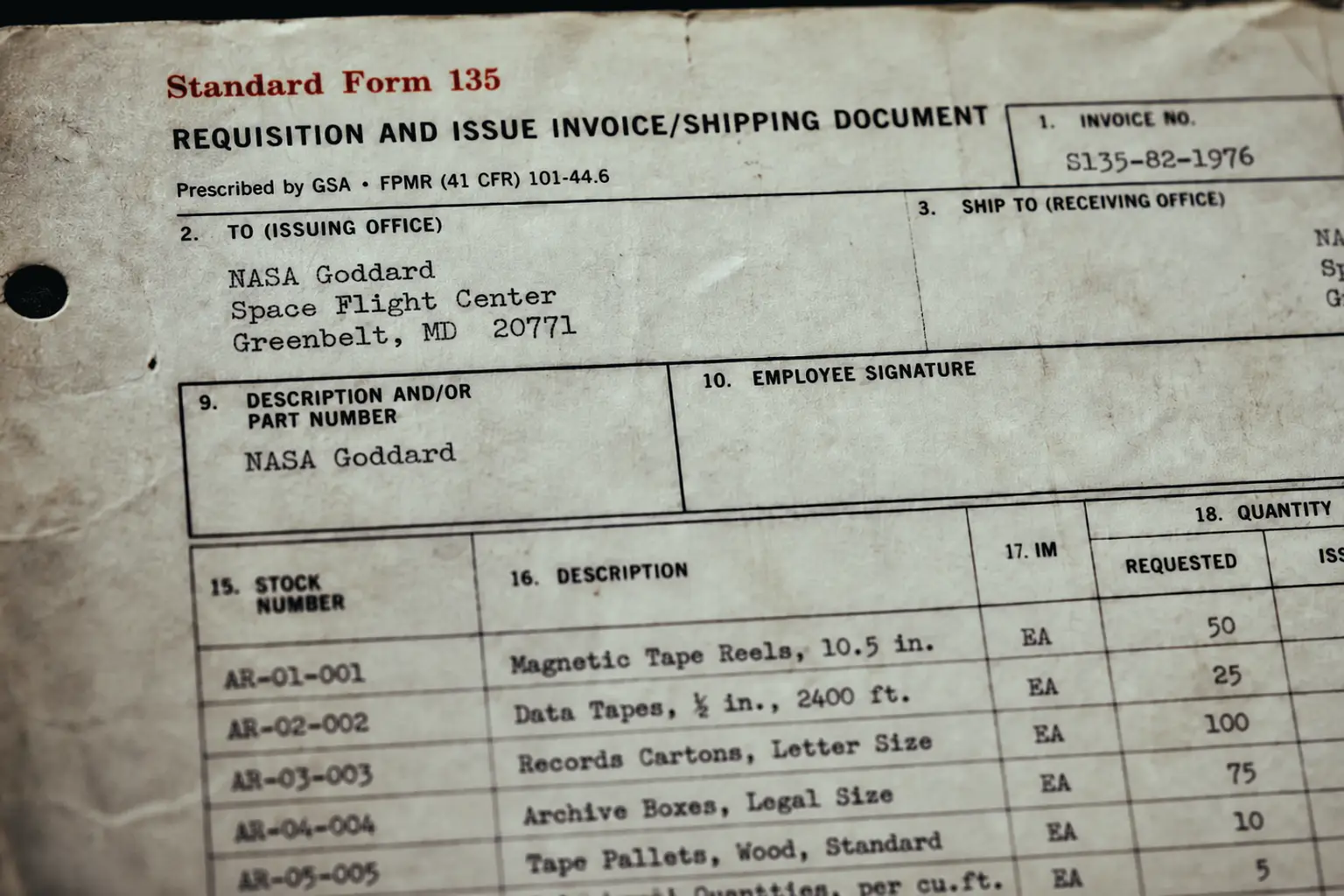
- Key Anomalies Documented: The withdrawal of accession 255-69A-4099 as generic environmental data without historical flagging; the omission of individual employee names on Standard Form 135 charge cards, which were signed generically as 'NASA Goddard'; the absence of a required destruction authorisation order from the Johnson Space Center; and the conflict between the 2009 internal Nafzger report confirming destruction and the 2019 agency statement claiming no footage was missing.
- Primary Sources Utilised: The Apollo 11 Telemetry Data Recordings: A Final Report (2009 Nafzger Report); GAO Report B-164392 (1969); NASA Records Schedule 26 (NC1-255-78-03); Standard Form 135 charge cards from the Washington National Records Center; official 2019 NASA public statement.
Glossary of Terms
- Slow-scan television (SSTV): A way of sending video using a narrower signal than standard broadcast TV. It produces clearer pictures but cannot be shown on a normal television without conversion. The Apollo 11 camera used this format because it needed less radio bandwidth.
- Degauss: To erase data stored on a magnetic tape by running it through a powerful magnetic field. Once degaussed, the tape is blank and can be recorded over. The process is permanent and cannot be reversed.
- Accession number: A unique reference code given to a group of records when they are placed in a federal archive. Similar to a library catalogue number. Accession 255-69A-4099 was the code assigned to the Apollo 11 telemetry tapes at the Washington National Records Center.
- Standard Form 135 (SF-135): The official government paperwork used when removing records from a federal storage facility. It is required to record who took what, and when. The SF-135 cards from the 1981 withdrawals named the organisation but not the individuals involved.
- NTSC: The broadcast television standard used in the United States in 1969. The raw slow-scan signal from the lunar surface had to be converted into NTSC format before it could be broadcast. The conversion reduced image quality significantly.
What Was Actually on the Tapes
The Apollo 11 mission used a slow-scan television camera fixed to the side of the lunar module. Slow-scan television (SSTV) is a way of sending video using a narrower radio signal than normal broadcast television. It produces a clearer picture, but it cannot be shown on an ordinary television without being converted first. Because the Apollo camera used this format, engineers at three tracking stations on Earth had to convert the signal live before it could reach the public.
Those stations were Goldstone in California, Parkes in New South Wales, and Honeysuckle Creek near Canberra. Each one recorded the raw, unconverted slow-scan signal straight onto one-inch magnetic tapes running at 120 inches per second. The tapes captured 14 separate tracks of data: voice communications, biomedical readings, and the uncompressed video feed. This was the engineering backup. If the live conversion failed, or if the relay to Houston broke down, the tapes would let engineers try the conversion again later.
The live broadcast worked. The converted signal reached television sets around the world on 20 July 1969. From that point, the engineering teams treated the 45 backup reels as redundant. The mission goal had been met. The tapes had done their job.
Here is the part nobody flagged at the time. No procedure required them to. The raw slow-scan footage on those tapes was sharper than anything the broadcast conversion could produce. Polaroid photographs taken directly from the slow-scan monitors at the Australian stations would later prove this. The public watched a degraded copy. The original sat in a box.
Telemetry Signal Path Comparison
Where data quality was lost during the Apollo 11 mission
Slow-Scan Path (Primary Data)
Captured video using a narrow radio signal for clearer pictures.
Received the direct slow-scan radio signal on Earth.
Recorded the raw, unconverted signal perfectly onto 1-inch backup tape.
NTSC Broadcast Path (Degraded)
Signal received from the lunar surface.
Engineers live-converted the slow-scan signal to NTSC broadcast standards.
The public watched a copy with significantly reduced image quality.
How the Tapes Were Logged
After the mission, tracking station staff boxed the 45 reels into 14-inch metal canisters and shipped them by airfreight to the Goddard Space Flight Center in Greenbelt, Maryland. From Goddard, the logistics division moved the boxes to the Washington National Records Center in Suitland, Maryland, a large federal storage facility for government records.
The tapes were filed under accession number 255-69A-4099. That is a catalogue number, a unique code that tells archivists which shelf to look on. The paperwork described the contents as ‘magnetic tapes’. Nothing more. There was no mission-specific flag, no historical preservation note, and no instruction separating these 45 reels from the routine satellite data stored next to them.
The records schedule that covered this material was NASA Records Schedule 26: ‘Computer-Sensible Scientific, Engineering, and Experimental Data’. It gave broad guidance on handling magnetic media but had no sub-category for historically irreplaceable material. Under the schedule, a reel of lunar surface footage and a reel of weather satellite data were the same class of object. No internal Goddard document flagging the slow-scan footage for permanent retention has been found.
The archival record from 1969 onwards contains no memos, annotations, or formal objections flagging the slow-scan footage for permanent retention.
Physical Journey of the Telemetry Tapes
45 reels boxed into 14-inch metal canisters and shipped via airfreight.
The logistics division processes the materials for storage.
Tapes filed under accession number 255-69A-4099. Paperwork describes contents only as 'magnetic tapes' under NASA Records Schedule 26. No historical preservation flag applied.
The Auditor Who Changed the Culture
Throughout the 1960s, Goddard had a simple approach to its magnetic tapes: keep them. By June 1969, the facility had built up more than 900,000 reels of data from decades of satellite and space missions. That approach was about to be reversed.
Between September 1968 and April 1970, the General Accounting Office (the federal agency that audits government spending) reviewed Goddard’s tape management and published the findings as Report B-164392. The report was blunt. Goddard was hoarding tapes at serious cost to the taxpayer, and it needed to stop. The financial case was plain: buying a new reel of tape cost $20. Erasing and reusing an old one cost $4.63. With 900,000 reels sitting in storage, the maths did not work.
The GAO issued a formal directive requiring NASA to start recycling tapes and to stop archiving data reels indefinitely. Goddard’s management responded by building a tape recertification operation inside the facility. New internal instructions said tapes should be held only until ‘meaningful information has been extracted’, then wiped and returned to circulation. The directive made no exemption for mission-specific or historically important data.
The audit effectively turned permanent records into consumable office supplies.
By forcing the facility to keep magnetic media in constant circulation, the new rules eliminated the concept of historical preservation. The instructions did not explicitly target the Apollo 11 reels, but its strict financial quotas ensured that erasing archival data became a daily administrative chore.
GAO Report B-164392 Findings
The financial case that eliminated permanent preservation
Tape Inventory (1969)
900,000+
Procure New Tape
Erase and Reuse
Formal Directive
Recycle Media
Federal auditor required NASA to stop holding tapes indefinitely and return them to active circulation.
The Landsat Crisis and the Withdrawal
By January 1981, Goddard’s tape supply was under severe strain. The Landsat satellite programme, which captured continuous environmental data from orbit, was producing far more data than anyone had planned for. The Network Operations Division (Code 850) issued a formal warning on 8 January 1981. The memo recorded that demand for magnetic media had jumped by 10 reels per day for one satellite network and 50 reels per day for the Image Processing Facility. Goddard’s tape recertification facility had already added a third shift. It was not enough.
By 7 May 1981, the situation had hit a wall. The Data Evaluation Section (Code 863.1) submitted a formal procurement demand for 164,220 reels of magnetic tape to supply active satellite networks over eight months. The budget could not cover that volume of new tape. Quality problems with outside manufacturers closed off that option too. Goddard’s logistics officers turned to the only source left: the Washington National Records Center archives.
Between 1981 and 1983, Goddard withdrew 42,996 boxes of tape from the Suitland facility. In 1981 alone, 25,443 boxes were pulled. The Apollo 11 telemetry tapes, filed under accession number 255-69A-4099, were somewhere in that batch. Nothing in the filing system marked them as different from any other box on the shelf.
System Requisition
Support the retrieval and hosting of these secure files.
How the Destruction Was Carried Out
The Network Procedures and Evaluation Division (Code 860) held management authority over the Data Evaluation Section. A former chief of that division confirmed issuing standing orders for the tape withdrawal process. The instructions were clear… strip all identifying labels from the recalled tape canisters, run the reels through the industrial degaussers to erase the magnetic data, and return the blank media to the active supply chain for the Landsat programme.
The Standard Form 135 charge cards (the official paperwork used when withdrawing records from a federal archive) were supposed to name the specific employee removing the materials. That is a standard chain-of-custody requirement under National Archives rules. The cards from the 1981 to 1983 withdrawals do not do this. The employee name fields record only ‘NASA Goddard’. No individual names appear. The specific logistics officers who physically signed out the pallets containing accession 255-69A-4099 cannot be identified from the surviving paperwork.
This was not an isolated slip. The incomplete SF-135 records run across the full withdrawal period, covering tens of thousands of boxes. The failure to record individual names appears to have been routine, not an exception made for any specific batch.
Chain of Custody Anomaly
- Standard Form 135 charge cards required a specific employee name when removing records from a federal archive.
- Records from the 1981 to 1983 tape withdrawals list only "NASA Goddard" in the employee name field.
- The failure to record individual names ran across tens of thousands of boxes. The specific officers who signed out Accession 255-69A-4099 cannot be identified.
Two Official Accounts That Do Not Match
On 16 July 2009, NASA held a press conference in Washington. Richard Nafzger, the senior video engineer who had led the internal search for the tapes, confirmed on the record that the 45 Apollo 11 telemetry reels had been degaussed and reused in the early 1980s to save money and cover a severe supply shortage. The agency published his findings as the official conclusion of the investigation.
In July 2019, a private auction of unrelated video tapes brought the question of the missing lunar footage back into public view. NASA responded with an official agency statement. The statement said there was ‘no missing footage from Apollo 11 since the video transmissions were relayed to the Manned Spacecraft Center’ and that ‘all the video was recorded elsewhere’.
These two positions cannot both be right.
The 2009 Nafzger report confirmed the destruction of the primary slow-scan telemetry data: the highest-quality raw footage, recorded only on the 45 tapes. The 2019 statement treats that destroyed primary data and the surviving broadcast footage as the same thing. The surviving NTSC broadcast footage is a lower-resolution conversion of the original signal. The 2019 statement conflates this surviving degraded copy with the primary slow-scan data that was systematically wiped in the early 1980s.
No internal NASA document has been found explaining why the 2019 statement departed from the 2009 findings. No correction to the 2019 statement has been issued.
Contradictory Public Postures
| Year | Source | Stated Position | Characterisation |
|---|---|---|---|
| 2006 | Public and media sentiment | Tapes are misplaced in a vast archive | Gross negligence or historical mystery |
| 2009 | Nafzger Report (NASA internal) | Tapes were systematically degaussed | Administrative process failure and resource shortage |
| 2019 | Official NASA agency statement | No footage is missing; backups exist | Dismissal of the primary evidence loss |
The Search and What It Found
The informal search for the tapes began in the late 1990s. Former tracking station engineers, prompted by Polaroid photographs taken from the slow-scan television monitors at the Australian stations in 1969, realised the raw footage was far better than anything the public had seen. The photographs showed a clarity that the broadcast conversion had thrown away.
John Sarkissian, an operations scientist at the Parkes Radio Observatory, began formal enquiries with various NASA centres. The search stalled because nobody could confirm the tapes’ location, existence, or last known handling department.
In August 2006, Goddard Space Flight Center Deputy Director Dolly Perkins authorised a formal internal investigation. Richard Nafzger led the search alongside Stan Lebar, the former project manager for the original Apollo lunar surface camera. The team searched the National Archives, the Washington National Records Center, and internal Goddard databases. They uncovered the 1981 logistics memos and the mass withdrawal records. Those documents confirmed the destruction.
The Code 863.1 logbooks would have been the clearest record. These internal logs tracked every tape accession that came into and left the Data Evaluation Section. Former employees confirmed those logbooks had existed. They cannot be found.
Investigation Chronology
-
Late 1990s
Informal Search Begins
Former tracking station engineers begin enquiries regarding the location of the raw telemetry tapes.
-
2005
Polaroid Evidence Surfaces
Photographs taken directly from tracking station monitors confirm the high quality of the raw slow-scan footage.
-
August 2006
Formal Investigation Authorised
Goddard Space Flight Center Deputy Director Dolly Perkins authorises an official internal search.
-
July 2009
Official Findings Announced
Richard Nafzger confirms the 45 telemetry tapes were degaussed and returned to circulation in the early 1980s.
Source
Sources include: the 2009 internal agency investigation, ‘Apollo 11 Telemetry Data Recordings: A Final Report’; the General Accounting Office audit ‘Report B-164392’ regarding magnetic tape management at the Goddard Space Flight Center; ‘NASA Records Schedule 26’ covering computer-sensible scientific data; and official agency statements issued to the press in 2009 and 2019.
Claim-Source Matrix
| Core Finding | Primary Source Document | Status |
|---|---|---|
| Tracking stations recorded the raw slow-scan signal onto 45 reels of 1-inch tape. | The Apollo 11 Telemetry Data Recordings: A Final Report | Confirmed (Privileged) |
| Tapes were filed at the Washington National Records Center with no historical preservation note. | NASA Records Schedule 26 (NC1-255-78-03) | Confirmed (Privileged) |
| A federal auditor required NASA to recycle tapes due to high storage costs ($4.63 to reuse vs. $20 to buy new). | GAO Report B-164392 | Confirmed (Privileged) |
| The 45 Apollo 11 telemetry reels were withdrawn, degaussed, and reused to supply the Landsat programme. | The Apollo 11 Telemetry Data Recordings: A Final Report | Confirmed (Privileged) |
| NASA's 2019 public statement conflated the surviving NTSC broadcast copy with the destroyed primary data. | Official NASA Press Release / Space.com | Confirmed (Privileged) |
What we still do not know
- Johnson Space Center Authorisation: Internal rules required written permission from Johnson Space Center to destroy Apollo data. No such authorisation has been recovered.
- Code 863.1 Logbooks: The internal tracking records that logged every tape into the Data Evaluation Section existed but cannot currently be found.
- Chain of Custody Names: The withdrawal charge cards from the 1981 period record 'NASA Goddard' instead of the specific logistics officers who physically removed the tapes.
- The 2019 Agency Statement: No internal document explains why NASA publicly departed from its own 2009 destruction findings to claim no footage was missing, and no correction has been issued.
Comments (0)