
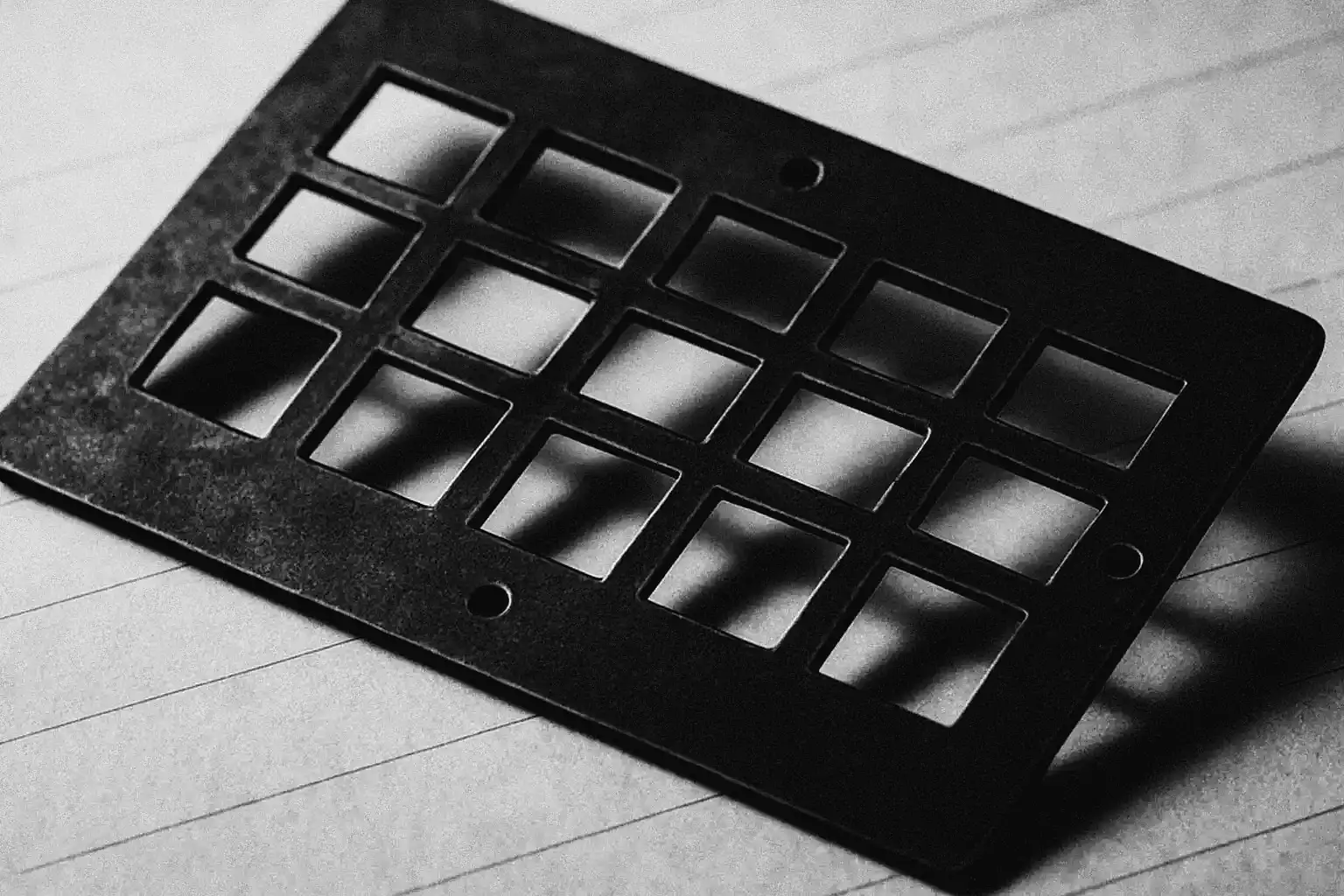
The Voynich parchment dates to 1404–1438. The earliest comparable documented stencil located in the reviewed cryptographic record appears 88 years after that range ends.
Data Manifest
- Primary Investigation: Whether the documented chronology of grille-based cryptography fits Gordon Rugg's proposed table-and-grille explanation for the Voynich Manuscript.
- Key Anomalies Documented: The parchment dates to 1404 to 1438 at 95 per cent confidence, while the earliest comparable steganographic stencil located in the reviewed record dates to 1526 and Cardano's grille to 1550.
- Primary Sources Utilised: University of Arizona radiocarbon dating; Philip M. Arnold's study of Jacopo Silvestri; and Montemurro and Zanette's analysis of Voynich word patterns. Gordon Rugg's 2004 table-and-grille proposal was represented through the reviewed research record rather than directly reviewed.
Glossary
- Radiocarbon dating: Testing used here to estimate when the animals providing the manuscript's parchment died. It does not date when the ink or pigment was applied.
- Grille: A card or stencil containing openings that reveal selected material beneath it. Rugg's proposed method moves such a grille across a table of word fragments.
- Palimpsest: A manuscript made by removing earlier writing from parchment so that the material can be written on again. Testing has been reported as finding no evidence that the Voynich Manuscript is one.
Understanding Radiocarbon Dating for the Voynich Manuscript
Four pieces of parchment from the Voynich Manuscript were sampled for radiocarbon testing. They came from folios 8, 26, 47 and 68, rather than from a single sheet. Their probability distributions were consistent with one another.
The combined result has been reported as 516±18 radiocarbon years before present, corresponding to 1421±8.5 AD. At 95 per cent confidence, the parchment falls within 1404 to 1438. The dating result was publicly announced on 8 December 2009.
That range applies to the parchment. Radiocarbon testing measures when the animals from which the skins were made died. It does not establish when somebody wrote or painted on those skins.
This distinction matters because the manuscript’s text cannot presently be given an equivalent radiocarbon date. Greg Hodgins of the University of Arizona explained that the quantities of material present in the inks are too small for direct dating and that some pigments contain inorganic material. A fifteenth-century parchment date therefore fixes one part of the manuscript’s chronology while leaving another part undated.
What the Radiocarbon Result Actually Dates
Four parchment samples establish the age of the material, not the date of the writing.
Samples tested
4
Folios 8, 26, 47 and 68.
95 per cent range
1404–1438
The estimated date range for the death of the animals used for the parchment.
Writing date
Undated
The ink and pigment cannot presently be given an equivalent radiocarbon date.
The Boundary
The scientific result fixes the parchment to the early fifteenth century. It does not establish when somebody wrote or painted on it.
Overview of the Gordon Rugg Table and Grille Method
Gordon Rugg proposed a method for generating Voynich-like text in his 2004 paper, ‘An Elegant Hoax?’
The system uses a large table containing word fragments arranged in groups corresponding to prefixes, middle elements and suffixes. A card or grille containing strategically positioned holes is placed over the table. The exposed fragments can then be combined into words. Moving the grille to different positions produces further combinations.
Rugg linked this mechanism to the grille associated with the sixteenth-century mathematician Girolamo Cardano. His proposed historical scenario was correspondingly late: he placed possible production after 1550 and suggested Edward Kelley, active around the court of Rudolf II, as a possible author of a hoax.
The post-1550 date was therefore part of the original proposal. It was not introduced as an answer to the later radiocarbon results.
Rugg and Gavin Taylor then developed the approach further and reported that generated pseudo-text could reproduce statistical characteristics associated with Voynichese. Their work concerned whether a relatively simple procedure could produce text with relevant statistical properties. It did not supply a fifteenth-century source for the physical mechanism.
How the Table-and-Grille Method Works
Arrange word fragments in a large table, grouped into prefixes, middle elements and suffixes.
Place a card or grille containing strategically positioned holes over the table.
Read the fragments exposed through the holes and combine them into words.
Move the grille to another position to expose a different set of combinations.
Chronological Discrepancies in the Voynich Manuscript Timeline
The parchment’s latest radiocarbon boundary is 1438. The earliest comparable stencil identified in the reviewed history of cryptography appears substantially later.
Leon Battista Alberti’s ‘De Cifris’, circulated in 1467, describes a rotating cipher disk. It provides an important early mechanical cryptographic device, but not a perforated mask selecting elements from a table.
Johannes Trithemius’s ‘Steganographia’, composed around 1499, concerns concealed communication without supplying a comparable stencil. His ‘Polygraphia’, published in 1518, contains the tabula recta, giving the history a table but still not the perforated selection mask required by Rugg’s procedure.
In 1526, Jacopo Silvestri published ‘Opus novum’ in Rome. Philip M. Arnold’s study of Silvestri identifies this work as the earliest printed presentation of a steganographic stencil in the cryptographic record reviewed here. It appears 88 years after 1438.
Cardano’s ‘De Subtilitate’ followed in 1550. The grille associated specifically with Rugg’s proposal therefore enters the documented record 112 years after the upper end of the Voynich parchment range.
Giovanni Battista della Porta’s ‘De Furtivis Literarum Notis’ appeared in 1563 and supplies further later evidence for techniques involving grilles and boards with openings.
No pre-1450 source documenting a grille, stencil or functionally comparable table-and-mask selection procedure was located in the material reviewed for this investigation. That identifies the present limit of the documentary search. It does not establish that an undocumented technique could not have existed.
The Documented Chronology
-
1404–1438
Voynich parchment
The 95 per cent radiocarbon interval for the parchment. The result dates the animal skins, not the writing.
-
1467
Alberti, 'De Cifris'
Describes a rotating cipher disk, not a perforated mask selecting elements from a table.
-
c.1499
Trithemius, 'Steganographia'
Deals with concealed communication without supplying a comparable stencil.
-
1518
Trithemius, 'Polygraphia'
Contains the tabula recta, providing a table but not the perforated selection mask required by Rugg's procedure.
-
1526
Silvestri, 'Opus novum'
The earliest printed presentation of a steganographic stencil identified in the reviewed cryptographic record, 88 years after 1438.
-
1550
Cardano, 'De Subtilitate'
Documents the grille associated specifically with Rugg's proposal, 112 years after the parchment's upper radiocarbon boundary.
-
1563
Della Porta, 'De Furtivis Literarum Notis'
Provides further later evidence for techniques involving grilles and boards with openings.
Analysis of Post Parchment Writing Scenarios
A later inscription date would require fifteenth-century parchment to have remained available until the technique proposed by Rugg was in use.
Laboratory work commissioned in 2009 identified iron-gall inks in the manuscript, with only minor compositional variation reported across the material examined. Pigment analysis also identified materials including copper-based compounds and a palette compatible with Renaissance practice. None provides a sufficiently precise date for the act of writing.
The inability to date the ink directly leaves room between manufacture of the parchment and application of the text. Other material observations narrow the possible scenarios without measuring that interval.
Protein testing and multispectral work have been reported as finding no evidence that the Voynich Manuscript is a palimpsest. On that evidence, the later-writing scenario cannot simply be explained as somebody erasing an earlier manuscript and writing over it.
René Zandbergen has also reported the view of manuscript curators that parchment was usually used relatively soon after its preparation. The qualification is important. ‘Usually’ does not mean that every prepared sheet had to be used immediately.
Codicologist Lisa Fagin Davis has likewise reported finding no compelling evidence that the manuscript is not an authentic fifteenth-century object. That assessment adds codicological evidence to the radiocarbon chronology, but it does not amount to a direct scientific date for the ink.
Priority Briefings
New investigations, evidence checks, and unresolved questions from Veriarch, sent directly to your inbox.
Evaluation of the Old Parchment Hypothesis
SantaColoma cites a Protonotarii register from 1523 with 88 vellum pages still blank. It shows that unused parchment could remain in a bound volume rather than being written on soon after preparation.
It does not show a complete manuscript subsequently being written on parchment known to have remained blank for many decades or more than a century.
No peer-reviewed codicological study quantifying a normal maximum storage period for unused parchment was located in the material reviewed. Technical literature on parchment manufacture does not supply that missing baseline.
The reviewed material also did not identify a named non-palimpsest manuscript in which a complete text has been shown to have been written on parchment stored blank for decades. Surviving blank leaves do not provide an example of that later inscription.
Nick Pelling has raised a separate objection based on the Voynich samples themselves. He argues that three of the four radiocarbon measurements cluster too closely to fit well with the idea that a much later maker simply gathered miscellaneous pieces of old parchment. He has also pointed to features including quire numerals, digit forms, contractions, parallel hatching and marginalia as indications of an early date.
Those observations address one possible route by which old parchment might have been obtained. They do not establish a measurable date for the writing.
Old Parchment: What the Evidence Does and Does Not Show
| Evidence | What It Supports | What It Does Not Establish |
|---|---|---|
| 1523 Protonotarii register cited with 88 blank vellum pages | Unused parchment could survive within a bound volume. | That an entire manuscript was later written on parchment stored blank for many decades or more than a century. |
| Curatorial assessment reported by René Zandbergen | Parchment was usually written on relatively soon after preparation. | That every prepared sheet had to be used immediately. |
| No named comparable manuscript located in the reviewed material | The investigation lacks a direct historical analogue for the proposed later-writing route. | That such a manuscript or practice could never have existed. |
| Nick Pelling's radiocarbon clustering argument | Three of the four measurements are argued to fit poorly with opportunistic assembly from miscellaneous old parchment. | A measurable date for when the Voynich text was written. |
Statistical Reproduction and Voynich Manuscript Text Generation
The chronological question is separate from whether Rugg’s procedure can imitate Voynichese.
Rugg and Taylor reported that generated text could reproduce statistical features associated with the manuscript. René Zandbergen later reported developing a table-and-grille configuration capable of generating page f9v under a constructed system. These experiments show that procedures of this general kind can be designed to produce output resembling features of the Voynich text.
A different question is whether the proposed historical process can account for the full structure found in the manuscript. Rugg did not provide a reconstructed historical table capable of generating a contiguous real Voynich passage through the meaningful-hoax procedure he proposed.
Other statistical work has also identified features requiring explanation. Marcelo Montemurro and Damián Zanette found keyword and co-occurrence patterns compatible with linguistic organisation, including clustering related to different manuscript sections. Their results concern relationships between words, not merely their lengths or frequency distributions.
The finding neither dates the manuscript nor establishes what Voynichese means. Any generation model intended to account for the text must still address more than superficially plausible words and broad frequency patterns.
Other meaningless-text hypotheses do not require Cardano’s grille at all. Torsten Timm and Andreas Schinner proposed a self-citation process which they described as feasible for a medieval scribe without additional tools. Their model does not carry the same chronological problem as Rugg’s: a meaningless-text explanation does not in itself depend on a sixteenth-century grille.
Support the Archive
Help fund the retrieval, hosting, and preservation of Veriarch investigations.
Source Box
Sources include: University of Arizona AMS radiocarbon dating of four Voynich Manuscript parchment samples; McCrone Associates’ January 2009 ink and pigment analysis; Gordon Rugg’s ‘An Elegant Hoax? A Possible Solution to the Voynich Manuscript’ in ‘Cryptologia’ 28(1), 2004, and Rugg and Gavin Taylor’s ‘Hoaxing Statistical Features of the Voynich Manuscript’ in ‘Cryptologia’ 41(3), 2017; Philip M. Arnold’s ‘An Apology for Jacopo Silvestri’ in ‘Cryptologia’ 4(2), 1980; Marcelo A. Montemurro and Damián H. Zanette’s ‘Keywords and Co-Occurrence Patterns in the Voynich Manuscript: An Information-Theoretic Analysis’ in ‘PLOS ONE’ 8(6), 2013; René Zandbergen’s ‘The Cardan Grille Approach to the Voynich MS Taken to the Next Level’, 2021; and Torsten Timm and Andreas Schinner’s ‘A Possible Generating Algorithm of the Voynich Manuscript’ in ‘Cryptologia’ 44(1), 2020.
Claim-Source Matrix
| Core Finding | Primary Source Document | Status |
|---|---|---|
| The tested parchment falls within 1404 to 1438 at 95 per cent confidence. | University of Arizona AMS radiocarbon dating | Confirmed |
| Rugg's proposed text-generation system uses a table of word fragments and a movable perforated grille, with his historical scenario placed after 1550. | Gordon Rugg, 'An Elegant Hoax?' (2004) | Confirmed |
| Jacopo Silvestri's 1526 'Opus novum' is identified as the earliest printed presentation of a steganographic stencil in the reviewed cryptographic record. | Philip M. Arnold, 'An Apology for Jacopo Silvestri' (1980) | Confirmed |
| Voynichese contains keyword and co-occurrence patterns compatible with linguistic organisation and topic-dependent clustering. | Montemurro and Zanette, PLOS ONE (2013) | Confirmed |
What We Still Do Not Know
- A forensic method has not yet dated the Voynich writing closely enough to distinguish fifteenth-century application from substantially later use of the parchment.
- No source before 1450 documenting a grille, stencil or functionally comparable table-and-mask selection procedure was located in the material reviewed.
- A named non-palimpsest manuscript in which a complete text can be shown to have been written on parchment stored blank for decades was not identified in the reviewed material.
- It is unresolved whether Rugg's table-and-grille method can reproduce the topic-dependent word clustering identified by Montemurro and Zanette as well as the statistical features already demonstrated.
- The evidence does not establish whether the manuscript's illustrations were applied at the same time as the text or during a later stage of production.
Comments (0)