
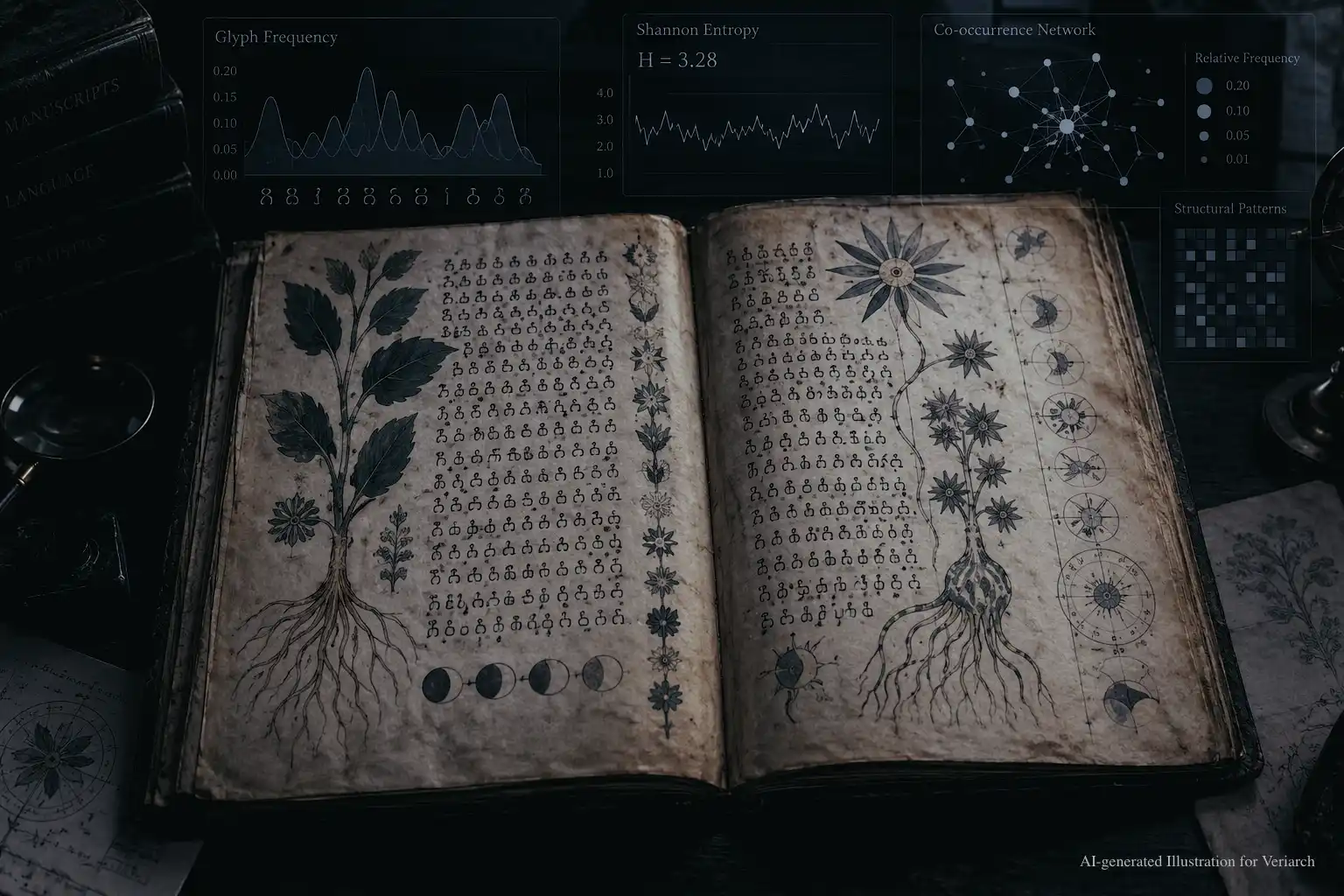
Voynichese has statistical features associated with natural language, but several can also be reproduced without meaning. Other measurements remain unusual and unresolved.
Data Manifest
- Primary Investigation: Whether published statistical properties of Voynichese can distinguish meaningful language from non-semantic text generation.
- Key Anomalies Documented: Unusually low conditional character entropy, a near-binomial word-length distribution, strong internal regularity and long-range organisation that has competing linguistic and non-semantic explanations.
- Primary Sources Utilised: Published analyses by Landini; Reddy and Knight; Montemurro and Zanette; Amancio and colleagues; Timm and Schinner; Lindemann and Bowern; Bowern and Lindemann; and Gaskell and Bowern.
Glossary
- Conditional entropy: A measure of how much uncertainty remains about a character once the preceding character is known.
- Bigraphic representation: A system in which units are represented through combinations of characters rather than a single character.
- Co-occurrence network: A network linking words that occur in related contexts, used in Voynichese research to examine possible structure between words.
- Self-citation generator: A proposed text-generation process that creates new forms by reusing and modifying forms that already appear in the text.
- Transcription: A written representation of the manuscript used for computational analysis. Choices about glyph identity and character boundaries are made before the statistics are calculated.
- EVA: The transliteration system developed by Gabriel Landini and René Zandbergen that became the dominant basis for later computational analysis of Voynichese.
Statistical Claims About the Voynich Manuscript
Statistical analysis of Voynichese has produced evidence for markedly different accounts of the manuscript.
In 2001, Gabriel Landini reported spectral properties associated with natural language and described the text as more than a random collection of characters. Andreas Schinner reached a different position in 2007. His analysis concentrated on the unusually low conditional character entropy of Voynichese and argued that the result favoured a hoax hypothesis.
Further comparisons complicated the picture. In 2011, Sravana Reddy and Kevin Knight found Voynichese characters more predictable than those in English, Arabic or Pinyin. At the same time, particular characteristics resembled Quranic Arabic and Chinese Pinyin.
Two studies published in 2013 strengthened the statistical case for linguistic structure. Marcelo Montemurro and Damián Zanette reported long-range organisation in the distribution of words and extracted co-occurrence networks that they interpreted as possible semantic structure. Diego Amancio and colleagues found Voynichese mostly compatible with natural languages on selected network measures, while also discussing its atypical word-length distribution.
The same text was producing both language-like and anomalous findings.
Priority Briefings
New investigations, evidence checks, and unresolved questions from Veriarch, sent directly to your inbox.
Zipf Law and Non Semantic Replication
One of the recurring findings is that Voynichese displays Zipf-like word frequencies. In ordinary language, a small number of words occur very frequently while progressively larger numbers occur less often. Landini, Montemurro and Zanette, and Amancio and colleagues all identified this kind of behaviour in Voynichese.
Later work showed why that finding has limited discriminatory value.
Torsten Timm and Andreas Schinner published a self-citation text generator in 2020. Their proposed process constructs new text through the reuse and modification of existing forms. Its output satisfied both Zipf laws alongside other statistical properties reported for Voynichese.
A different test followed in 2022. Daniel Gaskell and Claire Bowern asked 42 volunteers to produce meaningless text. Their human-written gibberish also displayed Zipf-compliant behaviour and reproduced aspects of Voynichese word morphology.
Those samples were not statistically interchangeable with meaningful writing. On average, the gibberish contained more repetition and less total information than meaningful text. Producing a Zipf distribution therefore did not reproduce every property under examination.
Zipf Behaviour Is Not a Decision Rule
| Text or Model | Reported Result | What It Establishes |
|---|---|---|
| Voynichese | Published analyses report Zipf-like word-frequency behaviour. | The manuscript has a statistical feature also associated with ordinary language. |
| Timm and Schinner self-citation generator | The generated output satisfied both Zipf laws alongside other reported Voynichese properties. | A non-semantic generative process can also produce Zipf behaviour. |
| Gaskell and Bowern human gibberish | Meaningless samples produced by 42 volunteers also displayed Zipf-compliant behaviour. | Human-produced meaningless text can independently reproduce the same broad frequency pattern. |
The non-semantic samples did not reproduce every property of meaningful writing or every statistical property of the manuscript.
Conditional Entropy Anomalies in Voynichese
Character predictability presents a different problem.
Reddy and Knight found Voynichese character sequences unusually predictable compared with English, Arabic and Pinyin. Luke Lindemann and Claire Bowern later separated unconditional character entropy from conditional entropy, which measures how much uncertainty remains about a character when the preceding character is known.
Voynichese fell within the normal comparison range for unconditional character entropy. Once the preceding character was taken into account, its entropy was unusually low.
There are competing explanations for that result. Bowern and Lindemann have argued that some forms of encipherment can produce similarly low conditional entropy. Bigraphic representations, in which units are represented through combinations of characters, and the insertion of null characters can increase predictability without requiring the original language itself to have that statistical property.
Schinner, and later Timm and Schinner, have treated the same anomaly as compatible with mechanically generated text in which character combinations are constrained by the production method.
What produced the unusually low conditional entropy remains unresolved.
One Statistical Result, Competing Explanations
The low conditional entropy is documented. Its cause is not settled.
Observed Result
Voynichese fell within the normal comparison range when characters were considered without reference to the preceding character.
Once the preceding character was taken into account, Voynichese entropy was unusually low.
Compatible Explanations
Bowern and Lindemann argue that bigraphic representations and null characters can lower conditional entropy without requiring the underlying language to have the same property.
Schinner, and later Timm and Schinner, treat the same predictability as compatible with text generated under constrained character-combination rules.
Voynichese Word Construction and Positional Constraints
Voynichese words are also unusual in their lengths and internal regularity.
Published analyses describe their length distribution as close to binomial, rather than following the distributions normally found in the natural-language samples used for comparison. Reddy and Knight reported Quranic Arabic as the closest comparison in their word-length analysis.
The resemblance is compatible with a linguistic explanation, because the written representation of a language can alter the statistics visible on the page. Mechanical accounts can also produce the same kind of distribution.
Constrained construction from a limited number of positions can also generate a binomial-like distribution of word lengths. Related generator proposals use restricted word formation or modification of existing forms to account for regularities in Voynichese morphology.
Long Range Linguistic Structure and Topic Modeling
Montemurro and Zanette’s 2013 study examined organisation extending beyond individual words. They reported long-range patterns in word distribution compatible with those found in real language sequences and identified networks of words occurring in related contexts. They interpreted these as candidates for semantic structure and as support for a genuine message in the manuscript.
Self-citation offers a non-semantic mechanism capable of producing some comparable organisation. Timm and Schinner argue that repeated local copying and modification can create clusters extending over longer portions of a document as forms are reused.
Gaskell and Bowern’s human experiment provides another comparison. Their meaningless samples developed morphology and clustering despite the participants not encoding messages in the resulting text. Meaningful and meaningless samples nevertheless differed on measures including repetition and information content.
Scale remains an important limitation. The volunteer gibberish samples were shorter than the Voynich manuscript. No published manuscript-length version of the experiment was located reproducing Montemurro and Zanette’s specific long-range information-decay result.
Support the Archive
Help fund the retrieval, hosting, and preservation of Veriarch investigations.
Statistical Groupings in Currier A and B
Internal variation in Voynichese was documented well before the more recent dispute over generative models.
In 1976, Prescott Currier identified two statistical groupings within the manuscript, subsequently known as Currier A and Currier B. Their existence provides evidence that Voynichese is not statistically uniform across the manuscript.
Bowern and Lindemann have treated the distinction within a linguistic framework, including the possibility that the groups represent different linguistic varieties or systems.
Timm and Schinner offer a different interpretation. They argue that the variation could result from changes in the method used to generate the text or from scribal drift rather than from two linguistic varieties.
Transcription Impact on Statistical Analysis
Computational work does not operate directly on the manuscript pages. It operates on transcriptions of them.
The EVA transliteration system developed by Gabriel Landini and René Zandbergen became the dominant basis for subsequent computational analysis. Other studies have used Currier material, EVA-family files and newer transcription systems.
That matters because transcription requires decisions about what constitutes a glyph and where one character ends and another begins.
Zandbergen, one of EVA’s developers, has stated that the accuracy of standard Voynich transcriptions is largely unknown and that some assumptions used in constructing them may be sub-optimal or incorrect.
Different transcription choices do not establish that published statistical findings are wrong. They do mean that the numerical results inherit decisions made before the statistical analysis begins. No study located in the reviewed literature quantified glyph-identity or glyph-boundary uncertainty and then propagated that uncertainty through the principal entropy or network measurements.
The Statistical Pipeline Starts With Transcription
Manuscript page: The physical Voynich text contains handwritten glyphs that must first be interpreted for computational analysis.
Transcription decisions: Researchers decide what constitutes a glyph and where one character ends and another begins.
Transcribed corpus: EVA became the dominant basis for later computational work, while other studies have used Currier material, EVA-family files and newer systems.
Statistical measurement: Entropy, network measures and other numerical results are calculated from the transcription rather than directly from the manuscript page.
The article found no study that quantified uncertainty over glyph identity or boundaries and propagated that uncertainty through the principal entropy or network measurements.
Evaluating Generative Models and Statistical Reproduction
The existence of non-semantic models changes what individual statistical matches can demonstrate.
Timm and Schinner’s self-citation generator reproduced Zipf behaviour together with a stated set of other Voynichese statistical properties. Gaskell and Bowern showed that humans deliberately producing gibberish could independently reproduce Zipf behaviour and aspects of word morphology.
Neither result amounts to a complete statistical reproduction of the manuscript.
Gaskell and Bowern documented measurable differences between meaningless and meaningful samples. Their experiment was also conducted on texts shorter than the Voynich manuscript.
No published generative model identified in the reviewed literature has been shown to reproduce every major Voynichese metric simultaneously. And no published metric-by-metric comparison was located applying the complete Amancio and Montemurro-Zanette test sets to the Timm and Schinner generator.
The published generator evidence therefore concerns overlapping subsets of Voynichese’s statistical properties rather than a single model reproducing the full statistical record.
Comparative Analysis and Linguistic Corpora Limitations
Whether a feature is called unusual depends partly on what it is being compared with.
Existing Voynichese studies have used corpora containing European languages together with selected Semitic and Sinitic material. Coverage of some other linguistic types is more limited. Agglutinative and polysynthetic languages are among those identified as under-represented in the reviewed material.
A broader corpus could leave the existing findings unchanged or alter where Voynichese sits within the comparison range; the present evidence does not establish which.
The same problem affects scrutiny of particular entropy comparisons. The detailed composition of the 316-text set cited in Zandbergen’s conditional-entropy material was not itemised in the online material reviewed, preventing a full audit of its linguistic coverage.
Source Box
Sources include: Gabriel Landini’s 2001 Cryptologia paper ‘Evidence of Linguistic Structure in the Voynich Manuscript Using Spectral Analysis’; Andreas Schinner’s 2007 Cryptologia paper ‘The Voynich Manuscript: Evidence of the Hoax Hypothesis’; Sravana Reddy and Kevin Knight’s 2011 paper ‘What We Know About the Voynich Manuscript’; Marcelo Montemurro and Damián Zanette’s 2013 PLOS ONE paper ‘Keywords and Co-Occurrence Patterns in the Voynich Manuscript: An Information-Theoretic Analysis’; Diego Amancio and colleagues’ 2013 PLOS ONE paper ‘Probing the Statistical Properties of Unknown Texts: Application to the Voynich Manuscript’; Torsten Timm and Andreas Schinner’s 2020 Cryptologia paper ‘A Possible Generating Algorithm of the Voynich Manuscript’; Luke Lindemann and Claire Bowern’s 2020 paper ‘Character Entropy in Modern and Historical Texts: Comparison Metrics for an Undeciphered Manuscript’; Claire Bowern and Luke Lindemann’s 2021 Annual Review of Linguistics paper ‘The Linguistics of the Voynich Manuscript’; Daniel Gaskell and Claire Bowern’s 2022 paper ‘Gibberish after all? Voynichese Is Statistically Similar to Human-Produced Samples of Meaningless Text’; and René Zandbergen’s Voynich Manuscript transliteration materials.
Claim-Source Matrix
| Core Finding | Primary Source Document | Status |
|---|---|---|
| Long-range word organisation and co-occurrence networks were reported as compatible with genuine linguistic structure. | Montemurro & Zanette, 'Keywords and Co-Occurrence Patterns in the Voynich Manuscript' (2013) | Confirmed |
| Voynichese was reported as mostly compatible with natural languages on selected network measures while retaining an atypical word-length distribution. | Amancio et al., 'Probing the Statistical Properties of Unknown Texts' (2013) | Confirmed |
| A self-citation text generator reproduced both Zipf laws alongside other reported Voynichese properties. | Timm & Schinner, 'A Possible Generating Algorithm of the Voynich Manuscript' (2020) | Confirmed |
| Voynichese showed ordinary-range unconditional character entropy but unusually low conditional entropy. | Lindemann & Bowern, 'Character Entropy in Modern and Historical Texts' (2020) | Confirmed |
| Human-written meaningless text reproduced Zipf behaviour and aspects of Voynichese morphology, while differing from meaningful text on repetition and information content. | Gaskell & Bowern, 'Gibberish after all?' (2022) | Confirmed |
What We Still Do Not Know
- The Timm and Schinner self-citation generator has not been shown here to reproduce Montemurro and Zanette's long-range information-decay measurements at Voynich-manuscript length.
- Amancio and colleagues' network results have not been established as materially unchanged when calculated from a non-EVA transcription such as Currier or v101.
- Conditional-entropy measurements have not been recalculated with quantified uncertainty over glyph identity and glyph boundaries propagated through the analysis.
- A typologically broader comparison corpus could leave Voynichese's position unchanged or alter where it sits relative to natural languages. The present evidence does not establish which.
- Manuscript-length human gibberish has not been shown here to reproduce the specific long-range clustering reported by Montemurro and Zanette.
- No single linguistic, cryptographic or non-semantic model has been shown to reproduce the manuscript's principal statistical properties simultaneously within declared tolerances.
Comments (0)