
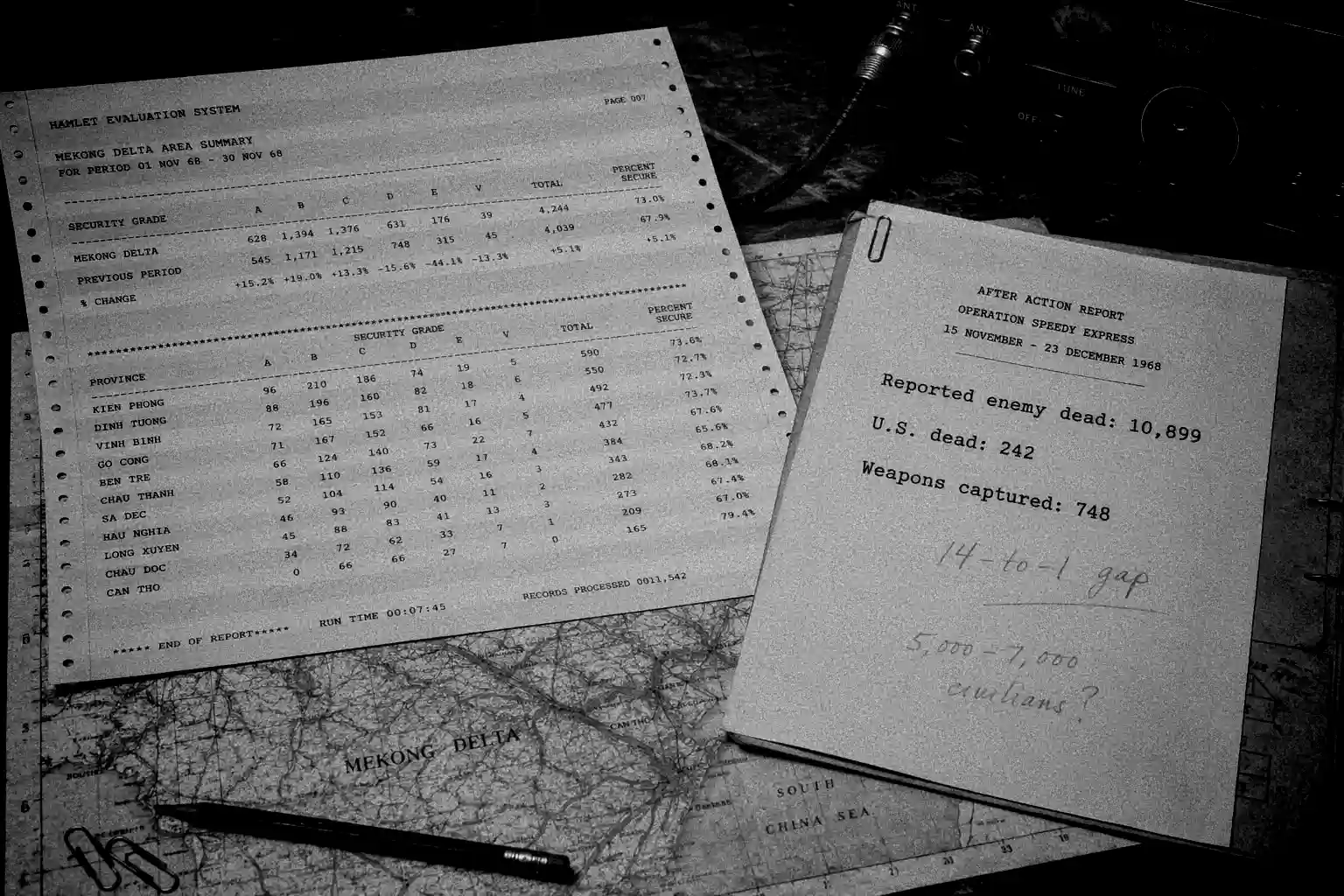
During six months of combat in the northern Mekong Delta, the United States 9th Infantry Division reported 10,899 enemy fighters killed, with 242 American casualties. Meanwhile, an unreleased internal Army review estimated 5,000 to 7,000 civilian deaths. Simultaneously, pacification computers in Saigon recorded the Delta as becoming increasingly secure.
Data Manifest
- Primary Investigation: The Vietnam War body count system under General William Westmoreland and the Mekong Delta pacification records of the 9th Infantry Division during Operation Speedy Express (1 December 1968 to 3 June 1969).
- Key Anomalies Documented: A documented dispute over the exclusion of irregular forces from the official Order of Battle, with MACV J2 publishing a guerrilla estimate of about 81,000 while Hamlet Evaluation System estimates remained around 155,000; a documented 14-to-1 gap between 10,899 reported enemy dead and 748 recovered weapons during Speedy Express; and a secondary-sourced Army Inspector General estimate of 5,000 to 7,000 civilian casualties, for which the original report has not been located.
- Primary Sources Utilised: US Department of State Foreign Relations of the United States minutes (21 November 1967), CIA History of the Hamlet Evaluation System (24 October 1966), US Army Center of Military History records, and Pentagon Systems Analysis Office audits.
Glossary
- Attrition: A military strategy that aims to win by wearing the enemy down through steady losses, rather than by capturing territory or cities.
- Crossover Point: The exact moment when American and allied forces were killing or capturing enemy soldiers faster than the enemy could recruit, draft, or train replacements. This was the mathematical goal of the attrition strategy.
- Order of Battle: The official intelligence estimate of enemy troop strength, listing how many fighters the enemy had and what kind of units they were organised into.
- Free-Fire Zone: A designated combat area where the standing rules of engagement classified anyone present as an enemy combatant, regardless of whether they were armed.
- Hamlet Evaluation System: A monthly survey used by American district advisors to score each South Vietnamese hamlet on an A-to-E letter scale, plus V for enemy-controlled, designed to measure how secure the population was under government control.
- Pacification: The wider civilian effort to secure rural areas, install local government, and provide economic and welfare support, running in parallel to combat operations.
Why Body Counts Became the Measure of Victory
American ground forces were pouring into South Vietnam by 1965, without a plan to capture or hold territory. The mission was to protect the government in Saigon, not to march on Hanoi. Without a map to point to, the Military Assistance Command, Vietnam needed a different way to prove it was winning.
General William Westmoreland, in charge at Saigon, chose attrition. That meant grinding the enemy down through steady losses, rather than seizing ground.
The measure of attrition was a single figure the command called the crossover point. This was defined as the moment when American and allied forces were killing or capturing enemy soldiers faster than the enemy could recruit, train, or draft replacements. It gave the war one number to chase. That number had to come from somewhere. Field officers were told to log the enemy dead after every engagement, and the tally became the primary way the command judged whether an operation had gone well. Promotions and evaluations moved with those numbers.
In designated free-fire zones, the rules of engagement let any body inside the boundary be logged as an enemy combatant, whether armed or not. Written reports made no separate entry for civilians killed inside these zones. Anyone who died there was recorded as an enemy fighter.
How the Crossover Point Was Meant to Work
- Enemy fighters killed or captured in combat operations
- Versus enemy fighters recruited, trained, or drafted as replacements
- The crossover point marked the mathematical threshold where losses exceeded replacements, defining the projected point of victory
How the Hamlet Evaluation System Scored Rural Vietnam
On 24 October 1966, Secretary of Defence Robert McNamara asked his officials for a quantitative way to measure pacification, the civilian effort to bring rural areas under government control. He thought the existing reports coming out of the villages were too subjective. He wanted numbers.
That request went to a task group at the Central Intelligence Agency, led by an analyst called George W. Allen. Their tool debuted in January 1967 under the name of the Hamlet Evaluation System, a monthly survey that scored each rural settlement on a letter scale. Allen’s team pushed the reporting baseline down from the village to the hamlet, on the reasoning that two hamlets inside the same village could sit at very different levels of safety.
Each worksheet ran to 18 criteria. Every criterion offered a set of pre-written statements about local security, government services, enemy presence, propaganda, and economic activity. A district advisor visited the hamlet, picked the statement that fitted best, and matched it to a grade.
Grades ran from Category A, meaning secure and functioning, down to Category V, meaning total enemy control.
Between 11,000 and 13,000 hamlets sat inside the survey each month. Raw worksheets were shipped to Saigon, where operators fed them into IBM 360 mainframe computers.
The machines produced thick statistical printouts, day and night. To commanders in Saigon and Washington, the reports looked like a scientific view of the countryside. The people reading them were often several layers removed from the hamlets being graded.
Hamlet Evaluation Grades (1967)
| Category Scale | Official Security Level Definition |
|---|---|
| Category A | Secure and functioning settlement under government control |
| Category B | Relatively secure with minor insurgent activity or presence |
| Category C | Contested settlement with competing government and enemy influence |
| Category D | Poor security with dominant enemy influence and weak government services |
| Category E | Minimal government presence and heavy insurgent control |
| Category V | Total enemy control |
The Intelligence Dispute That Made Tet Look Impossible
Pressure on the intelligence side of the house was reaching a peak by mid-1967. The dispute settled on the Order of Battle, the official military estimate of how many enemy fighters were in the field.
The Order of Battle dispute centred on which categories should count towards official enemy strength. MACV excluded low-level irregular forces, including Self-Defense units and political infrastructure cadre, from its official military estimates. Contemporary military records put the published MACV J2 guerrilla figure at about 81,000, while Hamlet Evaluation System estimates remained around 155,000. Army history also records roughly 120,000 Self-Defense and Secret Self-Defense personnel outside MACV’s official count.
At the Central Intelligence Agency, one researcher refused to accept the revision. Sam Adams argued from a database of captured documents that removing the categories did not change the physical count on the ground. MACV controlled the official military record. Lt. Col. Daniel Graham used crossover-point modelling internally to argue that enemy strength was declining and to defend the lower estimates.
The Tet Offensive
In late January 1968, Communist forces launched a coordinated surprise attack across dozens of cities and towns in South Vietnam. The scale of the assault was mathematically impossible under the revised Order of Battle.
The deleted irregulars had turned up on the streets. Sam Adams’s opposition, filed inside the CIA, did not travel far enough to move the files at MACV.
Conflicting Enemy-Strength Estimates (1967)
MACV J2 GUERRILLA ESTIMATE
Published military intelligence estimate for guerrilla strength.
HES GUERRILLA ESTIMATE
Hamlet Evaluation System estimate of guerrilla strength during the same dispute.
U.S. Army history also records roughly 120,000 Self-Defense and Secret Self-Defense personnel whom MACV declined to include in its official count.
When Johnson and McNamara Knew the Numbers Were Failing
On 21 November 1967, five men sat in a meeting to discuss whether the numbers coming out of Vietnam could be believed. Present were President Lyndon B. Johnson, Secretary of Defence Robert McNamara, General William Westmoreland, Ambassador Ellsworth Bunker, and the Chairman of the Joint Chiefs, General Earle Wheeler.
The minutes of that meeting, later declassified as part of the State Department’s Foreign Relations of the United States series, show a plain conversation about the loss of public trust.
McNamara said he dared not stop reporting casualty figures. He feared a press attack if he did. In the same breath, he said the American press was already sceptical of the figures. Johnson went further, saying that the press believed the government was lying about them..
Johnson agreed. He said the public and the press both believed the government was lying about the numbers.
Westmoreland defended his system. He told the meeting that his surveys had found the counts to be reasonable and conservative. He argued that heavy artillery and aerial bombardment killed more enemy fighters than could ever be counted, meaning the reported figures were, if anything, low.
When the room turned to whether the reporting structure should change, Westmoreland pushed back. He said the military had more to lose than to gain from an overhaul. Embedded reporters would still report American casualties, and if the enemy figures stopped, the public would see losses on only one side of the ledger.
Wheeler backed him. He said captured enemy documents verified the accuracy of the numbers.
The room broke without an audit. Nothing on the reporting side of the war was formally changed after the meeting adjourned.
Secretary Robert McNamara stated he dared not stop reporting casualty figures for fear of a press attack, while saying the American press was skeptical of the figures. President Lyndon B. Johnson went further, stating that the press believed the government was lying about them. General William Westmoreland defended his system as reasonable and conservative, arguing that embedded reporters would still report American casualties if enemy counts stopped.
21 November 1967 White House Meeting Minutes, Foreign Relations of the United States, Document 409Operation Speedy Express and the Fourteen to One Gap
Operation Speedy Express ran from 1 December 1968 to 3 June 1969 in the northern Mekong Delta. The operation belonged to the 9th Infantry Division, commanded by Major General Julian Ewell. Its stated purpose was to pacify large parts of the Delta ahead of the first American troop withdrawals.
Ewell was a strict believer in the body count. He demanded high kill ratios from his subordinate commanders and pushed the use of helicopter gunships in night operations.
The official after-action reports at the end of the operation showed the 9th Infantry Division claiming 10,899 enemy combatants killed against 242 American losses. That was a kill ratio of exactly 45 to 1. The logistics logs from the same operation recorded that the division had captured 748 weapons across the entire six months.
The gap between the reported dead combatants and the recovered rifles came to roughly 14 to 1. The figures do not represent a rounding error. They are drawn from the same set of after-action reports.
At the same time, the Hamlet Evaluation System registered the Mekong Delta as moving into the secure column. The mainframes in Saigon flagged a spike in the percentage of the rural population living in what was classified as ‘relatively secure’ conditions.
The contradiction also appeared in the pacification data. The physical villages inside many of those secure hamlets had been destroyed by the operation itself. Survivors of the aerial bombardment fled to government-run refugee centres. The Hamlet Evaluation System counted the arrival of these refugees inside the government perimeter as an indicator of pacification success, because the survey rewarded the provision of welfare assistance to refugee households.
A soldier who fought in Speedy Express later wrote a confidential letter to General Westmoreland. He described the 9th Division’s operations as amounting to ‘a My Lai each month for over a year’.
Westmoreland claimed the Army investigated every case. No soldiers were court-martialled for civilian killings, and the official body counts were never adjusted.
Between the reported dead and the recovered weapons, the 14-to-1 gap sits unreconciled inside the archive.
The 14-to-1 Gap: Speedy Express Records (December 1968 to May 1969)
Reported Casualties
10,899 reported enemy dead across six months of operations in the northern Mekong Delta.
242 American casualties, establishing an official kill ratio of exactly 45 to 1.
Physical Evidence & Internal Estimates
748 captured weapons logged across the entire operation, leaving a roughly 14-to-1 gap between reported dead and recovered rifles.
5,000 to 7,000 reported enemy dead estimated as unarmed civilians in secondary accounts of an internal Army Inspector General review. The original report has not been located.
The Pentagon Audits That Challenged the Body Count
Inside the Pentagon, the numbers were already being questioned. The Defence Department’s Systems Analysis Office, run by Alain Enthoven and K. Wayne Smith, was tasked with auditing the raw data coming out of Vietnam.
The military command frequently cited captured enemy documents as proof that its body counts held up. Enthoven’s team looked at the same captured documents and reached a different conclusion. They estimated the counts had been overstated by at least 30 per cent.
Around the same period, the Army Inspector General conducted an internal review of Operation Speedy Express. According to secondary references, the Inspector General estimated between 5,000 and 7,000 of the reported enemy dead had actually been unarmed civilians. The original physical Inspector General report has not surfaced in the accessible archive.
Nothing about the official body count records changed.
Four years after the last American troops left, in 1977, a survey of 173 generals who had served in Vietnam produced a striking result. Sixty-one per cent said the body counts they had relied on during the war had been grossly exaggerated.
They said it after the fact. The complete internal text of the Enthoven and Smith review, which would name the exact Pentagon desks that received the 30 per cent inflation finding, has not been recovered.
Public Claim, Private Finding (1970-71)
| Category | Official Military Claim | Internal Civilian Finding | Resulting Discrepancy |
|---|---|---|---|
| Speedy Express Casualties | 10,899 enemy combatants killed in action | Secondary accounts cite an Army Inspector General estimate of 5,000 to 7,000 unarmed civilian deaths | Official casualty logs were not revised on the basis of the cited estimate |
| Speedy Express Weapons | 45-to-1 kill ratio demonstrating operational success | 748 captured weapons logged in division logistics records | 14-to-1 gap between reported combatant deaths and recovered weapons |
| Territorial Security | Mekong Delta hamlets scored as secure by mainframes | Refugees fleeing aerial bombardment logged as pacification gains inside government perimeters | Welfare provision to displaced survivors counted as rural security improvement |
| Overall Count Accuracy | Captured enemy documents cited as verification of body counts | Systems Analysis Office audit concluded counts were overstated by at least 30 per cent | 1977 survey showed 61 per cent of general officers believed counts were grossly exaggerated |
The Newsweek Investigation That Nearly Exposed Speedy Express
Kevin Buckley, the Saigon Bureau Chief for Newsweek, teamed up with Alexander Shimkin, a former International Voluntary Services aid worker who spoke fluent Vietnamese. Shimkin had walked the Mekong Delta for years and knew what pacification looked like on the ground.
Together they spent months interviewing survivors of Speedy Express, matching military press releases against the physical state of the villages the reports described. Their draft ran to roughly 4,700 words under the title ‘Pacification’s Deadly Price’.
Newsweek held it.
Months of internal pushback followed. When the article eventually reached print on 19 June 1972, it had been drastically shortened. A week after publication, the magazine ran a counter-statement from Robert Komer, a former senior official closely involved in the pacification programme.
The official archive did not move. The crossover point remained the documented story of the war, even as the surviving evidence showed how fragile that story had become.
What was cut from the Buckley and Shimkin draft, and who inside Newsweek signed off on the reduction, has not been published.
The Path of an Investigation, 1971-1972
Saigon Bureau Chief Kevin Buckley and fluent stringer Alexander Shimkin spend months interviewing Mekong Delta survivors and matching accounts against military press releases.
Buckley and Shimkin file a 4,700-word draft titled Pacification's Deadly Price detailing civilian casualties during Operation Speedy Express.
Newsweek holds the manuscript for months amid internal pushback over the findings.
The investigation reaches print on 19 June 1972 in a drastically shortened form; specific internal editorial cut decisions remain unpublished.
One week after publication, the magazine runs a counter-statement from former senior pacification official Robert Komer.
Support the Archive
Help fund the retrieval, hosting, and preservation of Veriarch investigations.
Source Box
Sources include: declassified White House meeting minutes from the ‘Foreign Relations of the United States’ series (21 November 1967); the Central Intelligence Agency study ‘A History of the Hamlet Evaluation System (HES)’ (24 October 1966); U.S. Army Center of Military History volumes ‘Transition, November 1968-December 1969’ and ‘Combat Operations: Staying the Course, October 1967-September 1968’; Defense Department Systems Analysis Office audit records (1970-1971); internal correspondence from General William Westmoreland’s files regarding the 9th Infantry Division; and surviving drafts and reporting notes from ‘Newsweek’ Saigon Bureau correspondence (1971-1972).
Claim-Source Matrix
| Core Finding | Source / Evidence | Status |
|---|---|---|
| The crossover point defined victory as casualties inflicted faster than the enemy could recruit or draft replacements. | A Vicious Entanglement, Part V: The Body Count Myth (Para 6) | Confirmed |
| Field officer promotion pressure and career incentives were tied to enemy kill counts. | Anything That Moves – Guernica / Nick Turse (Para 6-7, Para 11) | Confirmed |
| Robert McNamara requested a quantitative pacification metric on 24 October 1966. | History of the Hamlet Evaluation System - CIA (Page 1) | Confirmed |
| George W. Allen led the CIA task group that developed the Hamlet Evaluation System in January 1967. | History of the Hamlet Evaluation System - CIA (Page 1-2) | Confirmed |
| The reporting baseline was moved down from village level to hamlet level. | History of the Hamlet Evaluation System - CIA (Page 1) | Confirmed |
| The system used 18 standardised worksheet criteria and a six-grade scoring scale (A to E, plus V). | Hamlet Evaluation System.pdf (Page 13) / History of the Hamlet Evaluation System (Page 1-3) | Confirmed |
| IBM 360 mainframes in Saigon processed Hamlet Evaluation System worksheet data day and night. | A Vicious Entanglement, Part V: The Body Count Myth (Para 4) | Confirmed |
| Westmoreland ordered Self Defense Forces and political infrastructure cadre removed from the Order of Battle. | Temple University dissertation (Page 262-269) | Confirmed |
| CIA analyst Sam Adams fiercely opposed the revised figures using captured documents. | Temple University dissertation (Page 258-268) | Confirmed |
| Lt. Col. Daniel Graham used crossover-point modelling internally to argue that enemy strength was declining and to defend MACV’s lower estimates. | Temple University dissertation (Page 259-260) | Confirmed |
| Westmoreland defended body counts as reasonable and conservative in private meetings. | A Vicious Entanglement, Part V: The Body Count Myth (Para 5) | Confirmed |
| 9th Infantry Division under Major General Julian Ewell ran Operation Speedy Express from December 1968 to May 1969. | US Army Center of Military History Transition volume (Page 32) | Confirmed |
| Ewell enforced strict body count doctrine and aggressive nighttime helicopter gunship missions. | The Asia-Pacific Journal - article-2346.pdf (Page 2) | Confirmed |
| 9th Infantry Division claimed 10,899 enemy killed and 242 American losses, an exact 45-to-1 kill ratio. | The Asia-Pacific Journal (Page 1) / US Army Center of Military History Transition volume (Page 32) | Confirmed |
| Division logistics logs recorded only 748 captured weapons across the entire six-month operation. | The Asia-Pacific Journal - article-2346.pdf (Page 1) | Confirmed |
| Refugees entering government centres were logged as pacification victories based on welfare provision. | Strauss Center study (Page 106) | Confirmed |
| A soldier wrote a confidential letter to Westmoreland describing operations as a My Lay each month for over a year. | The Asia-Pacific Journal - article-2346.pdf (Page 2) | Confirmed |
| Westmoreland claimed the Army investigated every case, yet no troops were court-martialled for civilian killings. | The Asia-Pacific Journal - article-2346.pdf (Page 2, Page 10) | Confirmed |
| Alain Enthoven and K. Wayne Smith ran the Defense Department Systems Analysis Office. | Ohio State University study (Page 504) | Confirmed |
| Systems Analysis Office audited captured documents and concluded body counts were overstated by at least 30 per cent. | Ohio State University study (Page 504) | Confirmed |
| Kevin Buckley and Alexander Shimkin led a months-long investigation interviewing Mekong Delta survivors. | The Vietnam Exposé That Wasn't - Type Investigations (Para 1-2) | Confirmed |
| Newsweek held the 4,700-word manuscript for months before publishing a shortened version on 19 June 1972. | The Vietnam Exposé That Wasn't - Type Investigations (Para 4, 6) | Confirmed |
| Newsweek published a counter-statement from former official Robert Komer one week after the article ran. | The Vietnam Exposé That Wasn't - Type Investigations (Para 8) | Confirmed |
What we still do not know
- Which specific officers physically signed the daily casualty logs of the 9th Infantry Division before those logs were transmitted to MACV headquarters in Saigon during Operation Speedy Express.
- Whether the programmers operating the IBM 360 mainframes in Saigon ever filed internal memos warning their superiors that the software could not tell a refugee camp apart from a secure village.
- Whether the original Army Inspector General report on Speedy Express can be located, and how any civilian-casualty estimate in that review was handled in the official casualty record.
- How Alain Enthoven's Systems Analysis Office calculated the 30 per cent inflation figure, and which specific desks at the Pentagon received the finished review.
- Whether Secretary McNamara requested any independent audit of the body count figures in the days after the 21 November 1967 meeting, or whether the inquiry stopped in that room.
- The private correspondence between General Westmoreland and Major General Julian Ewell regarding Speedy Express metrics has not surfaced in the accessible archive.
- What was cut from the Buckley and Shimkin draft, and who inside Newsweek signed off on the reduction, has not been published.
Comments (0)