
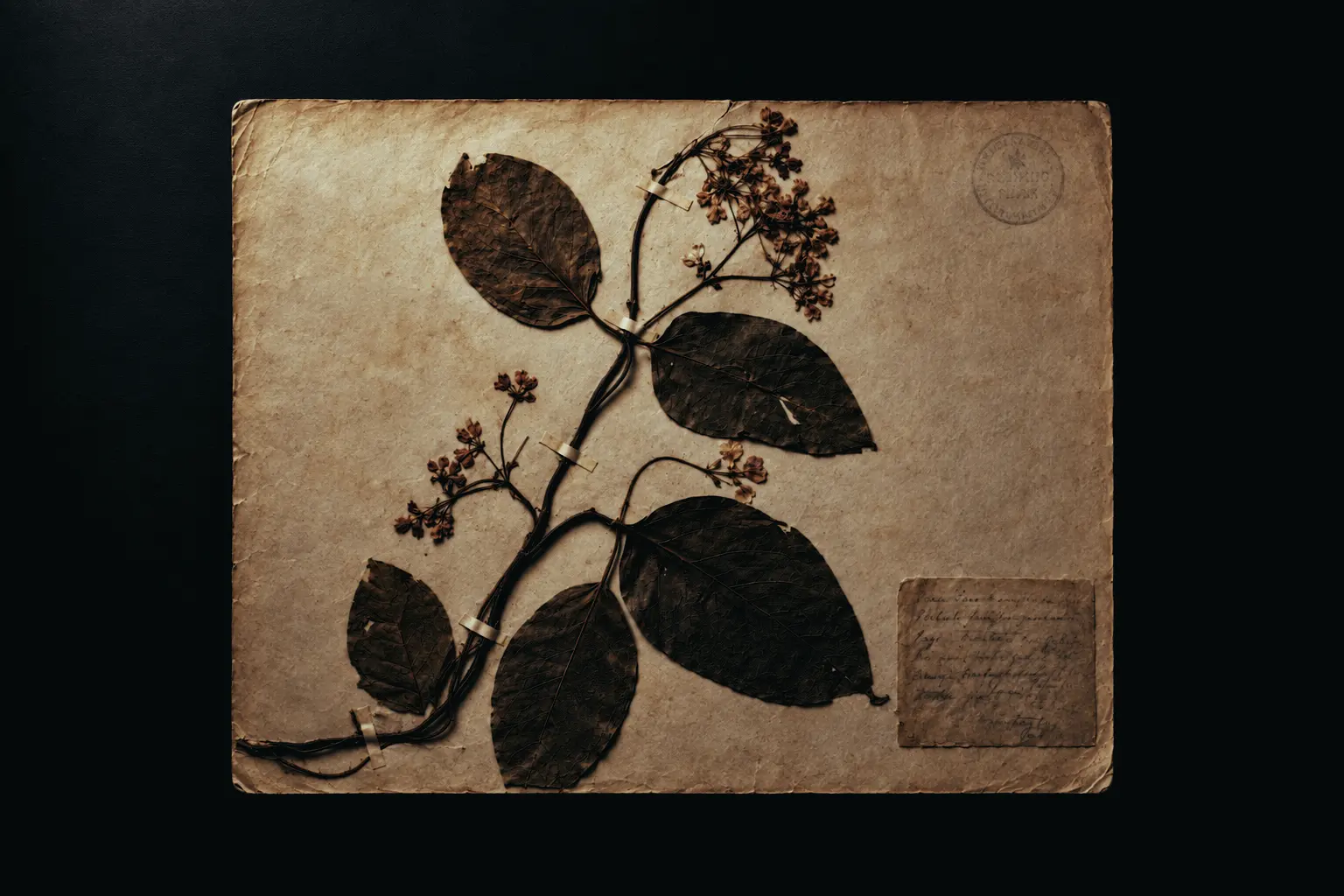
In 1974, a Field Museum botanist pressed a vine onto a herbarium sheet and noted that its flowers were ‘deep pink turning white with age’. Ten years later, an American businessman patented the same plant in Washington, claiming as novel a flower that was ‘rose coloured fading to near white with age’. The patent stood for seventeen years.
Data Manifest
- Primary Investigation: The grant, challenge, and reinstatement of US Plant Patent 5,751 on the Amazonian Banisteriopsis caapi vine known as ayahuasca, from Loren Miller's first filing in 1981 to the patent's expiry on 17 June 2003.
- Key Anomalies Documented: A twenty-five-year gap between the 1974 Martin & Plowman herbarium sheet and its arrival at the USPTO in 1999; a mid-review shift of the novelty basis from flower colour to leaf morphology; and a missing transcript of the May 2000 telephone interview between the examiner's office and Miller's attorney.
- Primary Sources Utilised: US Plant Patent 5,751, USPTO (1986 and 2001); CIEL 'PTO Decision Analysis' and 'PTO Examiner Transcript' (2001); Bosse, Queen's University Belfast (2024); Martin & Plowman 1805 herbarium sheet, Field Museum of Natural History (1974); Schultes, 'Journal of Ethnobiology' Vol. 6 No. 2 (1986).
Glossary
- Plant patent: A legal document granting an inventor exclusive rights for seventeen years to grow, reproduce, and sell a specific new plant variety they have either invented or discovered and cultivated.
- Prior art: Existing public knowledge or published writing that proves an invention is not genuinely new, which therefore disqualifies it from being patented.
- Herbarium sheet: A dried, flattened plant specimen mounted on stiff paper and stored in a museum, used as a permanent physical reference for scientific identification.
- Ex parte re-examination: A patent office review where, after lodging the initial complaint, the challenger is excluded from the proceedings, leaving the patent owner alone with the examiner to negotiate the outcome.
- Acuminate tip: A leaf tip that tapers to a long, narrow point, as opposed to a rounded or blunt one.
- Ridgway colour standard: A 1912 reference book of named colour chips, originally produced for ornithologists describing bird feathers, later treated by some patent examiners as the binding vocabulary for botanical colour notes.
1974 Diverging Records of Ayahuasca and Patent Law
Loren Miller travelled to the Ecuadorian Amazon in 1974. He was founder of the California-based International Plant Medicine Corporation. A tribal leader gave him a cutting of the Banisteriopsis caapi vine, the plant Amazonian communities know as ayahuasca or yage.
Miller carried the live cutting back to the United States. He has never named the community that handed it over, citing security concerns.
In the same year, Dr Timothy Plowman pressed his own Banisteriopsis caapi specimens into herbarium sheets. Working with Jon H. Martin, he catalogued one as ‘Martin & Plowman 1805’ and deposited it in the Field Museum of Natural History in Chicago. On the mounting board he wrote, in his own hand, that the flowers were ‘deep pink turning white with age’.
That sheet sat in the Chicago archive, publicly accessible, for the next quarter of a century.
Miller filed his first patent application in 1981. The seven-year gap matters as collecting the plant and seeking patent protection were separate decisions, made years apart.
Back at the patent office, the first filing was rejected as ‘informal and failing to present a written description in clear, concise, and exact terms’. Miller, by the patent office’s own internal account, did not know how to prosecute a patent. He had to find better help.
Parallel Tracks: 1974 to 1986
-
1974
Same Year, Two Records
Miller's Track
Loren Miller travels to the Ecuadorian Amazon and carries a live Banisteriopsis caapi cutting back to the United States. The providing community is not named.
Scientific Record
Dr Timothy Plowman, working with Jon H. Martin, deposits specimen 'Martin & Plowman 1805' at the Field Museum. Handwritten note on the mounting board: 'deep pink turning white with age'.
-
1981
First Filing, Rejected
Miller's Track
First patent application filed. Rejected as 'informal and failing to present a written description in clear, concise, and exact terms'.
Scientific Record
The Plowman sheet remains publicly accessible in the Chicago archive.
-
1982
Gates Monograph
Miller's Track
No public activity documented in the released records.
Scientific Record
Gates monograph published, describing the species' petals as 'pale pink, becoming pale yellow in age'. Later included in the patent office's own approved bibliography.
-
7 November 1984
'Da Vine' Refiled
Miller's Track
Refiled application lands at the patent office. Novelty basis: flowers 'rose coloured fading to near white with age'.
Scientific Record
Plowman sheet still publicly accessible. Gates monograph in circulation.
-
17 June 1986
Patent Granted
Miller's Track
US Plant Patent 5,751 granted. Primary examiner: James R. Feyrer. Seventeen-year exclusivity on asexual reproduction inside the United States.
Scientific Record
Herbarium sheet and monograph unchanged in status. Neither was cited in the grant.
The Patent Filing and Da Vine Novelty Claims
Miller’s final filing landed at the patent office on 7 November 1984. He named the variety ‘Da Vine’. Its claim to novelty rested on flowers ‘rose coloured fading to near white with age’.
The filing also described medicinal uses, including a claim that the plant could treat post-encephalitic Parkinsonism.
US Plant Patent 5,751 was granted on 17 June 1986. James R. Feyrer was named as primary examiner of record. Miller received seventeen years of exclusive control over the asexual reproduction of the vine inside the United States.
Eight months before the grant, the patent office’s own approved bibliography included the 1982 Gates monograph. Gates described the species’ petals as ‘pale pink, becoming pale yellow in age’.
US Plant Patent 5,751: The Claim
- Variety name: Da Vine (Banisteriopsis caapi).
- Filing date: 7 November 1984.
- Grant date: 17 June 1986.
- Primary examiner: James R. Feyrer.
- Novelty basis: Flowers 'rose coloured fading to near white with age'.
- Additional claims: Medicinal uses, including treatment of post-encephalitic Parkinsonism.
- Term of protection: Seventeen years of exclusive asexual reproduction inside the United States.
The 1999 Patent Challenge Using Prior Art to Fight Biopiracy
Amazonian Indigenous organisations appear to have remained unaware of the patent until 1994.
Two years later, the Coordinating Body of Indigenous Organisations of the Amazon Basin, representing more than four hundred indigenous groups across eight countries, declared Miller an enemy of indigenous peoples and barred him from entering their territories. Sources differ on whether the declaration was issued in 1996 or 1998.
On 30 March 1999, the Center for International Environmental Law and the Coalition for Amazonian Peoples filed a formal request for re-examination at the United States Patent and Trademark Office. They could not argue the patent was wrong in principle. The system did not accept that kind of argument.
What they could submit was prior art (existing public knowledge or published writing that proves an invention is not genuinely new). They sent the patent office the Martin & Plowman 1805 sheet, with Plowman’s twenty-five-year-old handwritten ‘deep pink turning white with age’ note in plain view on the mounting board.
On the basis of that single sheet, the patent office rejected the patent in autumn 1999. The Office Action was dated 3 November 1999. With it, the novelty argument based on flower colour could no longer hold.
The reversal lasted seventeen months.
Two Records, One Plant
| Plowman (1974) | Miller (1984) |
|---|---|
| Source: Herbarium sheet 'Martin & Plowman 1805', Field Museum of Natural History, Chicago. | Source: US Plant Patent 5,751 application, USPTO. |
| Format: Handwritten note on the mounting board. | Format: Typed patent claim. |
| Wording: 'deep pink turning white with age'. | Wording: 'rose coloured fading to near white with age'. |
| Status: Publicly accessible in the Chicago archive from 1974 onwards. | Status: Filed 7 November 1984, granted 17 June 1986, wording treated as novel. |
The 1912 Colour Standard
A book printed in 1912 became central to saving the patent.
Between February and May 2000, Miller filed written rebuttals to the autumn 1999 rejection. He did not contest the species identity. The argument turned on whether Plowman’s notes legally established identical traits.
That book was ‘Ridgway’s Colour Standards and Colour Nomenclature’, published in 1912 by an American ornithologist named Robert Ridgway. It was a catalogue of named colour chips originally intended to help bird taxonomists describe feather plumage with consistent vocabulary.
Plowman, writing on a herbarium sheet in 1974, had not used the Ridgway book.
In January 2001, the examiner agreed that Miller’s arguments were ‘unpersuasive in and of themselves’. But on the specific question of whether the Plowman notes proved identical flower colour, the examiner ruled they did not.
On the question of whether the plants matched, the examiner did not concede. He wrote that ‘there is no evidence to indicate, let alone prove‘ that the flower colouration in the two specimens was identical, and pointed to the 1982 Gates monograph as evidence of variation in the species.
CIEL’s lawyers later read the same ruling as ‘tacit agreement’ that the colours did match, and that only the Plowman vocabulary had failed the procedural test. That is an interpretation, not the transcript. The transcript disputes the match.
The Ridgway Standard
A 1912 bird-feather colour reference, later cited at the USPTO as the missing vocabulary in a 1974 herbarium note.
1912: Publication
Robert Ridgway, an American ornithologist, publishes 'Colour Standards and Colour Nomenclature'. A catalogue of named colour chips.
Original Purpose
Designed to help bird taxonomists describe feather plumage with a consistent vocabulary.
1974: Plowman's Note
Herbarium annotation 'deep pink turning white with age' recorded on the mounting board without reference to Ridgway.
2001: USPTO Application
Examiner rules the Plowman note does not, on its own, prove identical flower colour. Miller's arguments recorded as 'unpersuasive in and of themselves'.
Reexamining the Patent From Flower Colour to Leaf Morphology
The May 2000 telephone interview is the moment the record breaks. No transcript of the call between Examiner Feyrer’s office and Miller’s attorney has surfaced. Internal records confirm only that the two parties discussed how Miller might overcome the rejection.
Days later, Miller requested an extension of time. He used the extension to assemble a new comparison. Flower colour, on which the original 1986 grant had relied, was dropped from the argument.
The case became about leaves.
Karen Shigamatsu, a staff member at the Lyon Arboretum in Hawaii, sent in the leaf used for comparison. It arrived dried and pressed. Feyrer placed it next to the Plowman herbarium sheet from Chicago.
In January 2001, the examiner ruled that Da Vine had ‘a comparably greater length to width ratio, while being slimmer and smaller in overall size, and the adult foliage having a more acuminate tip’. An acuminate tip is one that tapers to a long, narrow point.
A Notice of Intent to Issue a Reexamination Certificate followed. In April 2001 the formal certificate was issued. The patent stood for the remainder of its statutory term and expired on 17 June 2003.
Two records would close the gap. The May 2000 transcript, and the chain-of-custody paperwork that could establish the provenance of the Hawaii specimen and its relationship to the plant collected in Ecuador in 1974.
Ex Parte Re-examination: The Da Vine Sequence
30 March 1999. CIEL and the Coalition for Amazonian Peoples file the re-examination request, submitting the Martin & Plowman 1805 herbarium sheet as prior art.
Under ex parte procedure, the challenger is removed from the proceedings after the initial filing. Only the patent owner and the examiner remain.
3 November 1999. The Office Action rejects the patent on the strength of the Plowman sheet. The flower colour claim collapses.
February to May 2000. Miller files written rebuttals arguing that the Plowman note does not legally establish identical traits.
May 2000. Telephone interview between the examiner's office and Miller's attorney. No transcript has surfaced. Internal records confirm only that overcoming the rejection was discussed.
Days later. Miller requests an extension of time and gathers a new line of comparative description based on leaf structure. Flower colour is quietly dropped.
January 2001. Examiner rules that Da Vine has 'a comparably greater length to width ratio, while being slimmer and smaller in overall size, and the adult foliage having a more acuminate tip'.
April 2001. Reexamination Certificate issued. The patent stands until expiry on 17 June 2003.
The 1930 Plant Patent Act and Failure to Recognise Indigenous Agriculture
The 1930 Plant Patent Act, codified at 35 U.S.C. ch. 15, was written for American commercial fruit growers and rose breeders. It required the patented plant to be intentionally cultivated rather than picked from the wild. The statute did not account for Amazonian systems of cultivation.
Miller’s filing met that cultivation requirement with a single sentence. His patent claimed the plant was ‘discovered growing in a domestic garden in the Amazon rain-forest of South America’. No garden owner is identified on the filing. The village is unnamed. No garden owner, village, coordinates or cultivator is identified.
That phrasing did two contradictory things at once. Satisfying the 1930 statute required cultivation. At the same time, the people responsible for that cultivation disappeared from the legal description.
Indigenous claimants who wished to defeat the patent by arguing the vine was wild had to legally deny their own centuries of selective breeding and forest management. If they argued the plant was cultivated, they conceded the very ground the patent stood on.
The bind was structural. Congress had simply not written a category for the agriculture being practised in the Amazon basin.
Schultes’ 1986 field notes, published in the Journal of Ethnobiology, documented Northwest Amazon communities deliberately selecting and propagating Banisteriopsis varieties for medicinal use. Miller’s patent file does not reference Schultes. Neither did the 1999 re-examination.
The 1930 Act, the Filing, and the Reality
| 1930 Plant Patent Act Requirement | Miller's Filing (1984) | Indigenous Reality |
|---|---|---|
| Plant must be intentionally cultivated, not picked from the wild. | Plant 'discovered growing in a domestic garden in the Amazon rain-forest of South America'. | Centuries of selective breeding and forest management by Amazonian communities, documented by Schultes and others. |
| Applicant is the inventor or discoverer of the plant. | Miller named as sole applicant and inventor. | Vine handed to Miller by a tribal leader in 1974. The community is not named in the filing. |
| Cultivation must be identifiable and specific. | No garden owner named. No village named. No co-ordinates, soil, or co-cultivator recorded. | Village-level cultivators, propagation practices, and medicinal use documented in the ethnographic record. |
| Exclusive rights granted for seventeen years within the United States. | Rights granted 17 June 1986 to the International Plant Medicine Corporation. | No provision in the 1930 statute for collective indigenous title or shared cultivator recognition. |
Why Indigenous Oral Knowledge Did Not Count
Under American patent statute at the time, prior art had to be a printed publication, or evidence of public use within the United States. The relevant section was 35 U.S.C. §102. Anything else did not count.
Centuries of indigenous oral practices across the Amazon basin had been documented by ethnobotanists and anthropologists. Legally, the practice itself was invisible to the patent system. Oral knowledge practised outside the United States therefore had no direct route into the prior-art analysis.
Even the printed records were poorly connected. The 1981 to 1986 examination at the patent office ran on databases of prior patents and approved botanical journals. Ethnographic archives and herbarium catalogues at institutions like the Field Museum sat in their own filing systems, unconnected to the patent search infrastructure.
A patent examiner sitting in Washington in 1985 could not query the Chicago herbarium catalogue from his desk. The Plowman sheet was publicly accessible to anyone who walked into the museum. From the examiner’s desk, the catalogue was invisible.
The re-examination procedure compounded the problem. CIEL’s lawyers filed the challenge and were then locked out. Ex parte re-examination, the only route available to outside challengers at the time, removed them from the room after the initial filing.
The remaining examination proceeded between the patent owner and examiner. That May 2000 telephone interview is the document we do not have.
Support the Archive
Help fund the retrieval, hosting, and preservation of Veriarch investigations.
Source Box
Sources include: US Plant Patent 5,751, USPTO (granted 17 June 1986; re-examination certificate April 2001); analyses by the Center for International Environmental Law, including ‘PTO Decision Analysis’ and ‘PTO Examiner Transcript’ (2001); Bosse, ‘Re-examining the “wild” story of the ayahuasca plant patent’, Queen’s University Belfast (2024); the Martin & Plowman 1805 herbarium sheet held at the Field Museum of Natural History, Chicago (1974); Schultes, ‘Recognition of Variability in Wild Plants by Indians of the Northwest Amazon’, ‘Journal of Ethnobiology’ Vol. 6 No. 2 (1986); Tahdooahnippah, ‘The “Ceremonial Use” Defense to Infringement of Psychedelic Patents’, ‘Berkeley Technology Law Journal’ Vol. 39 No. 2 (2024); and ‘Traditional Knowledge Digital Library: A Magic Bullet in the War Against Biopiracy’, San José State University ScholarWorks.
Claim-Source Matrix
| Core Finding | Primary Source Document | Status |
|---|---|---|
| Loren Miller carried a live Banisteriopsis caapi cutting from the Ecuadorian Amazon to the United States in 1974. | Bosse, 'Re-examining the "wild" story of the ayahuasca plant patent', Queen's University Belfast (2024). | Confirmed. |
| The Martin & Plowman 1805 herbarium sheet placed the same species in the formal scientific record in the same year, with the handwritten note 'deep pink turning white with age'. | Field Museum of Natural History, Chicago (1974); CIEL 'PTO Decision Analysis' (2001). | Confirmed. |
| US Plant Patent 5,751 granted 17 June 1986 with James R. Feyrer named as primary examiner. Novelty claim: 'rose coloured fading to near white with age'. | US Plant Patent 5,751, USPTO (1986). | Confirmed. |
| The 1982 Gates monograph, on the patent office's own approved bibliography, described the species' petals as 'pale pink, becoming pale yellow in age'. | US Plant Patent 5,751 bibliography; CIEL 'PTO Examiner Transcript' (2001). | Confirmed. |
| Amazonian communities became aware of the patent in 1994. | CIEL 'PTO Decision Analysis' (2001); Bosse (2024). | Confirmed. Peer-reviewed sources give 1994. |
| COICA declaration barring Miller from indigenous territories. | Bosse (2024); earlier contemporaneous accounts. | Contradicted. Bosse (2024) gives 1996; earlier accounts give 1998. |
| Re-examination request filed 30 March 1999 by CIEL and the Coalition for Amazonian Peoples. | CIEL 'PTO Examiner Transcript' (2001). | Confirmed. |
| Office Action dated 3 November 1999 rejected the patent on the basis of the Martin & Plowman herbarium sheet. | CIEL 'PTO Decision Analysis' (2001). | Confirmed. |
| January 2001 ruling: examiner disputed identical flower colour, stating 'there is no evidence to indicate, let alone prove' the two specimens matched, and cited the 1982 Gates monograph as evidence of variation. | CIEL 'PTO Examiner Transcript' (2001). | Confirmed. Corrects the earlier framing that the examiner accepted the colour match. |
| May 2000 telephone interview between the examiner's office and Miller's attorney took place. | Internal records, CIEL 'PTO Decision Analysis' (2001). | Confirmed as an event. Transcript missing from the public record. |
| January 2001 ruling shifted the basis of comparison from flower colour to leaf morphology, citing 'a comparably greater length to width ratio... and the adult foliage having a more acuminate tip'. | CIEL 'PTO Examiner Transcript' (2001). | Confirmed. |
| April 2001 Reexamination Certificate reinstated the patent. Term expired on 17 June 2003. | US Plant Patent 5,751 Reexamination Certificate, USPTO (2001). | Confirmed. |
| 35 U.S.C. §102 required prior art to be a printed publication or evidence of public use within US borders. Oral indigenous tradition did not qualify. | Tahdooahnippah, 'Berkeley Technology Law Journal' Vol. 39 No. 2 (2024). | Confirmed. |
| Schultes' 1986 field notes documented Northwest Amazon selective breeding of Banisteriopsis varieties for medicinal use. | Schultes, 'Journal of Ethnobiology' Vol. 6 No. 2 (1986). | Confirmed. |
What We Still Do Not Know
- The May 2000 telephone interview between Examiner Feyrer's office and Miller's attorney was never transcribed in any released document. Who first proposed shifting the patent's basis from flower colour to leaf shape cannot be established.
- The International Plant Medicine Corporation's 1974 expedition records, including grant applications, ledger entries, and travel expense reports, have not surfaced. The financial nature of Miller's exchange with the Ecuadorian tribal leader cannot be verified.
- Whether the 1981 to 1984 prior-art search included any query of non-patent botanical or ethnographic archives, or whether departmental policy barred such queries by default, is not documented in any released search log or routing slip.
- Chain-of-custody paperwork for the Lyon Arboretum's dried Da Vine specimen is absent from the dossier. The leaf compared against the Field Museum sheet cannot be confirmed as a genetically unaltered clone of the 1974 Ecuadorian plant.
- How the patent office reconciled its acceptance of Miller's 'domestic garden' description with its simultaneous rejection of indigenous cultivation evidence is not addressed in any released internal memo.
- Which other Banisteriopsis applications or related botanical patents were lodged in Examiner Feyrer's queue during the 1984 to 1986 period has not been mapped.
- Whether the COICA declaration banning Miller was issued in 1996 or 1998 remains open in the sources. Bosse (2024) gives 1996; earlier contemporaneous accounts give 1998.
Comments (0)