
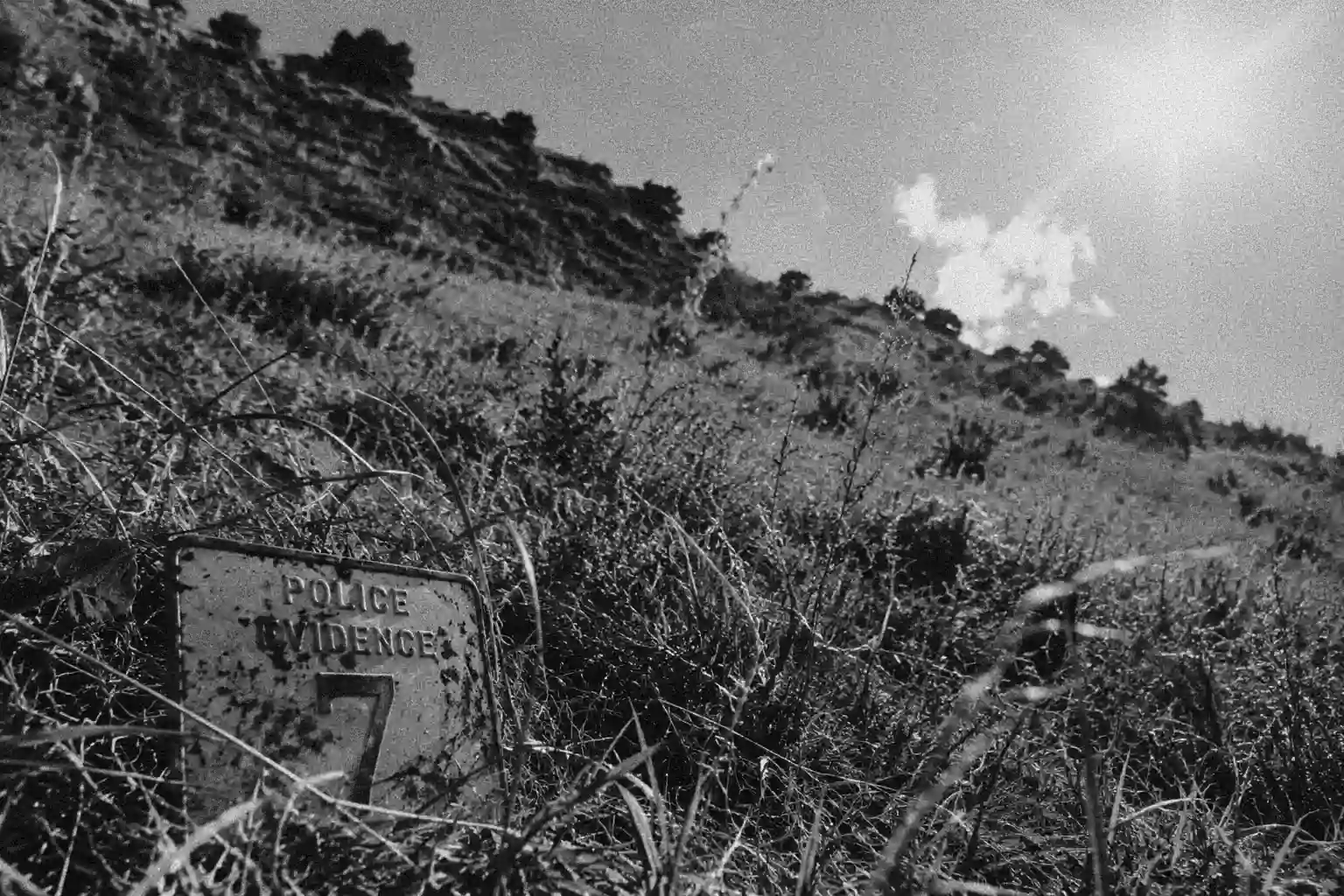
Manoel Pereira da Cruz and Miguel José Viana, two electronics engineers from Campos dos Goytacazes, were found dead on Vintém Hill on 20 August 1966. Most accounts of the case fix on the homemade lead masks beside their faces, on the small handwritten note about capsules, on the missing cash.
Our angle is different.
We wanted to know what the Rio de Janeiro state did with the evidence once the bodies were off the hill, and where each piece of it then went.
Data Manifest
- Primary Investigation: Forensic breakdown of the Vintém Hill deaths of Manoel Pereira da Cruz and Miguel José Viana on 20 August 1966 in Niterói, Rio de Janeiro, and the systemic handling of evidence by state authorities.
- Key Anomalies Documented: A 1962 unindexed precursor case (Hermes Luiz Feitosa) on Morro do Cruzeiro; a 48-hour police recovery delay on Vintém Hill; physical erasures on Autopsy Report NR-3052/66; premature formaldehyde embalming locking tissue chemistry; and a re-sent 1968 atomic thermal test report misread by police as a typographical error.
- Primary Sources Utilised: Niterói 2nd Police District Operational Files (1966); São Gonçalo Police Archives (1962); Autopsy Report NR-3052/66; Fluminense Medical-Legal Institute Exhumation Report (1967); Department of Posts and Telegraphs Parcel Records (1968); contemporary press archives ('O Fluminense', 1968).
Glossary
- Toxicology screen: A chemical test run on body tissue or fluid to check whether a person has been exposed to a poison or drug.
- Viscera: The soft internal organs of the body, such as the liver, kidneys, stomach and intestines, which are the standard target tissue for chemical testing after death.
- Exhumation: The formal or legal act of digging up a body from a grave, usually to conduct a new forensic or medical examination.
- Thallium: A toxic heavy metal historically used in rat poisons and industrial applications; it is highly lethal to humans even in small amounts.
- Cross-linking (of proteins): The chemical effect formaldehyde has on body tissue, locking the proteins together so tightly that later tests cannot pull any poison or drug back out of the sample.
The 1962 Forgotten Forensic Link
Four years before Cruz and Viana, in 1962, the body of a television technician called Hermes Luiz Feitosa was found dead on Morro do Cruzeiro. Morro do Cruzeiro sits in São Gonçalo, the next municipality along from Niterói, Rio de Janeiro, Brazil, about ten kilometres away. A lead mask lay near him. He had no external injuries, his belongings were still on him and robbery was ruled out at the scene. If you swap the names, the staging matches Vintém Hill almost exactly.
São Gonçalo closed the case. No cause of death was recorded. The file was archived locally, in São Gonçalo only, and never cross-indexed to neighbouring districts.
Then four years passed.
When the bodies turned up on Vintém Hill in 1966, the Niterói 2nd Police District treated the case as the first of its kind. Their public position was that nothing like it had ever happened before. The 1962 file did exist. They simply had no working way to find it. They learned about Hermes Feitosa in the end, but not from any archive. They learned about him because a civilian called José de Souza Arêas mentioned it during an interrogation in 1966. A witness in a chair had to supply what the precinct’s own cabinets could not.
We then went looking for the 1962 file ourselves. It is not in the São Gonçalo precinct archives. The original incident report, the coroner’s findings on Feitosa, the witness statements and the evidence log for the 1962 lead mask are all gone from the place they were filed.
Two Hills, Two Lead Masks, Four Years Apart
| Feature | 1962 Morro do Cruzeiro (Hermes) | 1966 Vintém Hill (Cruz and Viana) |
|---|---|---|
| Victim profession | Television technician | Electronics engineers |
| Location | Hilltop (São Gonçalo) | Hilltop (Niterói) |
| Mask present | Yes | Yes |
| External trauma | None | None |
| Personal effects | Intact | Intact |
| Robbery ruled out | Yes | Yes |
| Cause of death recorded | No | No (Unknown) |
| Archived location | São Gonçalo precinct only | Niterói 2nd Police District |
| Cross-indexed to neighbouring district | No | No |
The 48-Hour Delay at Vintém Hill
On 18 August 1966, a ten-year-old boy called Paulinho was out looking for a lost kite on Vintém Hill. He found two bodies. He walked down the hill and reported the find to Patrolman Antônio Guerra of the Radio Patrol. Guerra decided the boy had seen drunks sleeping in the grass and did nothing. Nothing dispatched. Nothing logged. Nothing inspected.
On 19 August, Paulinho went back up to check. The bodies were still there. He reported it to Guerra a second time. Guerra ignored him a second time.
Two days of tropical heat went by like that.
The afternoon of 20 August, an 18-year-old called Jorge da Costa Alves climbed the same hill, found the same scene and took the report somewhere other than Guerra. That triggered a formal police response. The recovery operation followed on 21 August under Police Commissioner Oscar Nunes. By that point the bodies had been on the hill for forty-eight hours longer than they needed to be.
Here is the consequence we cannot get past. Dr Astor Pereira de Melo, the coroner who later took the autopsy on 21 August, pointed to the advanced state of the bodies as the reason he could not run a wider chemical screen. Those bodies were in that state because no one had collected them when a child reported them twice. So the line Melo used to close out the toxicology had been written for him, in effect, three days earlier at the foot of the hill. None of this proves Guerra intended that outcome. The record we can see shows him sending Paulinho away twice and clocking off both shifts with two bodies still on the hill.
We went looking for an internal affairs file, a statement, anything indicating Guerra was asked to account for those two refusals. No record of a disciplinary response to the initial 48-hour delay is available in the archives consulted for this work. Whether one was ever opened, and quietly shelved, or never opened at all, we cannot say.
The 48-Hour Delay
-
17 August 1966, 09:00 to 18:30
Final Documented Movements
Cruz and Viana's last known movements before their estimated time of death on the hill.
-
18 August 1966
First Ignored Report
Ten-year-old Paulinho discovers the bodies and reports them to Patrolman Antônio Guerra. Guerra dismisses the report, taking no action to log, dispatch, or inspect the scene.
-
19 August 1966
Second Ignored Report
Paulinho returns to the hill, sees the bodies remain, and reports it a second time. Guerra ignores the civilian report again.
-
20 August 1966, Afternoon
Bypass Discovery
Eighteen-year-old Jorge da Costa Alves discovers the same bodies and bypasses Guerra, forcing a formal police response to be logged.
-
21 August 1966
Delayed Recovery Operation
Police Commissioner Oscar Nunes leads the recovery operation, 48 hours after the initial civilian report. The bodies have now entered advanced putrefaction.
Niterói Detective Murder (1966)
On 21 August 1966, the same day the recovery team was bringing Cruz and Viana down off the hill, Niterói detective Hilton Magalhães was murdered in a separate incident. His body was delivered to the Niterói Institute of Legal Medicine (IML) on the same shift the Vintém Hill remains arrived. A dead police detective draws senior police command, press cameras and laboratory time in a way two unidentified men on a hill do not.
Dr. Astor Pereira de Melo handled both cases inside the same building on the same shift. He was a serving coroner and at that point also a sitting city councillor in Niterói, so he was already a political figure. He was put under pressure that day in a particular direction. The murdered officer took priority. The Vintém autopsy was processed in the space left over.
How Melo split his hours that day does not appear in the surviving paperwork. Which case he took first, who was at his side while he worked, whether anyone telephoned down from the Magalhães end of the building while the cutting was going on, none of that is on the file we have. From outside the room, we can see only that the load on him was unusually heavy for a single shift. A minute-by-minute account of how the Vintém autopsy was actually run does not exist in any record we have located.
One Coroner, Two Cases, Twelve Hours
Dr. Astor Pereira de Melo, single coroner of record
The Magalhães Murder
Murder of Niterói detective Hilton Magalhães draws senior police command and press cameras to the Institute of Legal Medicine.
A dead police officer takes institutional and laboratory precedence over unidentified civilian remains.
The Vintém Recovery
Cruz and Viana are delivered from the hill on the exact same shift.
Processed in the space left over from the Magalhães autopsy, under severe time pressure.
Why Dr. Melo Failed to Test for Poisons in the Lead Masks Case
When the recovery team logged the contents of the scene on 21 August, one of the items in the inventory was a handwritten note. It read: ’16:30 be at the specified location. 18:30 ingest capsules, after the effect protect metals await signal mask.’ Three words matter here: ingest, capsules, signal. The note tells you, in writing, that the men expected to swallow something at half past six in the evening.
Dr. Melo opened the bodies and pulled viscera. Viscera is the inside-the-body soft organs: liver, kidneys, stomach, the things you would test if you wanted to find a poison. He successfully ran a toxicology screen, a chemical test for a poison or drug, for two specific substances: formic acid and potassium cyanide. Both returned negative.
Both tests worked.
Then he stopped. Melo’s official position, written into Autopsy Report NR-3052/66 and repeated to the press, was that the bodies were too far gone for any further toxicological work. He did not test for alkaloids, the family of organic compounds that includes things like strychnine, morphine and nicotine. He did not test for barbiturates, which are sedative drugs found in pills. He did not test for heavy metals. He did not test for hallucinogens.
Here is what bothers us about that. Cyanide is the unstable one. Cyanide breaks down faster in a dead body than alkaloids do, faster than barbiturates do, faster than heavy metals do. If the viscera were in good enough condition to give a clean cyanide answer, they were in good enough condition to run the slower screens too. The official reason for stopping does not match what the bench had just done.
The autopsy report itself has another problem. The surviving copy of NR-3052/66 carries visible physical erasures in the section that records the cause of death. Brazilian medical-legal protocol of the period required errors to be struck through with a single line, initialled and dated, so the original wording stayed legible for any later judge. The wording on NR-3052/66 has been physically rubbed out instead. The official cause of death now reads ‘unknown’. What it read before the erasure, and who authorised the change, is no longer legible on the file the state holds.
We need to be careful about what that means. One reading is that the erasure covered an initial poisoning hypothesis. Some press reports of the period suggest the erased text was nothing more than a doctor’s name. Without the original carbon copy we cannot rule between them. What we can say plainly is that the protocol of single strike, initials and date was not followed, and the place on the file where it was not followed is the line recording the cause of death.
We went looking for the carbon copy. The original dictation notes, the coroner’s draft notebook and the carbon copies of NR-3052/66 are missing from both the Niterói municipal archives and Dr. Melo’s personal papers. The path back to whatever Melo first wrote down is, at present, closed.
What Was Tested. What Was Not.
| Test Conducted | Result | Official Justification for Skipping |
|---|---|---|
| Formic acid | Negative | None (Successfully run) |
| Potassium cyanide | Negative | None (Successfully run) |
| Alkaloids | Not run | 'Advanced decomposition' |
| Barbiturates | Not run | 'Advanced decomposition' |
| Heavy metals | Not run | 'Advanced decomposition' |
| Hallucinogens | Not run | 'Advanced decomposition' |
How Formaldehyde Embalming Compromised Forensic Evidence
After the autopsy closed out as ‘unknown’, Colonel Eduardo do Couto Pfeill ordered the release of the bodies to the families in Campos for burial. That order went out before any wider chemical screen had been attempted. The signed transfer order itself has not surfaced in any archive we have seen.
To move corpses across state lines under the regulations of the period, the bodies had to be embalmed. Formaldehyde is the standard preserving fluid used by undertakers to stop a body rotting in transit. Mortuary attendants in Niterói pumped Cruz and Viana with very large, unregulated amounts of it. There was no judicial sign-off on the volume or the method. The transport rule simply ran straight over the top of the forensic one.
In March 1967, District Attorney Edmo Rodrigues Luterbak and Judge Jovino Machado Jordão formally rejected the initial police findings and forced the case open again. A second forensic chance now existed. On 25 August 1967, Dr. Sebastião Faillace, the director of the
Fluminense Medical-Legal Institute, oversaw the exhumation at Cajú Cemetery in Campos.
Faillace and Bastos examined the bodies in August 1967 and found the tissue saturated with formaldehyde. Proteins in the muscle and organs had cross-linked, meaning the embalming fluid had locked them together so tightly that the standard chemical pulls a 1967 lab could run would no longer release any poison or drug from the sample. Whatever Cruz and Viana swallowed at 18:30 on 17 August stayed inside that tissue. Their second forensic chance came back from the graveside with the same answer the first one had returned: ‘unknown’.
What was said in public did not match what was written in the file. Authorities told the press that any toxic substance would have naturally broken down inside the bodies over the year underground. The internal exhumation record from Faillace and Bastos said the opposite, plainly: the formaldehyde was the problem.
So we wanted to know how much formaldehyde. Who ordered it. At what concentration. The Niterói Embalming Manifest for the bodies of Cruz and Viana, which would tell us those four things, has not been located in any reviewed archive.
Two Mandates, One Body
Body of victim, August 1966.
Preserve tissue for future toxicology testing.
Unregulated formaldehyde embalming required for long-haul transit to Campos.
1967 Exhumation. Tissue proteins chemically cross-linked by formaldehyde. Toxicology locked and rendered blind.
The Missing 1968 Toxicology Report: Thallium and Bureaucratic Failure
Faillace’s team did not give up entirely. Between January and May 1968 they sent hair and viscera samples to the Nuclear Research Institute at the University Campus of São Paulo. Atomic thermal tests (a precise method for detecting trace chemical elements in organic samples) picked up an unidentified ‘toxic substance’. The next step was a tissue cross-check to name the agent.
The finalised report was put in the post on 7 June 1968. The Department of Posts and Telegraphs lost the parcel in transit between São Paulo and Niterói. That looked like the end of the line. The newspapers tell a different ending.
According to O Fluminense on 26 and 29 June 1968, the Director of the IML in São Paulo simply re-sent the report. The Rio de Janeiro Homicide Division received the second copy. They could not read it. The report named ‘Thallium’ as the substance picked up by the thermal tests, and the Homicide Division did not recognise the word. They treated it as a typographical error and put the file aside.
In late 1968, Judge João Antônio da Silva formally archived the file. The condition he attached was that the investigation would only be reopened if new evidence came to light. By that point, the re-sent São Paulo report had been sitting on the Homicide desk in Rio for months, treated as a typo and untouched.
We then went looking for the postal trail of the original 7 June parcel. Its dispatch reference, its registered tracking number and its last known waypoint have never been published in any postal manifest located so far. We can see the receipt of the second copy in Rio. We cannot trace the first parcel’s path at all.
Lost in the Post, 7 June 1968
- Dispatching Institution: Nuclear Research Institute, University Campus of São Paulo
- Destination: Niterói Institute of Legal Medicine
- Contents: Finalised atomic thermal test results on hair and viscera
- Carrier: Department of Posts and Telegraphs
- Known Status: Lost in transit, never recovered, no tracking number released in public postal manifest
Source
Sources include: São Gonçalo Police Archives (1962); Niterói 2nd Police District Radio Patrol Logs and Witness Statements (August 1966); Autopsy Report NR-3052/66 from the Niterói Institute of Legal Medicine; the Fluminense Medical-Legal Institute Exhumation Report (25 August 1967); Department of Posts and Telegraphs Parcel Records (7 June 1968); and contemporary press coverage from ‘O Fluminense’ (June 1968).
Archival Note: Due to the historical and regional nature of this 1966 case, the primary police files, autopsy reports, and internal memos are held in Portuguese. We want to explicitly credit the independent archive at pmig96.wordpress.com, whose years of dedicated work tracking down, compiling, and translating these primary documents made this English-language forensic breakdown possible.
Claim-Source Matrix
| Core Finding | Primary Source Document | Status |
|---|---|---|
| Hermes Luiz Feitosa was found dead on Morro do Cruzeiro in 1962 with a lead mask, no external trauma, and his personal belongings intact. | Lead Masks Case: sources (part 8) (pmig96), Para 16 and 28 | Confirmed |
| The Niterói 2nd Police District only learned of the 1962 Hermes case in 1966 when civilian José de Souza Arêas mentioned it during an interrogation. | Lead Masks Case: sources (part 8) (pmig96), Para 16 | Confirmed |
| Ten-year-old Paulinho found the bodies on 18 August 1966 and reported them to Patrolman Antônio Guerra, who dismissed the report as drunken vagrants and took no action. | Lead Masks Case: sources (part 7) (pmig96), Para 16 | Confirmed |
| On 20 August 1966, eighteen-year-old Jorge da Costa Alves discovered the bodies, bypassed Guerra entirely, and triggered a formal police recovery operation. | The Lead Masks Case (pmig96), Para 30 | Confirmed |
| On 21 August 1966, Niterói detective Hilton Magalhães was murdered; his body was delivered to the Niterói Institute of Legal Medicine on the same day as the Vintém Hill recovery operation. | The Lead Masks Case (pmig96), Para 36 | Confirmed |
| Coroner Dr. Astor Pereira de Melo successfully extracted viscera and ran targeted assays for formic acid and potassium cyanide, with both returning negative. | Lead Masks Case: sources (part 7) (pmig96), Para 8 | Confirmed |
| Between January and May 1968, hair and viscera samples dispatched to the Nuclear Research Institute in São Paulo underwent atomic thermal tests that detected an unidentified toxic substance. | Lead Masks Case: sources (part 7) (pmig96), Para 142 and 143 | Confirmed |
What we still do not know
- Whether the original dictation notes or carbon copies of Autopsy Report NR-3052/66 exist outside the erased file held in Niterói, and what the erased line read before it was rubbed out.
- Where Colonel Eduardo do Couto Pfeill's signed transfer order authorising the unregulated formaldehyde embalming is now held.
- Which postal depot received and lost the original 7 June 1968 parcel, and on whose log it was last signed.
- Where the 1962 Morro do Cruzeiro investigative file on Hermes Luiz Feitosa now sits, given its absence from the São Gonçalo archives.
- How much of the Cr$ 3,000,000 the victims were carrying disappeared from the scene before police secured it.
- Whether Patrolman Antônio Guerra was ever the subject of internal discipline for ignoring two civilian reports.
Comments (0)