
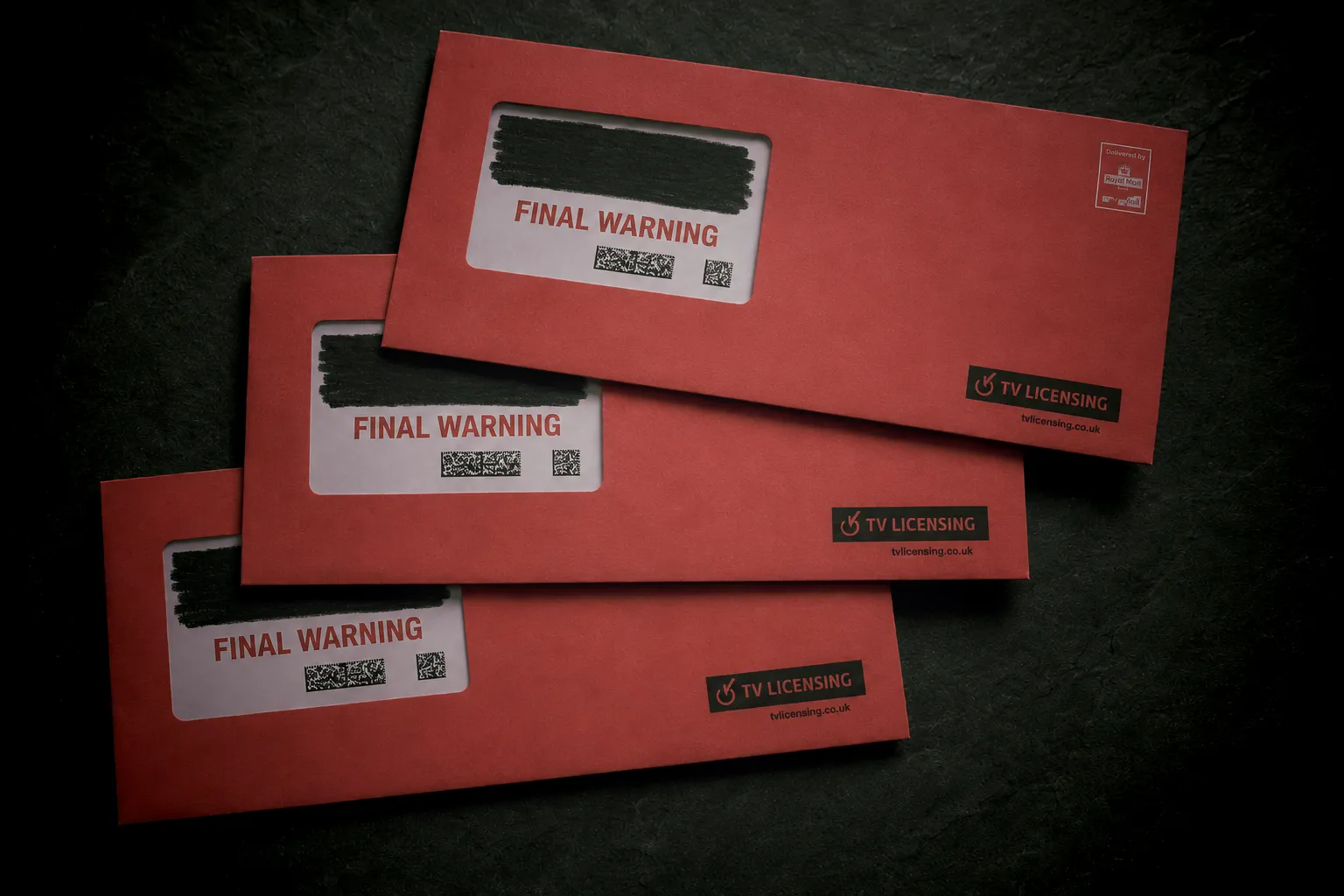
On 27 February 2017, the BBC’s Director-General condemned Capita’s doorstep bonus scheme. The scheme was not wound up until 21 July 2023, when a union agreement finally consolidated it. Six years and five months sat between the statement and the fix.
Data Manifest
- Primary Investigation: BBC and Capita TV Licensing Enforcement System.
- Key Anomalies Documented: A multi-million-pound abandoned IT upgrade, a six-year delay in dismantling condemned doorstep prosecution quotas, and a strict two-year automated enforcement loop for exempt households.
- Primary Sources Utilised: Public Accounts Committee Report HC 1037, FOI disclosures (RFI20111589, RFI20130974), CWU Pay Agreement, and The Guardian undercover reporting.
Glossary
- 'No Licence Needed' declaration: A formal statement a household lodges with TV Licensing saying it does not watch or record live television and therefore does not require a licence.
- Field commission scheme: A pay arrangement in which staff working on the doorstep earn a bonus on top of basic pay for hitting specified targets, in this case licence sales and prosecution statements.
- Service Level Agreement: The section of a commercial contract that sets out the performance standards the supplier must meet and the penalties that apply if they fall short.
- Freedom of Information (FOI) exemption: A legal reason a UK public body can give for refusing to release a document it holds, such as protecting law enforcement operations or commercial interests.
- Public Accounts Committee: A cross-party committee of MPs that scrutinises how the government and public bodies spend taxpayer money.
BBC-Capita Enforcement Procedures
In December 2011, the BBC signed its administration contract with Capita Business Services Limited. The agreement placed day-to-day running of the TV Licensing system, including the mailing of enforcement letters and the doorstep visits that follow them, in the hands of a private contractor. From that point on, the operational record of how the licence fee is enforced has sat inside Capita’s files, not the BBC’s.
Some of those files are known to exist. A public Freedom of Information request, which is the legal route citizens use to force a UK body to release documents it holds, produced a response on 25 January 2012. That response confirmed the presence of an internal file called the ‘BBC Letters approvals matrix’, which governs the wording of the automated enforcement mailings.
The matrix document itself carries redactions inside it. But the BBC’s response letter answered the sign-off question directly in its main body. The last BBC person to approve an individual enforcement letter before printing is a Marketing Manager or Campaign Manager within the BBC TV Licensing Sales and Marketing team, with accountability for the content of those letters resting with the Head of that team, named in the response as Peter Kirk.
A second document, the Visiting Procedures manual, remains entirely withheld. The BBC refused requests for its full text by citing Section 31 of the Freedom of Information Act to protect law enforcement, and Section 38 for health and safety. So the document that tells Capita field officers how to conduct a doorstep visit is not something an outside investigator can read,aligning with the corporation’s routine statutory withholding of records.
Procedural Timeline
-
December 2011
Contract Signed
The BBC signs its administration contract with Capita Business Services Limited.
-
25 January 2012
Approvals Matrix Confirmed
FOI response confirms the presence of the 'BBC Letters approvals matrix' governing automated enforcement mailings.
-
Ongoing
Visiting Procedures Withheld
The manual instructing field officers on doorstep visits remains sealed under Section 31 and Section 38 FOI exemptions.
Undercover Reporting and the 28-Statement Quota
An undercover investigation covered by The Guardian on 27 February 2017 revealed a specific instruction inside Capita’s TV Licensing field operation. Area managers told field officers to secure 28 conviction statements per week to unlock their bonus payments under the field commission scheme, an arrangement that linked doorstep officer pay to sales and prosecution targets. The quota measured prosecutions, not licence sales.
Later that same day, BBC Director-General Tony Hall wrote publicly to Capita’s chief executive to condemn the practice. Hall said Capita had fallen short of the standards the BBC expects, and demanded an urgent investigation. The Public Accounts Committee later referenced this letter, dated 27 February 2017, in its own report on the licence fee.
The 27 February timeline forces a direct clash. Undercover footage exposed a commission-based prosecution quota running live on the ground, while hours later, the corporation’s Director-General accepted on the record that the practice breached BBC policy.
Capita’s exact 28-statement quota does not appear in any released internal management document. The finding rests on the undercover footage and on union records referenced in the source material, and on Hall’s same-day acceptance that the underlying practice fell short of BBC policy.
A 2014 internal review had already made clear that a visibility problem existed. In it, the BBC admitted it held no material relating to the training of Capita visiting officers, treating that training as an internal Capita matter.
So on 27 February 2017, the corporation publicly condemned a practice at doorstep level over which it had already admitted, three years earlier, that it held no training documentation. That condemnation and the visibility gap have never been formally reconciled in the public record.
27 February 2017: The Doorstep Contradiction
- The Quota: Undercover reporting exposes Capita area managers instructing field officers to secure 28 conviction statements per week to unlock bonus payments.
- The Response: Hours later, BBC Director-General Tony Hall publicly writes to Capita's chief executive, condemning the practice as falling short of BBC standards and demanding an urgent investigation.
The Abandoned BBC-Capita IT Modernisation Programme
On 24 April 2017, the House of Commons Public Accounts Committee published its findings on the BBC’s licence fee arrangements. Sitting in that report was a plain admission. A planned IT modernisation programme between the BBC and Capita had failed and been abandoned.
In place of the modernised system that never arrived, the BBC and Capita were left running their enforcement operation across legacy databases. Manual workarounds stood in for the automated link that had been planned.
The problem is what those workarounds meant on the ground. When a household submitted a ‘No Licence Needed’ declaration, which is the formal statement a household lodges to say it does not watch or record live television and does not require a licence, the record had to travel between three separate holders: the BBC’s own database, Capita’s operational system and the mailing operation run by the printing firm Proximity London Limited. At each transfer, the declaration could stall.
Finding a single, unified record of an individual household’s enforcement status is impossible because FOI requests return completely different reference numbers depending on which of the three entities holds the file.
The PAC report described the IT failure in detail. It did not attach a financial consequence to Capita for that failure. The clauses that would carry one sit inside the service level agreement, the part of the contract that sets performance targets and the penalties for missing them, and that section is sealed under Section 43(2), the commercial interests exemption.
Fragmented Declaration Routing
Household logs a formal 'No Licence Needed' statement.
Due to an abandoned IT modernisation programme, the record must be transferred manually across legacy databases.
The record stalls as it travels between the BBC database, Capita's operational system, and Proximity London Limited's mailing operation.
A Six-Year Accountability Gap
The BBC’s public position on the field commission scheme was clear on 27 February 2017. Tony Hall wrote to Capita’s chief executive to condemn the practice, and demanded an urgent investigation.
The scheme itself was not abolished until 21 July 2023.
That fix came not from the BBC, but from a pay agreement negotiated between Capita and the Communication Workers Union. The CWU announcement of that agreement referred directly to the consolidation of commission monies for Capita TVL field members. Under the deal, the field commission scheme was wound up, and the monies were folded into the pay structure.
Six years and five months separated Tony Hall’s condemnation from the CWU consolidation. In that interval, the scheme remained live at doorstep level. The BBC has released no internal audits or meeting minutes showing they actually tried to dismantle the scheme after condemning it.
Neither the BBC nor Capita has released correspondence showing if the corporation demanded the scheme’s abolition after February 2017, or if the contractor simply ignored the Director-General’s condemnation until the union forced the issue in 2023.
Consolidation came through a union agreement rather than through the BBC’s own contractual machinery. The relevant clauses sit within the redacted portion of the service level agreement. So the change was possible through a route the BBC controlled, and instead arrived through one it did not.
The Accountability Gap
-
27 February 2017
Public Condemnation
BBC Director-General condemns the field commission scheme and demands an urgent investigation.
-
Interval: 6 Years, 5 Months
No Oversight Record
The scheme remains live on the doorstep. No public domain records show the BBC auditing or dismantling it during this period.
-
21 July 2023
Union Consolidation
The Communication Workers Union negotiates an agreement to wind up the field commission scheme, folding monies into basic pay.
The Two-Year Declaration Reset
A ‘No Licence Needed’ declaration does not shut off the enforcement machinery permanently. It resets on a timer.
Inside an FOI disclosure released to a Mr Hillas under reference RFI20130974, the operational procedure is stated in plain terms. The document instructs that if the customer does not indicate a date of expected use, ‘they should be informed that we will not communicate with them again for 2 years’.
After exactly 24 months, the automated enforcement letters simply resume. A household legally exempt from a licence is forced back into the active threat cycle every two years, regardless of whether their viewing habits have actually changed. A household utilising legal television licence exemption routes is forced back into the active threat cycle every two years.
The reset is not gated on any evidence about the household. It runs on a clock. No verification of an actual change in viewing occurs before the letters begin again.
Who set the two-year figure and on what evidence is not written down anywhere in the released material. The rule stands; the reasoning behind it does not appear alongside it.
The Two-Year Declaration Reset
Automated procedural loop bypassing actual household status changes.
Phase 1: Exemption
Household formally states they do not watch live television.
Internal procedures dictate no communication for exactly 24 months.
Phase 2: Reactivation
The 24-month clock expires without checking for actual viewing changes.
Exempt household is automatically returned to the active threat cycle.
Source
Sources include: Freedom of Information disclosures regarding letter approvals and visiting procedures (2012-2018); the House of Commons Public Accounts Committee report on the BBC licence fee (HC 1037, 2017); internal TV Licensing operational procedures; contemporary press coverage from ‘The Guardian’ detailing undercover investigations (2017); and the Communication Workers Union pay agreement concerning field commission consolidation (2023).
Claim-Source Matrix
| Core Finding | Primary Source Document | Status |
|---|---|---|
| FOI response confirming the internal file 'BBC Letters approvals matrix' exists. | RFI20111589 Peter Jones - BBC FOI Response | Confirmed |
| Undercover investigation reveals instructions to secure 28 conviction statements per week to unlock bonuses. | The Guardian (27 February 2017) | Confirmed |
| Planned IT modernisation between the BBC and Capita failed and was abandoned. | Public Accounts Committee Report HC 1037 | Confirmed |
| Automated reactivation of enforcement letters at the end of the two-year window. | RFI20130974 Mr Hillas Disclosure Document 1 | Confirmed |
What We Still Do Not Know
- Whether the BBC ever imposed a financial penalty on Capita under the service level agreement for the abandoned IT modernisation, and if so, in what form.
- How the BBC TV Licensing Management Team audited or challenged Capita's commission scheme between the 27 February 2017 statement and the 21 July 2023 consolidation.
- Nobody has produced the original policy paper that set this two-year countdown, nor the name of the official who signed it off.
- What the sealed Visiting Procedures manual instructs an officer to do at the doorstep when a resident states they hold an active 'No Licence Needed' declaration.
- The full training material Capita issues to its own visiting officers, given the BBC's 2014 admission that it holds none of it itself.
Comments (0)