
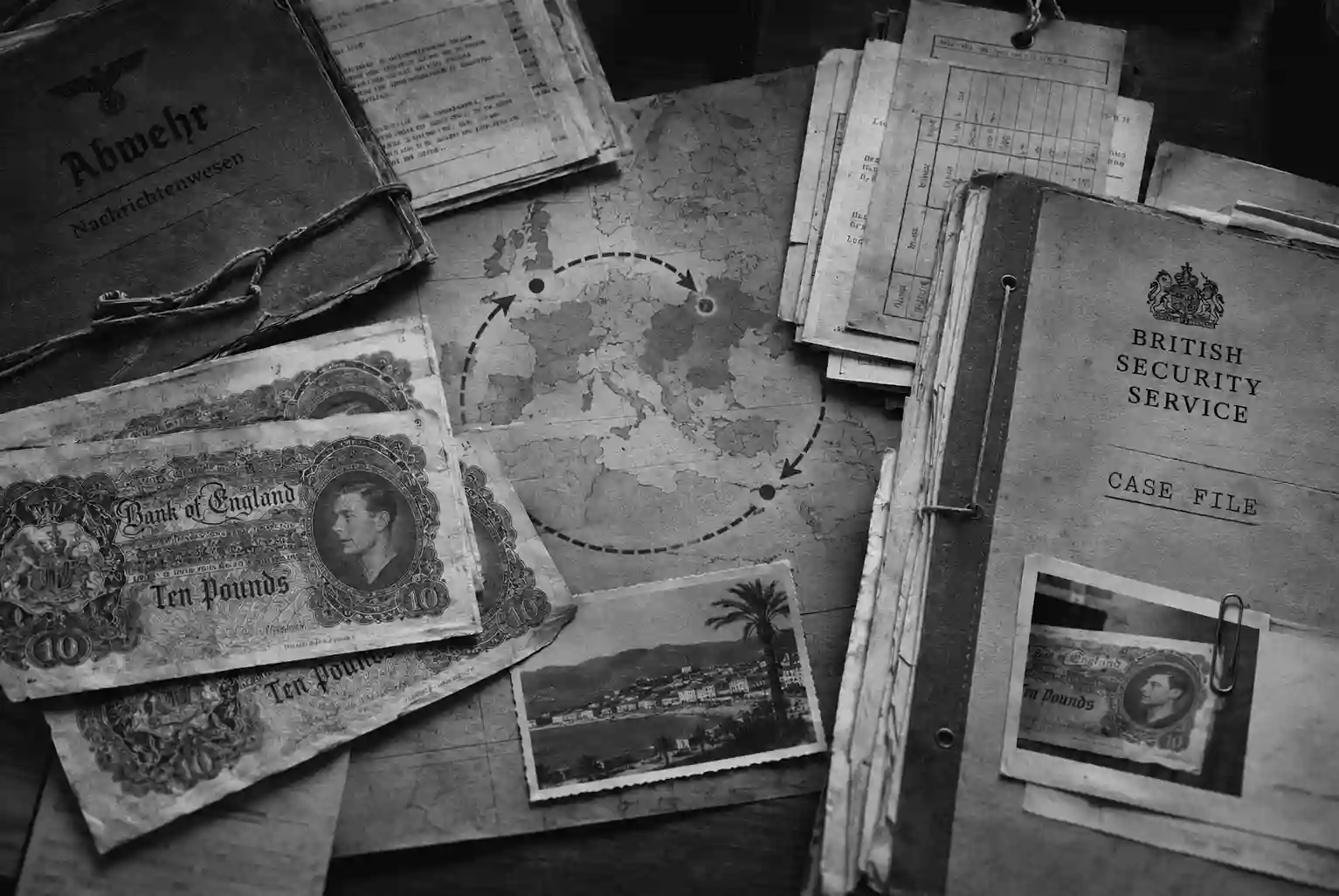
German intelligence paid agents operating against Britain, including some already controlled by MI5. The surviving records trace counterfeit payments but leave the German authorisation chain incomplete.
Data Manifest
- Primary Investigation: How German intelligence continued handling and funding agents operating against Britain while British records document extensive MI5 control of those agents, including Garbo's fictional network.
- Key Evidence or Documented Discrepancies: British records document Garbo's 27 fictional sub-agents. Separate reporting on released MI5 material identifies counterfeit German payments associated with British-controlled agents, including Tricycle and Treasure. The precise German authorisation chain remains unresolved, and the reviewed sources do not connect Garbo's reported payments directly to Operation Bernhard currency.
- Principal Sources: MI5 Security Service historical records and declassified agent files; John Cecil Masterman's post-war assessment as reviewed through declassified Anglo-American material; The Guardian's 17 February 2012 reporting on released MI5 material concerning the counterfeit payment loop.
Glossary
- Abwehr: The German military intelligence organisation discussed in the article, including its Madrid operation and overseas agent network.
- Twenty Committee: The British committee established on 2 January 1941 under John Cecil Masterman to coordinate the system for controlled German agents.
- Chicken feed: Accurate and verifiable information supplied through controlled agents so German handlers could check reports and build confidence in the source.
- Operation Bernhard: The German counterfeiting programme revived in 1942 under SS Major Bernhard Krüger, producing forged Bank of England notes at Sachsenhausen.
How Britain Controlled German Agents
At the end of 1938, MI5 had 30 officers and 103 secretaries and registry staff. By the second quarter of 1940, it was receiving an average of 8,200 vetting requests each week. The service that would later control a large part of Germany’s espionage network in Britain began the war under considerable administrative pressure.
Its approach to captured German agents changed during 1940. By September, British policy had moved towards turning captured agents rather than simply removing them from the field. On 2 January 1941, the Twenty Committee was established under John Cecil Masterman to coordinate the system.
One of its basic methods was known as ‘chicken feed’. Controlled agents were allowed to send accurate and verifiable information that would not materially damage the British war effort. German handlers could check these reports independently. The purpose was to establish the credibility of the source before more consequential deception was introduced.
The system eventually included agents such as Snow, Brutus, Bronx, Treasure, and Garbo. Masterman’s post-war assessment records 226 meetings of the Twenty Committee and more than 120 controlled cases before it was disbanded in May 1945.
Those figures need to be kept separate from another post-war tally. British assessments reported that almost all of the approximately 115 German agents targeted against Britain had been identified and caught. One identified exception was Jan Willem Ter Braak.
The British Control Architecture
-
End of 1938
MI5 before wartime expansion
MI5 had 30 officers and 103 secretaries and registry staff.
-
Second quarter of 1940
Administrative pressure rises
The service was receiving an average of 8,200 vetting requests each week.
-
September 1940
Policy shifts towards turning agents
British policy moved towards turning captured German agents rather than simply removing them from the field.
-
2 January 1941
Twenty Committee established
John Cecil Masterman chaired the committee coordinating the controlled-agent system.
-
10 May 1945
Twenty Committee disbanded
Its post-war assessment recorded 226 meetings and more than 120 controlled cases.
Jan Willem Ter Braak’s Uncontrolled Operation
Engelbertus Fukken, operating under the identity Jan Willem Ter Braak, parachuted into Buckinghamshire around the beginning of November 1940. Secondary accounts disagree over the exact date, placing his arrival somewhere between 31 October and 3 November.
His forged identity documents already carried a problem. Numbers on them had previously been assigned to Snow, an agent under British control.
Ter Braak nevertheless reached Cambridge and operated independently. His radio transmitter was concealed inside a leather suitcase. Within months, its batteries had run down. Replacing them without attracting attention presented the same basic difficulty that affected his money and documentation: normal civilian transactions carried the risk of exposure.
By late March 1941, Ter Braak had been in Britain for nearly five months. Before his death, Ter Braak left his radio at a Cambridge railway left-luggage office. On 30 or 31 March, he shot himself with his Abwehr-issued pistol in a public air raid shelter at Christ’s Pieces.
Ter Braak’s documented difficulties provide context for accounts of other German agents in Britain whose apparent operations continued for much longer.
That comparison does not establish what German officers knew about the differences or whether anyone formally examined them.
Priority Briefings
New investigations, evidence checks, and unresolved questions from Veriarch, sent directly to your inbox.
Major Kühlenthal and the Madrid Outpost
Major Karl-Erich Kühlenthal was a senior officer in the Abwehr’s Madrid organisation and became Garbo’s German handler.
In April 1943, Operation Mincemeat placed fabricated invasion documents on the body of Glyndwr Michael before it was released off the Spanish coast. The documents entered German channels in Spain and reached Kühlenthal. He forwarded them to Berlin as genuine intelligence.
What checks he carried out before doing so are less clear. The surviving material establishes the onward transmission, but not a complete German verification procedure or a documented decision by Kühlenthal to bypass one.
Garbo’s fictional network raises a separate question about German verification. British records document 27 fictional sub-agents. No independent German check confirming the physical existence of those 27 people has been identified in the sources reviewed for this investigation.
Operation Bernhard and the Counterfeit Currency
German counterfeiting of British currency began in early 1940 under Operation Andreas. The original objective was to produce forged Bank of England notes for distribution across Britain in an attempt to damage the economy.
The programme was revived in 1942 under SS Major Bernhard Krüger and became known as Operation Bernhard. At Sachsenhausen concentration camp, 142 prisoners were selected for specialist work including engraving, printing and photography. Nearly nine million counterfeit notes were ultimately produced, with a face value exceeding £134 million.
The purpose also changed. Rather than relying primarily on an aerial campaign against the British economy, German authorities began using forged currency to finance overseas intelligence operations. German intelligence obtained Operation Bernhard notes and distributed them to handlers in neutral countries including Spain and Portugal. From there, money reached agents operating against Britain.
According to The Guardian’s 17 February 2012 reporting on released MI5 material, counterfeit notes reached agents including Tricycle (Dušan Popov) and Treasure (Nathalie Lily Sergueiew), both of whom had been turned into double agents by MI5. The reporting describes counterfeit currency passing into British intelligence hands rather than remaining with German agents.
The records document different sides of the payments. German intelligence distributed currency to overseas agents, while British files record counterfeit notes surrendered by agents under MI5 control. The available material does not establish a matching German and British entry for every payment.
What remains incomplete is the German administrative chain between production and payout. No Department Z sign-off sheets for releases of Operation Bernhard currency to Madrid have been identified in the material reviewed. It remains unclear what form the authorisation records took or which officers approved the releases.
The Counterfeit Currency Route: Known Stages and Gaps
Operation Bernhard produced forged Bank of England notes at Sachsenhausen concentration camp.
German intelligence acquired forged currency for overseas espionage operations.
No Department Z sign-off sheets for releases to Madrid have been identified in the reviewed material. The form of the authorisation records remains uncertain.
Currency was distributed through handlers in neutral countries including Spain and Portugal.
Funds reached agents, including cases in which those agents were already working under MI5 control.
Counterfeit notes surrendered by controlled agents were logged as confiscated and placed in secure storage.
Garbo’s Payments and the Iron Cross
Juan Pujol García had already been rejected by the British three times when he began constructing his own intelligence operation against Germany. Working from Lisbon, he created reports about Britain using materials that included a tourist guide, a map, a reference book and a railway timetable.
His early reporting contained errors about British geography, currency and cultural habits. German intelligence nevertheless continued to treat him as an agent.
After British intelligence brought him under control, Pujol worked with his case officer, Tomás Harris. Together they expanded the fictional organisation attributed to Garbo until it contained 27 supposed sub-agents. Among them were a Swiss banker in London and a supposed KLM pilot or courier providing a route for reports to Portugal. They existed on paper and in communications, not as an independently operating espionage network.
Between January and June 1944, Garbo’s reporting became part of Operation Fortitude. His messages supported the deception that the Normandy landings were a diversion and that the principal Allied attack would come through the Pas-de-Calais.
In July 1944, the Germans awarded Garbo the Iron Cross Second Class.
Secondary historical accounts report approximately $340,000 in German payments to Garbo and his fictional network over the course of the war. This was a reported cumulative total, not a single July 1944 payment. The original German financial entries have not been directly examined. None of the sources reviewed establishes that Garbo received Operation Bernhard counterfeit notes.
Garbo's Fictional Network
- Claimed network: 27 fictional sub-agents attributed to Garbo.
- Documented examples: A Swiss banker in London and a supposed KLM pilot or courier carrying reports towards Portugal.
- British control: Juan Pujol García and MI5 case officer Tomás Harris developed the fictional network.
- German reporting: The invented identities appeared in intelligence communications as members of Garbo's network.
Reid’s Report and the Missing German Records
In February 2012, The Guardian reported on newly released MI5 files concerning German counterfeit-currency payments. Its account refers to a 1945 memorandum by Sir Edward Reid, a banking expert associated with British intelligence.
The newspaper describes German intelligence acquiring counterfeit British currency and using it to pay agents, including some already controlled by MI5. Those agents surrendered the notes to their British case officers.
The original German ledger entries have not been directly examined, leaving their precise wording and accounting treatment uncertain.
Support the Archive
Help fund the retrieval, hosting, and preservation of Veriarch investigations.
Sources
Sources include: MI5 Security Service historical records concerning wartime staffing, German agents and the British double-cross system; John Cecil Masterman’s post-war assessment of the Twenty Committee, examined through the CIA’s declassified ‘Masterman Revisited’; MI5 GARBO case material concerning Juan Pujol García, Tomás Harris and their fictional agent network; secondary historical accounts concerning Jan Willem Ter Braak and Major Karl-Erich Kühlenthal, including details attributed to MI5 files that were not independently inspected for every claim; secondary historical accounts concerning Operation Bernhard and the counterfeiting programme at Sachsenhausen; Richard Norton-Taylor, “Nazis tried to flood Europe with fake British banknotes, MI5 files show”, The Guardian, 17 February 2012, reporting on the February 2012 release of declassified MI5 material and referring to Sir Edward Reid’s 1945 memorandum. The original memorandum and its National Archives catalogue reference were not independently examined; and secondary historical accounts reporting approximately $340,000 in cumulative German payments to Garbo’s network, with the original German financial entries not directly examined.
Claim-Source Matrix
| Core Finding | Supporting Source | Status |
|---|---|---|
| The Twenty Committee was established on 2 January 1941 and later recorded 226 meetings and more than 120 controlled cases. | MI5 historical material and the declassified review of John Cecil Masterman's post-war assessment. | Confirmed through reviewed privileged sources. |
| British records document 27 fictional sub-agents attributed to Garbo. | MI5 GARBO files. | Confirmed through reviewed privileged material. |
| The Guardian's reporting on released MI5 material identifies Tricycle and Treasure among double agents associated with counterfeit German payments. | Richard Norton-Taylor, The Guardian, 17 February 2012, reporting on newly released MI5 files and referring to Sir Edward Reid's 1945 memorandum. | Reported in secondary coverage of the archival release. The original Reid memorandum and its precise National Archives reference were not directly reviewed. |
| No Department Z sign-off sheets for Operation Bernhard currency releases to Madrid have been identified in the reviewed material. The form of the authorisation records remains uncertain. | Research Pack, Section 9, Missing Pieces Inventory. No underlying Department Z sign-off record directly reviewed. | Documentary gap identified in the Research Pack; not independently verified as an exhaustive archival absence. The existence or loss of particular sign-off sheets is not established. |
| Secondary historical accounts report approximately $340,000 in cumulative German payments to Garbo and his fictional network. | Juan Pujol García (Wikipedia); War History Online; Double-Cross System (Grokipedia). | Reported in secondary historical accounts. Original German financial entries were not directly reviewed, and no reviewed source establishes that Garbo's payments consisted of Operation Bernhard counterfeit notes. |
What We Still Do Not Know
- The German offices or officers who authorised releases of Operation Bernhard funds to handlers in Spain and Portugal, and which surviving documents establish that chain.
- Whether any surviving wartime German memorandum questioned the apparent survival or effectiveness of agents operating in Britain.
- The routing records needed to trace particular batches of forged currency from Sachsenhausen to intelligence handlers in Spain and Portugal remain unresolved.
- It is not established whether Karl-Erich Kühlenthal ever faced a formal internal review over the intelligence he handled after Operation Mincemeat or at another point.
- What surviving records show about the handling or discontinuation of British-theatre agent files during the final stages of the war.
- Ter Braak's precise operational orders and expected support arrangements have not been identified in the material examined.
Comments (0)