
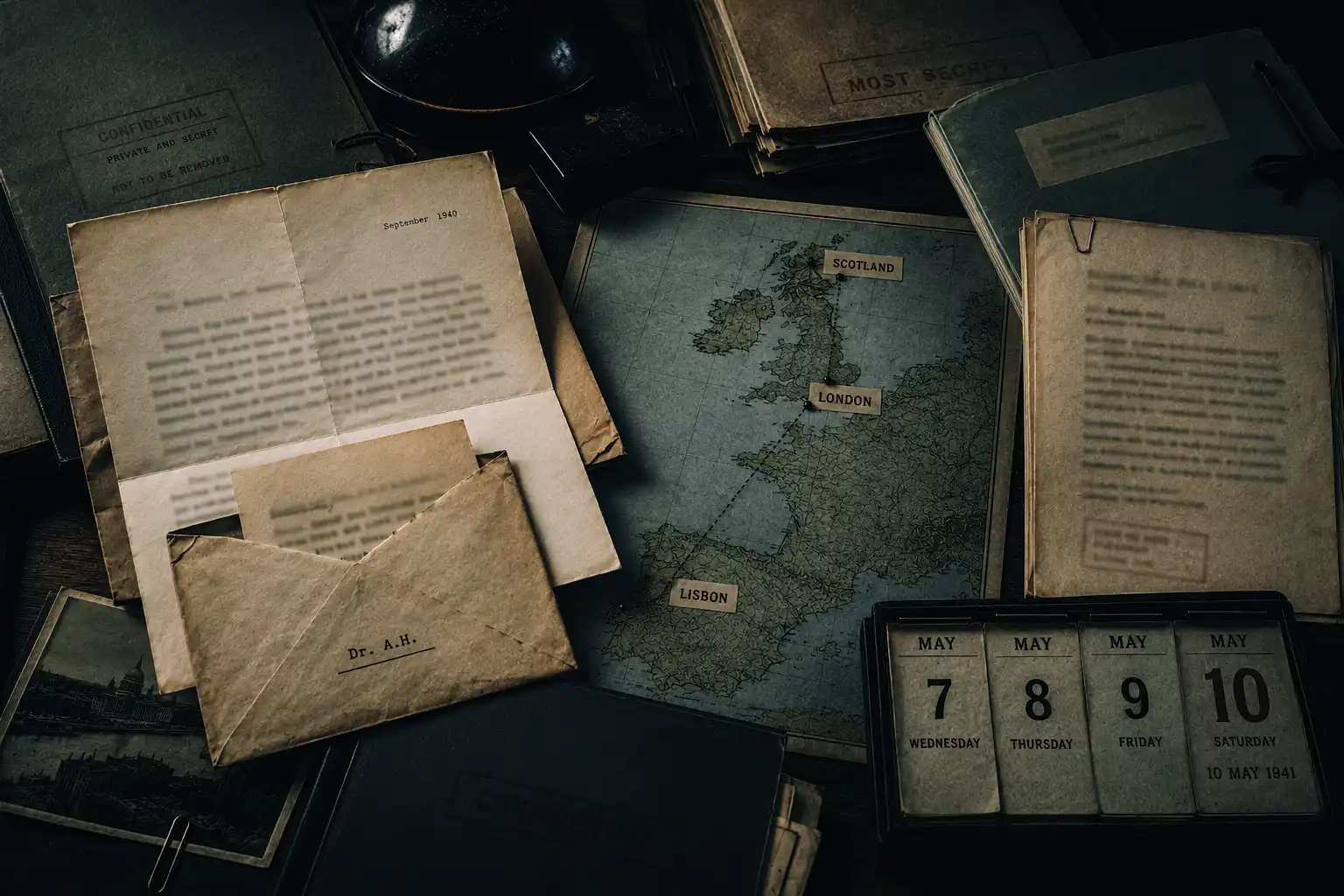
The interval between Albrecht Haushofer’s September 1940 approach to the Duke of Hamilton and Rudolf Hess’s parachute landing at Dungavel on 10 May 1941 runs to nearly eight months. During that period the letter was reviewed inside MI5, an operation was built around it, and the operation was cancelled seven days before Hess arrived. The parliamentary statement made twelve days after the landing does not describe any of that.
Data Manifest
- Primary Investigation: The documentary trail from Albrecht Haushofer's September 1940 approach to the Duke of Hamilton through MI5 review, B1A mission planning, cancellation and the later parliamentary account of Rudolf Hess's arrival.
- Key Anomalies Documented: The Commons account omits the earlier intercept and B1A operation; Scottish Regional Security still listed Hamilton as a suspect after central intelligence had investigated, cleared and recruited him; a surviving Morrison letter carries a date that does not fit the 1942 libel sequence.
- Primary Sources Utilised: The intercepted Haushofer correspondence, B1A and Air Ministry records, Major Perfect's signal to Box 500, Herbert Morrison's correspondence and the House of Commons record.
Glossary
- B1A: The MI5 branch run by Major T.A. Robertson and used for the planned operation involving Hamilton.
- Box 500: MI5's postal address in London, used in Major Perfect's 11 May 1941 signal from Scottish Regional Security.
- Double-cross work: The type of intelligence operation handled by B1A, through which the proposed Hamilton mission to Lisbon was routed.
The Haushofer Intercept of 1940
Albrecht Haushofer, a German academic with close ties to the Nazi leadership, met Rudolf Hess at Bad Gallspach in Austria on 8 September 1940. They discussed a back-channel to a British peace faction.
Eleven days later, on 19 September, Haushofer wrote to Douglas Douglas-Hamilton, 14th Duke of Hamilton, opening with ‘My Dear Douglo’ and asking whether they might meet somewhere on the outskirts of Europe, suggesting neutral Portugal as the venue. The two men had met at the 1936 Berlin Olympics.
The letter was routed through a third party. The outer envelope was addressed to Mrs Violet Roberts in Lisbon. The inner envelope was marked simply ‘Dr AH’ and contained the message for Hamilton. It did not reach Mrs Roberts. On 2 November 1940, censors at the Ministry of Information in London opened it, copied it and forwarded copies to MI5 and the Foreign Office.
Priority Briefings
New investigations, evidence checks, and unresolved questions from Veriarch, sent directly to your inbox.
MI5 Delays and Investigation into Hamilton
Through the winter, the intercept was reviewed by Guy Liddell, Director of Counter-Espionage at MI5, and by Major T.A. Robertson, who ran the B1A branch. MI5 identified Haushofer as an expert on the British Empire and opened an investigation into Hamilton to see whether he was a willing participant in anything treasonable.
The investigators found no positive proof of pro-German or anti-British activity on his part.
Hamilton himself was not shown the letter until 26 February 1941. Almost four months had passed since it landed on the censor’s desk. For that entire period, the state possessed knowledge of an attempted German approach to Hamilton that Hamilton did not.
Hamilton and the Proposed Lisbon Trip
On 25 April 1941, Robertson met Hamilton to plan a reply to Haushofer and a possible trip to Lisbon. In a contemporaneous internal note, Robertson described Hamilton as ‘a slow-witted man’ who ‘gets there in the end’ and who could ‘do a very useful job of work’ if ‘properly schooled’. The characterisation is Robertson’s private assessment on a B1A memo.
Hamilton was reluctant. He initially suggested that his brother David go in his place. On 28 April 1941 he wrote to Group Captain Blackford at the Air Ministry, formally agreeing to the mission on two conditions: the British Ambassador in Lisbon was to be fully briefed, and Hamilton required a workable cover story to explain why it had taken him seven months to reply. The operation was routed through B1A, the branch that handled double-cross work.
Support the Archive
Help fund the retrieval, hosting, and preservation of Veriarch investigations.
The Cancellation of the Lisbon Operation
On 3 May 1941, five days later, Blackford wrote to Hamilton cancelling the Lisbon trip. He instructed Hamilton to regard the matter as being in ‘abeyance’. The stated grounds, preserved on the file, were that a ‘watertight excuse’ for the seven-month delay would be very difficult to construct, and that there could be ‘undesirable political consequences’ if the cover failed.
Blackford’s letter is the outcome. The internal argument that produced it is not in the public archive. The minutes of the intelligence committee meetings that led to the cancellation have not been located.
Hamilton in the Central and Regional Records
| Central Intelligence Record | Scottish Regional Security Record |
|---|---|
| MI5 had investigated Hamilton and found no positive proof of pro-German or anti-British activity. | On 11 May 1941, Major Perfect reported that 'the Duke of Hamilton is on the suspect list'. |
| Hamilton had been briefed and recruited into planning for a possible B1A operation involving Lisbon. | The public archive described in the investigation does not show when the regional suspect information was issued or updated, or by whom. |
The surviving records establish the mismatch. They do not establish why the regional entry remained inconsistent with Hamilton's status in the central files.
Rudolf Hess Lands at Dungavel
Seven days after the operation was placed in abeyance, on the evening of 10 May 1941, Rudolf Hess flew a Luftwaffe aircraft solo across the North Sea and parachuted into Scotland. He landed near Dungavel House, the Hamilton family’s hunting lodge. He gave a false name, Alfred Horn, was captured by the Home Guard and asked to see the Duke of Hamilton.
A search at Maryhill Barracks in Glasgow turned up a plain, unaddressed envelope in his possession. Inside were visiting cards for Albrecht Haushofer and for his father Karl Haushofer. The physical items connected the pilot back to the intercept file behind the proposed Lisbon operation, which had been placed in abeyance seven days earlier.
The next day, 11 May 1941, Major Perfect of Scottish Regional Security signalled Box 500, MI5’s postal address in London, reporting the capture and the visiting cards. In that signal Perfect noted that ‘the Duke of Hamilton is on the suspect list’.
The regional file said one thing; the central file said another. By then, Hamilton had been investigated, cleared, briefed and recruited by central intelligence. On the ground in Scotland, the regional security officer still had him flagged. Why the regional suspect-list entry remained inconsistent with Hamilton’s status in the central files, when the relevant list was issued, or by whom, the public archive does not show.
From Intercept to Hess's Arrival
-
8 September 1940
Haushofer meets Hess
Albrecht Haushofer and Rudolf Hess meet at Bad Gallspach and discuss a back-channel to a British peace faction.
-
19 September 1940
Letter sent towards Hamilton
Haushofer writes to the Duke of Hamilton, opening 'My Dear Douglo' and suggesting a meeting in neutral Portugal.
-
2 November 1940
Censors intercept the letter
The Ministry of Information opens and copies the correspondence, forwarding copies to MI5 and the Foreign Office.
-
26 February 1941
Hamilton sees the letter
After almost four months of internal review and investigation, Hamilton is shown the intercepted approach.
-
25 April 1941
Lisbon operation discussed
Robertson meets Hamilton to plan a reply to Haushofer and a possible trip to Lisbon.
-
28 April 1941
Hamilton agrees subject to conditions
Hamilton writes to Blackford agreeing to the mission if the British Ambassador is briefed and a workable cover story explains the seven-month delay.
-
3 May 1941
Operation placed in 'abeyance'
Blackford cancels the Lisbon trip, citing difficulty producing a 'watertight excuse' and possible 'undesirable political consequences' if the cover fails.
-
10 May 1941
Hess lands in Scotland
Seven days after the cancellation, Hess parachutes near Dungavel House, gives the false name Alfred Horn and asks to see Hamilton.
-
11 May 1941
Regional suspect record surfaces
Major Perfect signals Box 500 and reports that 'the Duke of Hamilton is on the suspect list'.
Parliamentary Accounts of the Hess Incident
Twelve days after the landing, on 22 May 1941, Sir Archibald Sinclair, Secretary of State for Air, made a statement to the House of Commons. He told Members that Hess had arrived giving a false name and asking to see the Duke, that Hamilton was ‘apprised by the authorities’ and had visited the prisoner in hospital, and that it was at that hospital meeting that Hess had revealed his identity for the first time. Sinclair framed the prior connection between the two men as a brief encounter at the 1936 Olympic Games.
Winston Churchill separately declined to make Hess ‘a hero’, describing him as a ‘creature’ and one of the ‘filthiest’ fellows.
Read alongside the internal record, the Commons account omits certain items. It does not mention the intercepted Haushofer letter of September 1940. It does not mention the four-month MI5 review, the B1A recruitment meeting on 25 April, Hamilton’s letter to Blackford on 28 April or the cancellation of the Lisbon operation on 3 May. What survives on the departmental files sits alongside what was said in Parliament. The two accounts share very little material.
The Commons Account and the Surviving Internal Record
| 22 May 1941 Commons Account | Earlier Internal Record |
|---|---|
| Sinclair said Hess arrived under a false name, asked for Hamilton and that Hamilton was then 'apprised by the authorities'. | The Haushofer approach to Hamilton had already been intercepted on 2 November 1940 and reviewed inside MI5. |
| The prior connection was framed around the brief 1936 Olympic encounter. | By 25 April 1941 Robertson was discussing a reply to Haushofer and a possible Lisbon trip with Hamilton. |
| The statement did not describe the earlier operational planning. | Hamilton formally agreed to the proposed mission on 28 April and Blackford placed it in 'abeyance' on 3 May. |
The comparison establishes differences in what the two surviving records contain. It does not by itself establish why those details were omitted from the parliamentary account.
The 1942 Libel Suits and State Intervention
Public rumours about Hamilton did not stop with the Sinclair statement. In February 1942, Hamilton sued the London District Committee of the Communist Party over an article in World News and Views which alleged that he had negotiated with Nazi Germany and had known Hess was coming. He also sued the journalist Pierre van Paassen for describing him as a British Fascist.
The Communist Party indicated that it would seek to call Rudolf Hess himself as a witness.
A letter from Herbert Morrison, then Home Secretary, to Sinclair survives on the record. In it, Morrison asks Sinclair to use his influence to have Hamilton drop the libel actions on the ground that Hess could not appear in a public witness box. The letter as preserved is dated 18 June 1941. The date does not fit the sequence: the suits were filed in February 1942, so a request to have them dropped cannot logically have been sent seven months earlier. The document itself is on the record; the timeline around it is not resolved.
Hamilton settled, accepting an apology from the Communist Party. The Sinclair-to-Hamilton correspondence that would show how the settlement was arrived at has not been located.
The Morrison Letter Date Conflict
-
18 June 1941
Date preserved on Morrison's letter
The surviving letter asks Sinclair to use his influence to have Hamilton drop the libel actions because Hess could not appear in a public witness box.
-
February 1942
Libel suits filed
Hamilton sues the London District Committee of the Communist Party and also takes action against Pierre van Paassen.
-
Sequence unresolved
The dates do not fit
A request to drop actions filed in February 1942 cannot logically have been sent in June 1941. The document is on the record, but the chronology around it remains unresolved.
Source Box
Sources include: MI5 B1A records concerning the intercepted Haushofer approach and Major T.A. Robertson’s 25 April 1941 meeting with the Duke of Hamilton; Hamilton’s 28 April 1941 letter to Group Captain Blackford and Blackford’s 3 May 1941 cancellation letter; Major Perfect’s 11 May 1941 signal to Box 500; House of Commons Hansard records concerning Rudolf Hess and Hamilton, including 22 May 1941; Herbert Morrison’s surviving letter to Sir Archibald Sinclair concerning Hamilton’s libel actions; and Security Service file KV 2/35 concerning Rudolf Hess and the early interrogation material.
Claim-Source Matrix
| Core Finding | Primary Source Document | Status |
|---|---|---|
| Haushofer's approach to Hamilton was intercepted and passed to MI5 and the Foreign Office. | Intercepted Haushofer correspondence, September to November 1940 | Confirmed |
| Hamilton was recruited into planning for a possible Lisbon operation after the investigation found no positive proof of pro-German or anti-British activity. | B1A records, including Robertson's 25 April 1941 meeting record | Confirmed |
| Hamilton formally agreed to the proposed mission subject to the ambassador being briefed and a workable explanation for the delay. | Hamilton's 28 April 1941 letter to Group Captain Blackford | Confirmed |
| The Lisbon trip was placed in 'abeyance' on 3 May 1941. | Blackford's 3 May 1941 letter to Hamilton | Confirmed |
| Scottish Regional Security still recorded Hamilton as being on a suspect list on 11 May 1941. | Major Perfect's 11 May 1941 signal to Box 500 | Confirmed |
| The Commons account of 22 May did not describe the earlier intercepted letter, MI5 review or planned B1A operation. | House of Commons record, 22 May 1941, read alongside the surviving departmental files | Confirmed |
What We Still Do Not Know
- No surviving minutes or records have been located for the intelligence discussions preceding the 3 May 1941 cancellation, including who argued for or against it.
- The MI5 central registry distribution record showing when Scottish Regional Security's suspect information was issued or updated, and by whom, has not been located.
- Still-restricted early interrogation material from Maryhill Barracks could clarify what Hess said during the first stages of questioning.
- The released record does not establish whether the Haushofer file reached the Director-General of the Security Service before Blackford signed the cancellation or whether the decision remained at departmental level.
- Major Perfect's written instructions from Box 500 in the hours after his 11 May 1941 signal are not available in the public record described here.
- The Sinclair-to-Hamilton correspondence showing how Hamilton was persuaded to drop the 1942 libel suits, along with any further Home Office record of the intervention, has not been located.
Comments (0)